






Markets have trounced active managers over the past few years. So much so, that there are few reasons to ever pick an active fund if following the data.
Active management exists on the premise that markets are inefficient and that gifted individuals can beat an index over time. But active managers are having an ‘embarrassing’ year so far, with just two in five outperforming passives in the first half. The rut, however, has been much longer.
Short timeframes like six months make it difficult to gauge whether active managers can truly achieve this goal, so below, Trustnet scanned the performance of funds over three and five years.
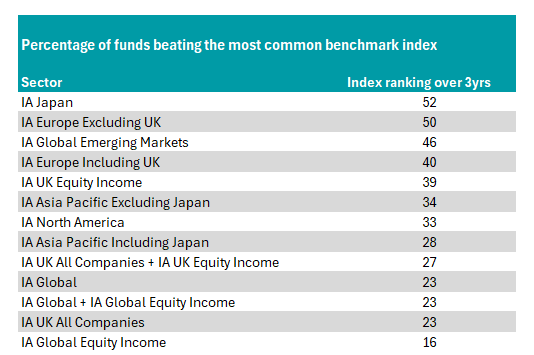
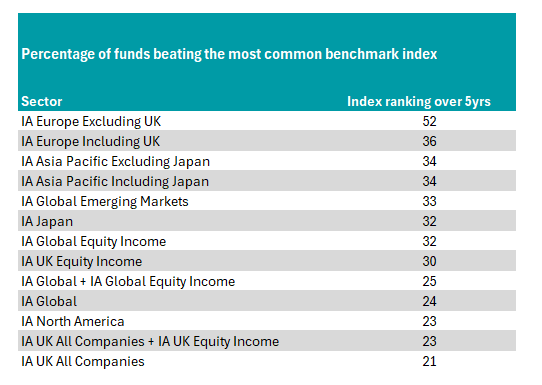
To do this, we looked at the performance of the most common benchmark index in a range of different Investment Association equity sectors, then ran a percentile table, showing where index sat in the peer group. The figures below show the percentage of funds in the different sectors that have beaten the relative benchmark.
We have also included two areas where multiple sectors had the same benchmark: the UK (IA UK All Companies and IA UK Equity Income) and global (IA Global and IA Global Equity Income).
Source: FE Analytics
Over three years, there are only two sectors where an investors’ chance of picking a fund that would outperform was around a coin flip (or 50/50).
In the IA Japan sector, 52% of funds beat the TSE TOPIX benchmark. Dan Coatsworth, head of markets at AJ Bell, said: “Japan-focused active managers have found their groove of late and they have shown to be more effective at stock picking than Western peers in general over the short and long term.
“Their latest success isn’t down to luck – the trend points to a long history of being able to find opportunities and apply true active management to deliver a different and better performance than the broader market.”
Japan has been the best-performing major developed market so far in 2026, yet active funds have performed even better. The market has been led higher by value stocks, typically those in the mid-cap space, which have dominated in recent years.
Meanwhile, growth managers have struggled, with some sectors typically associated with rapid earnings growth now cheaper than traditional value areas.
The only other area where investors could have made the case for active management was Europe, where 50% of IA Europe Excluding UK funds outperformed the MSCI Europe ex UK.
However, the sector is dominated by exchange-traded funds (ETFs) focusing on singular strategies. For example, seven of the top 10 funds in the sector are passives that track narrower indices. These include Invesco EURO STOXX High Dividend Low Volatility UCITS, iShares EURO Dividend UCITS ETF and UBS Euro Stoxx 50 ESG UCITS ETF.
Outside of these two regions the readings were relatively bleak. Around 46% of IA Global Emerging Markets funds beat the MSCI Emerging Markets index, while 40% of funds in the IA Europe Including UK sector were ahead of the MSCI Europe index.
Jason Hollands, managing director of Bestinvest, said: “In large part this reflect the phenomenon of increased stock concentration across a number of indices over the last few years.
“While that is fairly well understood in respect of the US market, where the technology sector has grown to become 38% of the S&P 500 and the 10 largest companies represent 36% of the index by market-cap, this is also true in respect of global indices, as well as emerging markets where three semiconductor stocks – TSMC, Samsung Electronics and SK Hynix – together represent nearly 28% of the entire index.”
Some 39% of IA UK Equity Income funds beat the FTSE All Share, just over a third. This was better than the IA UK All Companies peer group, here just 23% managed the feat – less than a quarter. Combined, investors had a 27% chance to beat the index across all UK options.
Hollands said: “While tech has been the key driver of this [market concentration] in a number of markets, the UK has also seen highly divergent performance in recent years with exceptional outperformance by defence stocks, banking shares and in the oil and gas space. Managers who weren’t on the right side of these previously unloved sectors will have lagged.”
The IA Global Equity Income sector sat at the foot of the table, with the MSCI ACWI index sitting in the 16th percentile of the peer group, although this jumped to 23% when including the IA Global sector.
Source: FE Analytics
Over five years the figures were even worse. IA Europe Excluding UK topped the list, with 52% of funds ahead of the MSCI Europe ex UK index but there was a sharp drop to the IA Europe Including UK (36%).
Meanwhile, the IA UK All Companies sector was at the bottom of the pile this time, with 21% beating the FTSE All Share.
“Despite a few bright spots of late, active fund managers remain in the doldrums when looking across the market,” said Coatsworth. “It’s no wonder more investors are switching to passive as they’re fed up of not getting the outperformance they’ve paid for.”