






Gold has had a volatile year but looks to be getting back on track in the past month. The price of the yellow metal spiked in February on the back of central bank buying and a weaker dollar, as well as the outbreak of war between the US and Iran.
It then fell sharply backwards for many reasons including fears that central banks would raise rates, the appointment of Kevin Warsh as Fed chair and suggestions that the war in Iran would be over quicker than expected, with multiple truces and negotiations taking place.
Latterly there has been a renewed wave of buying as the US Treasury said it would at least double its long-end bond buybacks, from a maximum of $2bn to at least $4bn per operation, beginning in September. The aim is to hold down long-term borrowing costs itself, rather than wait on the Fed to cut rates.
That leaves gold caught between two forces pulling in opposite directions, with concerns over US debt and fiscal credibility on one side, which tend to support the gold price, and a Federal Reserve that is talking about raising rates on the other, which tends to hurt it.
Russ Mould, investment director at AJ Bell, said: "Gold tends to do best when markets fear policy error or sense that central banks are not in control.”
That was true in the 1970s, when gold surged under a Fed seen as bowing to political pressure, and untrue in the 1980s and 1990s, once the Paul Volcker-led Fed crushed inflation and gold fell out of favour. The current standoff, in his view, has more in common with the earlier pattern.
Meanwhile, Chris Beauchamp, chief market analyst at IG, noted that the next catalyst is Federal Reserve chair Warsh's Jackson Hole speech on 28 August, “the first real read on where the Fed's hawks stand heading into the September meeting”.
Warsh has resisted giving markets forward guidance and 30-year treasury yields touched 5.3% last week, their highest since 2007, as Trustnet covered this morning. That dynamic between the Fed and the Treasury is at the centre of gold's next move.
Spot gold price (GBP/kg) sector over 1yr
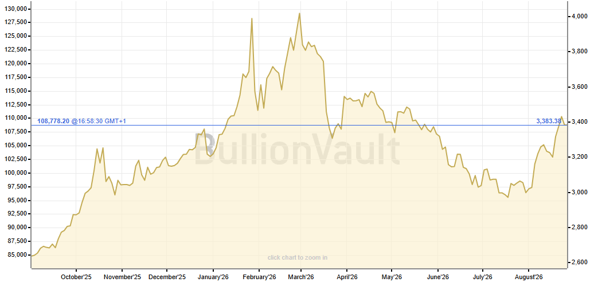
Source: BullionVault
Daniel Casali, chief investment strategist at Evelyn Partners, thinks the more important implication is for the currency rather than yields.
“If the US Treasury increasingly leans against that adjustment by absorbing duration risk from the market, part of the burden may shift to the currency instead,” he said. “Gold could be one of the principal beneficiaries.”
For Mould, the markets do not believe the Fed will raise rates. “Gold is telling you the Fed will hold or even cut and take its chances with inflation to keep borrowing costs down and try to fuel the nominal growth needed to try and salt down the debt-to-GDP ratio, to the detriment of bondholders and, possibly, equity valuations,” he said.
Mark Burridge, managing partner and fund manager at Baker Steel, called the initial sell-off over the spring and summer “a knee-jerk overreaction” to Warsh's appointment, one that “does not materially alter the broader downward trajectory of US real interest rates”.
He pointed to how quickly gold has recovered from similar dips before: “During gold's previous trough in October 2025, it took just 19 days to reach the bottom.” The scale of this year's move has already been sharp.
Gold's rise this month alone, from $4,047 to $4,595 per ounce, is evidence that the metal is doing exactly the job his portfolios hold it for, said Elliot Farley, chief executive and fund manager at T. Bailey Asset Management – namely providing “diversification for the portfolios during periods of heightened concern over fiscal credibility, real yields and monetary conditions”.
What it means for investors
The recent decisions by US Treasury officials have prompted some managers – including Wilf Blake, investment manager at RC Brown – to increase their gold exposure.
Mould, however, said there are trade-offs to buying more today. Anyone who fears policy error or persistent inflation “may put a portion of their portfolio in gold, possibly at least as a partial replacement for bonds” – but physical gold “does come with an opportunity cost”, especially with the Bank of England base rate at 3.75% and 10-year gilt yields around 5%. “Income investors may shun gold as it offers no yield.”
Miners are the alternative for those who want income alongside the exposure. “Gold miners can pay a yield,” Mould said, “and many of them are currently generating copious cashflow, given how spot metal prices sit well above the all-in sustained cost of production.”
They also amplify the moves in both directions, which means homework: assessing “whether a miner is a producer, an explorer or licence holder”, the jurisdictions its mines sit in, and management's track record for capital discipline rather than “grandiose acquisitions” or dilutive equity raises.
Given how easily individual miners can disappoint, Mould suggested most investors going down this route “buy a basket of miners, senior or junior, either directly or via a passive or actively managed fund”, rather than picking single names.