






The world’s 300 largest pension funds had a bumper year in 2025, with assets up 13.4% to a record $27.7trn, while the largest – The Government Pension Fund of Norway – topped $2trn for the first time, according to a report by the Thinking Ahead Institute.
Growth was even stronger among the largest funds, with the top 20 biggest pensions increasing their assets by 14.7% last year, taking their total assets to $11.9trn.
It has been a successful past half-decade for pension funds, with the cumulative growth rate in the first half of the 2020s at 27.5%. On an annualised basis, the top 300 pension funds rose 5% per year, while the top 20 were slightly better at 5.5%.
So what do the world’s largest pension funds invest in? On average, the top 20 funds, which include the Government Pension Fund of Norway, the Japanese Government Pension Investment Fund ($1.9trn) and the US Federal Retirement Thrift (£1.1trn), are 46.2% weighted to equities. They hold 27.6% in bonds, 23.9% in alternatives and 2.2% in cash.
Russ Mould, investment director at AJ Bell, said: “You can see why some institutional investors may have elected to cut equity weightings and seek to diversify using other asset classes. Equities have done very well, so valuations have gone up and valuation is the ultimate arbiter of investment return.
“To expect an asset class to continue to provide above-long-term-trend returns from, at least in the case of US equities, a starting point of well-above-average valuations is, for some, the very definition of a bubble.”
Meanwhile, bonds have been in a five-year bear market, meaning government bonds may be good value, he said. An uptick in alternatives is also “understandable” when viewed through the lens of diversification, although this broad bucket requires nuance.
For example, commodities are a hedge against any sustained bout of inflation, while Covid and wars in Ukraine and the Middle East have “taught the importance of resource security as part of national security,” he said.
Private credit and equity markets are “trickier”, however, as both thrived during the era of lower interest rates, but both rates and starting valuations are higher now.
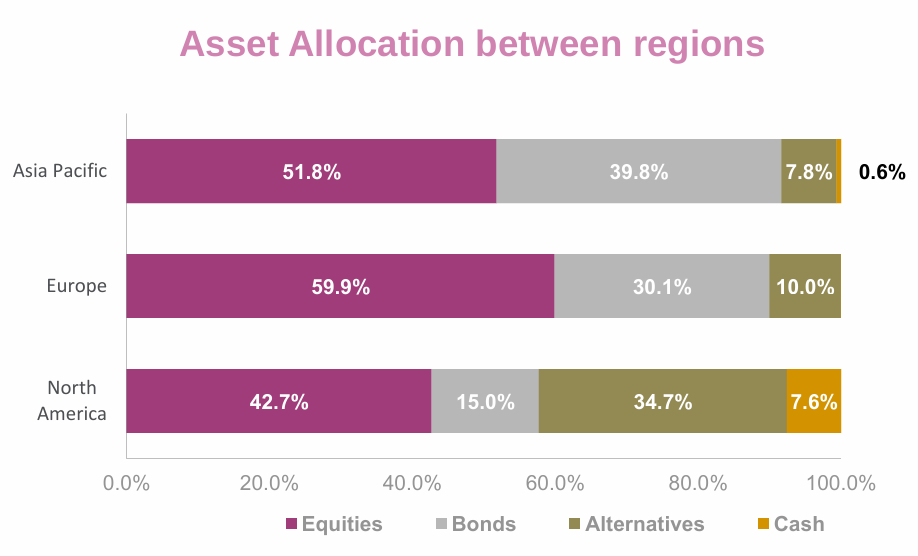
That said, pension fund asset allocations varied markedly by geography. On average, Asia Pacific pension funds had 51.8% in equities. However, they were also the most confident on bonds, with 39.8% allocated to fixed income and just 7.8% in alternatives.
European pension funds were the most bullish on equities, with 59.9% of their cash tied to the stock market. They had 30.1% in bonds and 10% in alternatives.
Source: Thinking Ahead Institute
Most remained broadly the same when the research was expanded to the top 300 pension funds. However, Europe was significantly different, with equities plummeting to 48.3% and a 6- and 5-percentage-point rise in bond allocations and alternative holdings, respectively.
With more than 70% invested in equities, Norway’s Government Pension Fund pulls the top-20 European allocation towards equities, as Stefan Rusev, senior strategic asset allocation strategist at Fidelity International, noted.
"At the same time, parts of the European DB market are relatively mature and more heavily allocated to fixed income, which may further contribute to the more bond-heavy allocation seen when the sample is broadened to the Top 300," he said.
Jason Hollands, managing director of Bestinvest, said: “Differences in pension fund asset allocation between these regions is likely to be partially down to differences in regulation and the maturity profile of the liabilities for these schemes.
“This helps explain the relatively lower allocation to equities among large European schemes, where there is a greater emphasis on asset and liability matching (hence also they have much higher exposure to bonds than in the US).”
North American pension funds among the top 20 largest in the world were the least weighted to bonds (15%). They were also the most cautious on equities (42.7%) and were the most heavily weighted to alternatives (34.7%) and cash (7.6%).
Alternatives can include hedge funds, private market assets, real estate and infrastructure. Hollands noted that these large pension funds have the “scale, expertise and time horizons to access illiquid investments that are often unavailable, or unsuitable, for ordinary investors”.
The DB to DC transfer
The state of the pension market is changing, although the largest pension funds remain shaped by defined benefit (DB) assets, the report noted.
“Defined contribution systems continue to grow in importance across many markets, bringing new challenges and opportunities for pension funds,” it read.
DB assets increased by 9.4% in 2025, while defined contribution (DC) assets grew faster at 15.8%.
“DC systems have become very effective at accumulating assets during working life, supported by scale, defaults, governance and institutional pricing. The weakness appears at retirement, when those benefits often fall away,” the report said.
In the US, more than $6.3trn worth of pension plans have exited DC schemes over the past decade through rollovers and cash-outs.
Owen MccCrossan, senior solutions director and head of investments from Aberdeen Group Pensions Schemes, said including the top 300 pensions “may mean capturing more of the DB-heavy corporate plans, which have seen significant de-risking in recent years”.
Rob Andrew, head of UK pension strategy & solutions at the firm added: “Never before has there been a more interesting time for pension fund investing. As one example, in the UK many legacy defined benefit pension schemes are now considering running on for longer, rather than transferring risk to insurers at the earliest opportunity.
“This shift has profound implications for investment strategy, influencing both near-term asset allocation decisions and the long-term deployment of capital.”
A takeaway for your own portfolio
The allocations above represent very large institutional schemes that are influenced by regulatory factors, making direct comparisons difficult for individual investors, said Hollands. However, the figures do show the importance of diversification across different assets and not being wholly exposed to equities, “as many DIY investors are”.
“The ‘right’ asset mix will ultimately depend on an investor’s time horizon, objectives, risk tolerance and whether they need income. In simple terms, the longer you have until you need to access your pension pot, the greater exposure to more volatile asset such as equities can be tolerated, but asset allocation needs to evolve over time,” he said.
Rusev broadly agreed but added that in a world of higher and more volatile inflation and greater concerns over debt sustainability, bonds have become more positively correlated with risk assets and have provided less diversification than they did over much of the past two decades.
"Investors should therefore reassess whether their bond exposure remains appropriate and whether strategies such as absolute return, market neutral, gold or short-duration income and real assets such as infrastructure and real estate can help improve portfolio resilience," he concluded.