






AI players, as well as healthcare and infrastructure, are all ways to back the technology for the remainder of the year, according to BlackRock’s Autumn Investment Directions report, while Japan and India represent opportunities for those who want to move their money away from the dominant market theme.
Since 2023, the share of AI and technology names has risen significantly across broad US equity indices and more than doubled in emerging market stocks.
Even European investment-grade bonds are not immune. Here, indices have 14% exposure to US issuers, roughly half of which is concentrated in AI names.
As such, investors now need to be more selective about the opportunities. “The volatility of, and dispersion within, AI-related exposures call for deliberate and intentional allocations in and around the AI stack,” BlackRock’s report said.
BlackRock maintains conviction in the overall theme, suggesting there are still returns to be made from here despite the strong rises already seen in many of the world’s leading players, with the firm noting the relative share price weakness in recent months has improved valuations.
“In our view, this summer’s sell-off wasn’t based on any deterioration of fundamentals – in fact, it coincided with an improving earnings backdrop for AI and semiconductor stocks,” the BlackRock report read.
Semiconductor stocks in the S&P 500 are now expected to have grown earnings by 151% year-on-year in the second quarter, up from an already lofty forecast of 126% from June, the firm noted.
However, the money going into the sector has aimed to catch everything, the report said, with some $164bn flowing into exchange-traded products (ETPs) and only 30% of all money entering active strategies.
“We believe rotating market leadership across semiconductors and software calls for a more intentional and deliberate allocation to the core of the AI theme,” BlackRock analysts said.
“Active AI strategies can help investors take a dynamic approach to AI by navigating the evolving ecosystem selectively as leadership shifts.”
There is also growing demand for areas that are “AI-adjacent”, with strong inflows for infrastructure products in the first half of the year as investors anticipated the market moving towards companies behind the data-centre roll-out.
“As competition for capital intensifies, the AI buildout is creating opportunities across infrastructure, power and commodities, reinforced by investment in competitiveness and energy security,” the report said.
“Power is a critical constraint on the AI buildout, as rising electricity demand converges with energy-security and supply-chain pressures.”
Here, BlackRock analysts highlighted European infrastructure companies as key beneficiaries of AI-driven investment, with EU electricity consumption projected to rise 60% from 2023 to 2030.
This requires an estimated €584bn worth of investment to modernise ageing assets and strengthen electrification, competitiveness and energy security.
“We expect increasingly power-intensive AI data centres to support structurally higher power demand. Within this, we see opportunity in nuclear as a reliable source of low-carbon baseload power, with multiple companies reporting strong earnings and order-book growth,” the report read.
Away from the industrial companies, commodities are also on the agenda, having been in focus this year thanks to the outbreak of war between the US and Iran.
“Diversified commodities today serve both a macro and portfolio role: providing differentiated exposure to the AI ecosystem and energy in the event of a rise in geopolitical tensions,” the report said.
This includes being a useful diversifier to gold, which BlackRock analysts said has been investors’ favoured hedge over the past 18 months, as the chart below shows.
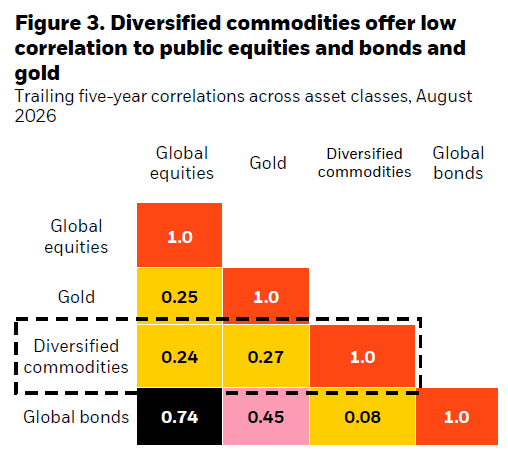
Source: BlackRock’s Autumn Investment Directions report
Lastly, the firm highlighted that AI is benefiting healthcare companies, as advances in drug discovery and development improve productivity and offer new opportunities in the sector.
“We also see healthcare as an attractive portfolio diversifier: a beneficiary of AI adoption, but with return drivers that are less correlated with the core tech-led AI theme,” BlackRock analysts said.
“While US policy uncertainty could add to near-term volatility, particularly in subsectors like pharma, it's unlikely to overwhelm the sector’s longer-term innovation and structural growth story, in our view.”
The non-AI plays
Away from AI, the firm highlighted two key areas for those wanting to move away from the seemingly all-encompassing technology.
Firstly, flexible active US large-cap equity strategies are an option, provided they “aim to deliver alpha with very low correlation to the broad market and the AI theme”.
Blending this type of fund with a high-conviction AI thematic strategy can “diversify alpha, enhance active returns for a given risk budget and manage AI concentration,” the report said.
Away from the US, BlackRock suggested Japan, where corporate reform is translating into improved capital efficiency and shareholder returns. The market is up around 30% over the past year, although earnings growth, rather than multiple expansion, is the largest driver of this.
Large-cap multiples have actually cheapened by 7% over this time, the analysts found, which creates a “compelling entry point” for those not already invested.
“The market can help diversify beyond AI: MSCI Japan has a 0.3 correlation YTD to our high-conviction AI strategy,” the report noted.
Elsewhere, in emerging markets, India has attractive fundamentals. In particular, while earnings are down just 1.9% this year, shares have dropped significantly more, leaving the market on a price-to-earnings ratio of 21.7x, compared with 26.4x at the start of the year.
“In our view, the equity market has been punished for its software exposure, while other sectors have held up amid improving earnings,” they said.