






Just a month ago, the US labour market looked as though it was beginning to weaken. July payrolls had initially been reported as falling, private-sector hiring was soft and services employment had slipped into contraction.
August’s report, released on Friday, muddied that picture somewhat. The US economy added 162,000 jobs, well ahead of expectations, and unemployment held at 4.1%.
These figures hardly show that the US economy is re-accelerating but they do undermine the view that it is rolling over.
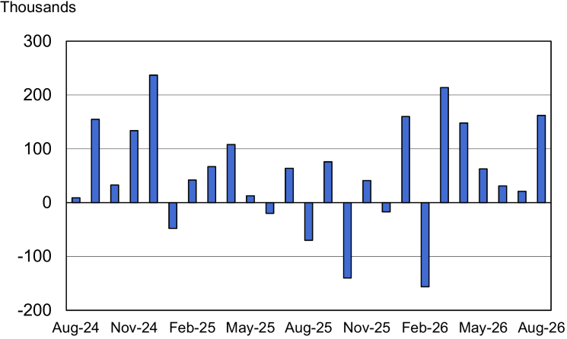
The initial July employment report caused something of a stir when nonfarm payrolls were first estimated to have fallen by 23,000, against expectations for an increase of between 80,000 and 95,000. The weak ADP private-employment report and a fall in the ISM services employment index reinforced this picture.
That narrative has now been largely revised away. July’s payroll figure was restated as a small gain of 21,000 jobs, rather than a fall, and June was revised higher too. August then brought an increase of 162,000.
Some of that rebound reflects the reversal of a statistical distortion in July: local government education added 42,000 jobs, largely undoing the previous month’s fall, while food services and drinking places contributed a further 59,000, well above their recent average.
Together, those two industries accounted for close to two-thirds of the total, while most other major sectors were little changed.
US nonfarm payroll employment: Monthly change
Source: T. Bailey, US Bureau of Labor Statistics.
A labour market that is holding up
Such revisions are a reminder that payrolls are one of the more volatile economic releases and suggest interested parties shouldn’t set their store by one month’s numbers.
The three-month average pace of job creation remains modest by historical standards, at around 71,000 jobs a month. However, labour-force growth has also slowed, in part because of the US’s tighter immigration policy.
Fewer new jobs are therefore needed to prevent unemployment rising. With overall unemployment unchanged at 4.1%, the labour market appears to be holding up better than was thought.
What this means for the Fed
For investors, this is both good and bad news. Continued employment growth supports household spending and company revenues. It also makes the Federal Reserve’s inflation problem harder to resolve.
A weakening jobs market would have allowed the Fed to be more patient with inflation still above its 2% target, but a stable labour market gives it less room to do so.
Yet the report does not make a September rate rise inevitable. Federal Reserve officials Christopher Waller and John Williams have both continued to stress the importance of the next inflation readings.
That said, should this week’s PPI and CPI data show that price pressures remain above target, the case for a September increase becomes much stronger.
Why bond yields are moving higher
The rise in longer-term government-bond yields over recent weeks adds a further complication. In the US, the move appears to reflect a reassessment of real yields and of the strength of the economy rather than a rise in long-term inflation expectations.
Inflation breakevens have remained broadly stable and the US dollar has not weakened materially. Higher yields are therefore more consistent with a view that interest rates need to stay higher in real terms while activity proves more resilient than expected.
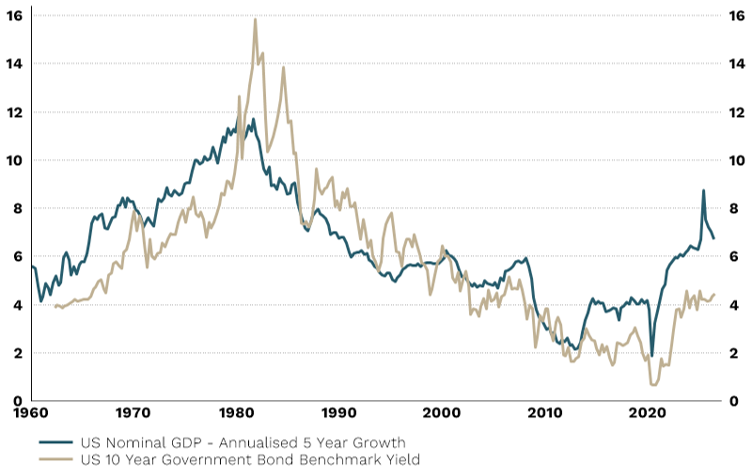
That view finds some support in the strength of US nominal GDP growth, the rate at which the tax base, corporate revenues and household incomes expand in cash terms.
US 10-year treasury yield and rolling five-year annualised nominal GDP growth
Source: T. Bailey, LSEG Workspace.
For much of the period since the financial crisis, the US government has been able to borrow at rates comfortably beneath the cash growth rate of the economy. As the chart shows, that gap has not closed and the adjustment in long-term interest rates looks incomplete.
A similar pattern played out in the 1960s and 1970s, when benchmark yields lagged behind an expanding economy before eventually catching up.
The broader point is that there has not been a clear weakening of the US labour market and inflation remains above target. That presents a less comfortable backdrop for investors in long-dated bonds and for parts of the equity market priced on the assumption that rates will fall quickly.
We believe it remains sensible to own a diversified mix of assets, but with an emphasis on businesses that can grow earnings without relying on cheaper money: companies with pricing power, strong balance sheets and dependable cash generation.
That approach does not depend on a particular payroll number, a single Fed meeting or the most favourable outcome for inflation.
Elliot Farley is CEO of T. Bailey Asset Management. The views expressed above should not be taken as investment advice.