






Nvidia has been one of the standout holdings in Guinness Global Innovators for over two decades. Now, Matthew Page and Ian Mortimer have added the US tech giant to their Guinness Global Equity Income fund too.
“Nvidia is a company we have owned in the Global Innovators Fund since 2003, and it’s up about 67,000% since that initial investment,” Page said, speaking at the Guinness Global Investors annual conference.
“Given this, we have recently brought it into the Guinness Global Equity Income fund.”
Holdings in Guinness Global Equity Income and Guinness Global Innovators
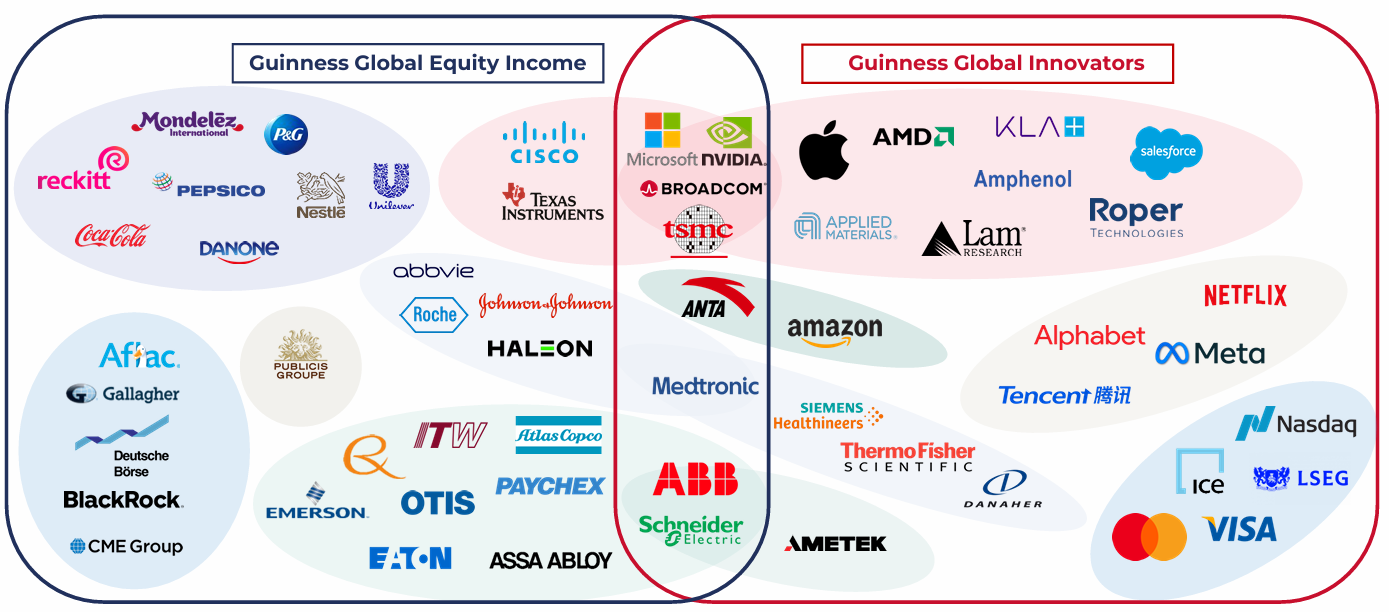
Source: Guinness Global Investors. Data as of 31 August 2026.
This is an unusual move for an income fund, as tech companies have traditionally reinvested profits into growth rather than paying dividends. However, some tech stocks, such as Nvidia and Meta, are increasingly focused on returning more cash to shareholders.
Page’s case for the addition of Nvidia to Guinness Global Equity Income rests on its dividend growth potential, with the company growing its dividend by 25x this year, from $0.01 to $0.25 per share.
“Looking at the growth of its free cashflow, there is great scope for Nvidia to continue to grow the dividend, and it won’t be that expensive [to do so],” he said.
His confidence is underpinned by how the huge amount of investment in the AI build-out is being distributed.
“AI capital expenditure has continued to be revised up over the course of the past year,” Page said, noting that the hyperscalers are expected to spend as much as $800bn by the end of this year and surpass $1trn in 2027 and beyond, generating an estimated $987bn in cumulative cashflow in 2027 and $1.2trn in 2028.
Much of this money is flowing down to semiconductors, Page said, with Nvidia currently taking up the lion’s share of the market. This is having a positive impact on free cashflow – and therefore increasing the possible dividend payout for investors.
Semiconductor free cashflow is set to grow: 2025-2028 (estimated)
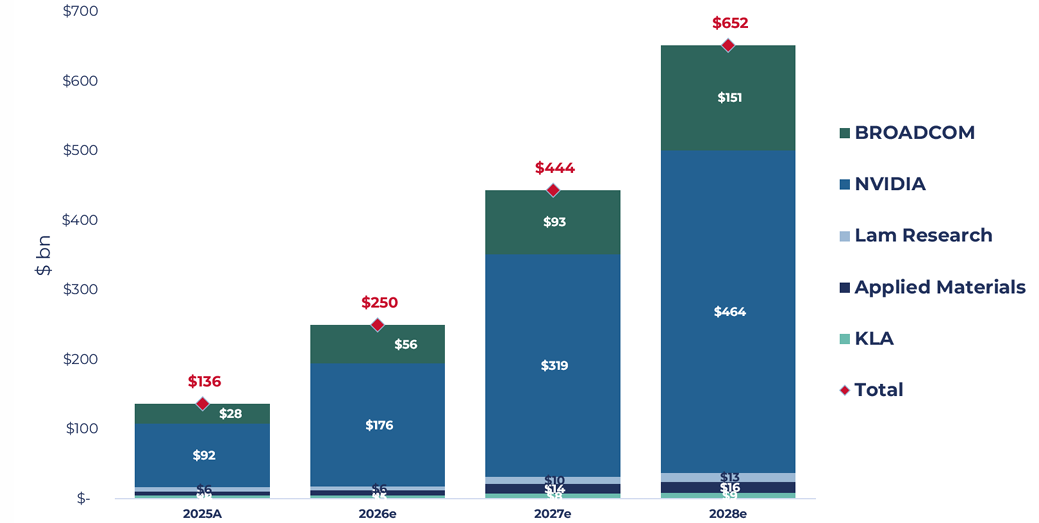
Source: Guinness Global Investors, Bloomberg. Data as of 31 August 2026.
“The place to be if you want to get at free cashflow is in semiconductor companies, as they are ultimately benefiting from all the AI spend,” Page said. “Nvidia alone generated $92bn of free cashflow in 2025 – remember that free cashflow is after capex.”
Free cashflow: Hyperscalers vs semiconductors
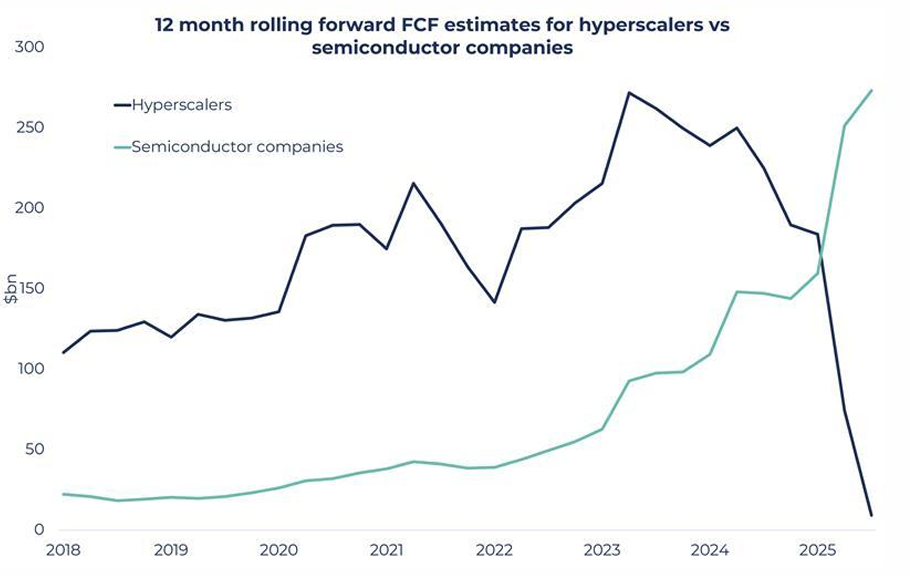
Source: Guinness Global Investors, Bloomberg. Data as of 31 August 2026.
As well as the potential to grow its dividend, Page also highlighted Nvidia’s fundamentals that make it a strong quality portfolio holding for the income strategy.
For example, the company is currently trading cheaper relative to history, at around 27x price-to-earnings (P/E) versus highs of more than 50x.
“Also keep in mind that Nvidia has generated a consistently high return on capital for a very long time and it has an incredibly robust balance sheet and a huge competitive moat,” he added.
“There is no one that can do what it is doing, and is has this huge scale, which really gives it an incredible competitive position in terms of being able to potentially acquire or see off potential new entrants.”
Last month, Nvidia announced its second-quarter results, which beat forecasts on both revenue and profit, reporting a second-quarter fiscal revenue of $46.7bn, up 56% year-over-year. The company expects this trajectory to continue, forecasting 70% revenue growth in its 2028 financial year.
The company is laying the groundwork to ensure this future growth. Earlier in August, it announced plans to help mobilise up to $500bn for new AI infrastructure alongside financial partners including BlackRock, Goldman Sachs and Brookfield.
While Nvidia offers the prospect of a fast-growing dividend, the fund’s income today still rests mainly on holdings that already pay out more substantially.
“Guinness Global Equity Income strategy is crammed full of companies that are consistently generating high levels of return on capital, and we think these will continue to provide important diversifiers to those tech companies as well,” Page said.
These other portfolio holdings include French multinational food products company Danone, asset manager BlackRock and pharmaceutical company AbbVie.
Danone’s annual dividend is €2.25 per share – up 4.7% year-on-year – while BlackRock and AbbVie have declared quarterly dividends of $5.73 and $1.73 per share respectively. For BlackRock, this represents a 10% increase.
AbbVie has grown its dividend over 25 consecutive years, up more than 330% since the company’s 2013 inception.