






Commodities have been one of the biggest market buzzwords of the past few years in markets but are they essential to portfolios?
Last month, when Rathbones asked professional investors whether they used active funds, passive funds or a blend of both to allocate to different asset classes, they were also given a fourth option: ‘do not invest’.
Nobody eschewed developed market large-cap equities (as may be expected). However, the next most-owned asset class was commodities. Only 2% said they did not have some exposure to the basket, less than emerging markets equities, small-caps or even bonds.
Commodities hit the headlines thanks to an extraordinary run in the gold price, which started in 2022 but has turbocharged since in 202the election of 4 by US president Donald Trump in 2024’s election victory. It was subsequently joined by silver and other metals, which rocketed alongside gold.
As the shine came off these metals, the start of the war in Iran at the end of February 2026 brought commodities as an asset class back into the spotlight, with oil taking up the mantle from gold as the main headline maker.
The closure of the Strait of Hormuz sent the oil price above $100 per barrel. Although it came down when the conflict looked like it was cooling, it is back to $100 , a level it remains around today despite several drops as negotiations between Iran and the US have fallen apart.
Despite different assets commodities leading at different times, the overall asset class has shone. Over the past five years, the IA Commodity/Natural Resources sector has been the best-performing peer group, beating the IA Technology & Technology Innovation sector by around 12 percentage points.
Performance of sectors over 5yrs
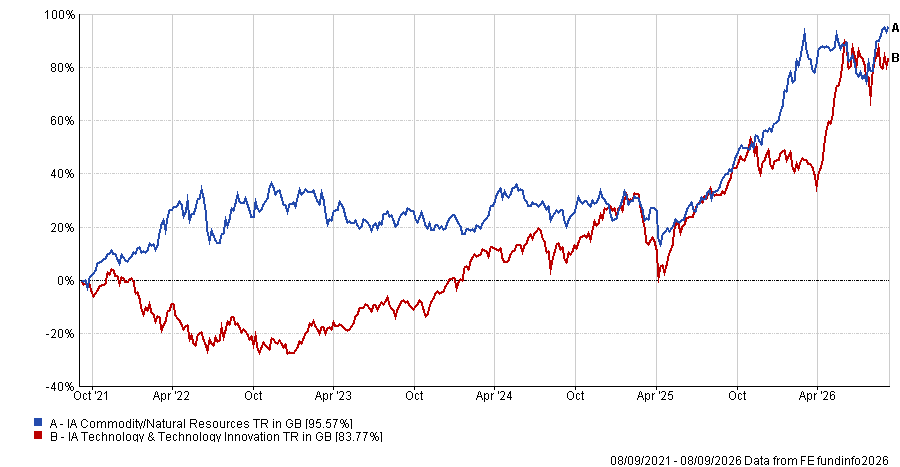
Source: FE Analytics
Below, Trustnet asked investment professionals whether commodities had have become essential to clients in the current environment, or if they remain something that can be avoided.
Commodities are essential in multi-asset portfolios
Lynn Hutchinson, head of ETF and index solutions at Raymond James, said commodities are “an important structural component of a diversified multi-asset portfolio”.
“Their role is less about expressing a single macroeconomic view and more about providing exposure to a range of return drivers that can behave very differently from equities and bonds,” she said, adding that they offer investors “valuable diversification during periods of inflation or geopolitical stress” when other asset classes move in the same direction.
She noted that commodities the asset class works particularly well for this as it they areis made up of many different assets. For example, while energy markets can be driven by geopolitics, supply-demand dynamics and inventory levels, industrial metals are more likely centred around longer-term themes such as electrification and grid investment.
Precious metals, on the other hand, are a reflection of real interest rates, the strength of the US dollar, central-bank demand and safe-haven flows, while agricultural products are influenced by weather, crop conditions and input costs.
“These distinct return drivers are one reason we prefer broad commodity exposure rather than concentrating heavily in a particular commodity or sector. At present, we see supportive factors across several areas of the commodity complex, but also meaningful and often commodity-specific risks,” she said.
“In our view, this supports the case for commodities as a structural allocation, offering diversification alongside potential protection against inflation and geopolitical risk.”
To do this, she uses holds the L&G Multi-Strategy Enhanced Commodities ETF, which uses a range of techniques such as backwardation tilts, contract selection, seasonality and momentum to provide a better allocation to traditional commodity products, which typically “track the front end of commodity markets”.
For David Hood, head of central investment solutions at RBC Brewin Dolphin, commodities are also essential. “We consider commodities to be an integral part of clients' portfolios, particularly at the lower-risk end, where they can help diversify a portfolio,” he said.
However, he noted that RBC Brewin Dolphin typically only uses gold when considering commodities as other assets in the basket can have “negative carry”; in other words they can cost more to hold than the returns they generate.
Hood also noted that gold and other commodities can be volatile, “so sizing the position in client portfolios is critical”. For example, the firm’s investment committee reviews the firm’s gold position on a regular basis and determines the optimal allocation based on “prevailing market conditions"."
Commodities are not essential for diversification
Ahmer Tirmizi, head of fixed income strategy at 7IM, disagreed with the idea that commodities were essential, noting the firm has no direct commodity exposure in its portfolios. In particular, there are some big issues with the asset class that some investors may miss.
“First, a significant portion of commodity returns come from the ‘collateral’ of holding commodity futures, which is essentially a cash return. Strip these out and returns are more mediocre than long-term commodity charts usually imply (other than gold) and can be negative for long -periods of time,” he said.
Second, the choice of commodity index matters significantly as some indices have over half in energy, while others limit their exposure to around a third. This distinction matters and the choice between different funds can vary depending on the macroeconomic environment.
Lastly, he noted that the commodity markets are not simply a function of investors, but also the producers and buyers of the underlying assets, which can lead to sharp fluctuations.
“We do see tactical value in commodities, but the portfolio benefits tend to be in the weeds. Using strategies that take advantage of these ‘natural buyers’ can be beneficial to investors rather than buying direct commodities. At 7IM, we do this with our alternatives strategies, which are quantitative,” he noted.
Others agreed with Tirmizi that commodities are not essential, although they do use the asset class. Chris Fernyhough, director at Freyr Investment Management, was one such example. He noted argued that commodities “are not essential” as investors can build “a fully diversified, risk-appropriate portfolio without touching them”.
However, he said they can “earn their place as a genuinely useful diversification tool as their returns tend to move quite differently to equities and bonds”, meaning even a small allocation can smooth returns over a cycle.
His preference is gold and other precious metals, through which he suggested investors could use a “straightforward” exchange-traded product such as the iShares Physical Gold fund.
Another who uses commodities but does not see them as essential was Elliot Farley, chief executive at T. Bailey Asset Management, who said he would “push back” on the notion that it was relevant to all investors.
“The problem with commodities is that they pay you nothing while you wait for a thesis to come good and typically cost you to hold them. There's no earnings stream to model against, so you never quite reach the comfort you get with a company that you've understood properly,” he said.
However, the firm’s multi-asset funds have objectives linked to inflation, giving real assets “an obvious claim” to the portfolios. At present, commodity exposure across the firm’s funds sits at around 8%.
“Presently, we favour gold and copper, largely for opposite reasons. Gold is a monetary asset that responds to geopolitical tension and to doubts about monetary policy and central bank independence,” he said.
“In contrast, copper is an industrial metal with constrained supply, low inventories and faces demand from data centre buildouts, electrical grid upgrades and continued urbanisation in Asia. As a pair they tend to perform in different conditions, which is why we hold both.”
Eleanor Ingilby, head of high net worth at Atomos, also uses gold in her portfolios, as it has the “clearest portfolio role” among the different commodities.
“Gold can provide a different form of protection from government bonds. While it is generally less dependable than government bonds in traditional disinflationary growth shocks, it has historically tended to be supported during periods of geopolitical stress, inflation risk, concerns about monetary credibility or confidence in currencies,” she said.
However, she said holding a broad basket of different commodities directly in portfolios is not essential.
“First, investors will have indirect exposure to commodities through other asset classes, most obviously equities. Second, investors can build well-diversified portfolios that perform well over a traditional business cycle without holding commodities directly. Third, commodities are not a single, uniform, asset class,” she said.