






Risk-taking is likely to be rewarded, according to Robeco analysts, who have highlighted emerging markets as the best place to invest over the coming half a decade, while cash savers are likely to miss out.
The market regime of the coming five years will look very different to the period between 2021 and 2026. Over the past five years, valuation re-ratings have done “much of the heavy lifting”, the report found, with equities benefiting from substantial multiple expansion while bond investors profited from strong spread compression.
Today, there is greater dispersion and more reliance on realised earnings and cashflow growth.
As a result, the firm highlighted three macro trends that will shape the coming half a decade. The first is trade rewiring, which will favour a broader set of distributors around the world as countries move to more local supply chains – particularly following the outbreak of the Iran war.
‘Capital deepening’ will support sectors and markets with greater exposure to investment spending, while its third theme – AI adoption – will reward firms that successfully redesign production processes rather than merely supplying the technology.
“Together, these forces argue for a less concentrated return environment than investors have experienced so far in this bull market,” the report found.
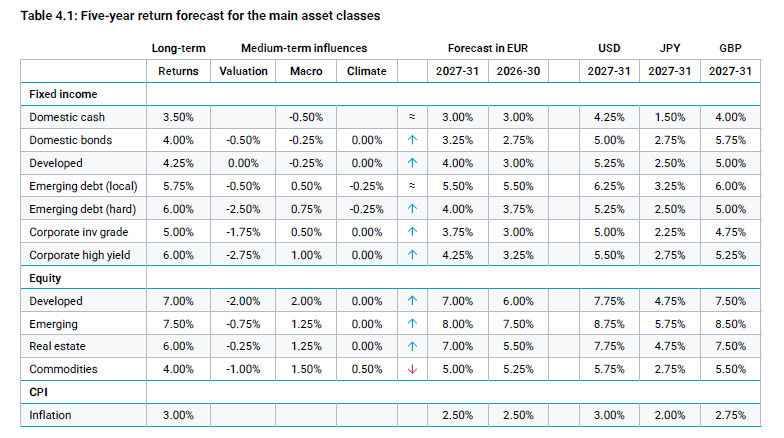
This can be seen in the return expectations below, with the forecasts discussed throughout made in euros. For UK investors, the sterling-based returns are in the final column.
Source: Robeco
Topping the pile are emerging market (EM) equities, which are anticipated to make around 8.5% per year in sterling terms, a full percentage point ahead of developed markets and real estate. In the fixed income space, local currency EM debt is forecast to do best at 6% per year.
Conversely, commodities are only expected to return 5.5% per year from here, just ahead of cash – the worst-performing asset – at 4%.
The report noted that equities and other risk assets were the best place to invest when there is strong productivity growth and “elevated investment intensity”. In particular, it noted that US unemployment is a key barometer for this. If below 6%, risk assets tend to do well.
“As we expect US unemployment not to reach 6% until the 2030s, the implication is that we are still in an environment where risk-taking is likely to be rewarded,” the Robeco report said.
However, this does not mean investors can buy indiscriminately, as valuation still matters and elevated starting prices are an important determinant of returns in the medium term.
“After a period dominated by multiple expansion, we believe investors are moving toward a lower-P/E [price-to-earnings], higher-EPS [earnings per share] environment. Future returns are therefore likely to depend more heavily on earnings delivery, income generation and successful capital allocation,” the report read.
This leads to three broad conclusions, the first being that equities should continue to outperform bonds. For those concerned that markets have already performed well, the Robeco analysts noted that although the S&P 500 is up 238% since the Covid nadir, the average bull market return is 343%.
Second is that opportunities are likely to broaden beyond the narrow group of companies as the market moves from enablers to adopters, while third is that there will be greater capital spending on infrastructure.
Below, Trustnet looks at how the report recommends investors approach different asset classes across the investment landscape.
Equities
Starting with stocks, Robeco analysts said markets are “buzzing” rather than in a bubble, but warned that trading could “become choppier” as it did towards the back half of the 1990s.
“After a strong rerating over the past few years, we enter a phase of the equity cycle where the burden of proof is shifting from the valuation multiple to earnings delivery. The transition from a market driven by P/E to one driven by earnings growth makes the market more vulnerable to both future earnings disappointments and negative discount rate news,” the report said.
“For equity investors, this changes the question. It is no longer sufficient to ask whether artificial intelligence will raise productivity. The more relevant question is whether the largest capital deepening cycle in decades can generate enough durable earnings to justify the investment.”
The US remains the main market to beat and still leads the world in earnings and AI infrastructure. However, after decades of ‘US exceptionalism’, the reasons for being overweight American companies are dwindling as it requires a multitude of factors to go right.
“The US now needs continued superior EPS delivery, AI capex that keeps paying off, benign disinflation, a sustained global preference for US capital markets and no major deterioration in policy credibility. That is a high bar,” the report read. The valuation starting point also leaves little room for error.
Emerging markets remain the highest-returning equity region, although the return gap versus developed markets has narrowed compared to last year.
The report said EM equities tend to outperform when the dollar weakens, global trade volumes improve, industrial activity broadens and capital starts flowing toward regions with greater productivity catch-up potential.
“These forces have more room to run. In a world in which globalisation does not disappear but reorganises around security, particularly energy security, emerging markets could continue to outperform,” the report said.
It is one of five areas that should do well if the argument for US exceptionalism wanes, including Europe, smaller companies, value investing and low volatility products.
“Each needs a different macro regime. EM needs synchronised global expansion and a weak dollar. Europe needs fiscal revival and risk-premium compression. Small-caps need domestic demand and easing financial conditions. Value needs higher capital absorption and a higher real-rate world. Low volatility shines if negative supply shocks become more frequent and the bear case materialises,” the report said.
Bonds
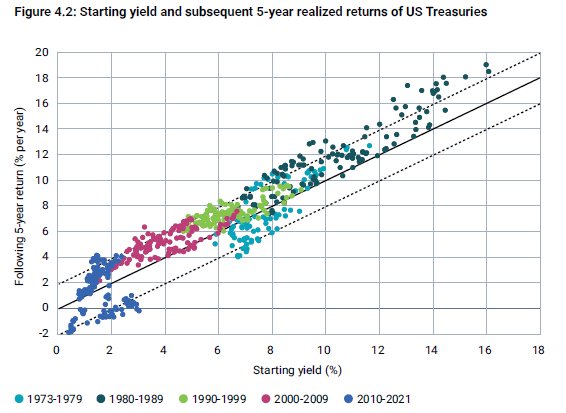
For government bonds, the starting yield is an important determinant of expected return, as the below chart shows.
Source: Robeco
“Our approach to determining whether major government bond markets are fairly valued is to compare the yield curve with market expectations for returns on rolling bills and long-term interest-rate levels,” Robeco analysts said.
They noted that German bunds are expected to make around 3.25%, while bonds from the eurozone as a whole pay 3.75%. In the US, bond returns are higher at 5%, although this reflects the fact that US treasuries are “no longer the safe-haven asset they once were”.
“Compared with previous years, investors demand a higher premium for holding US government debt, reflecting increased policy and fiscal uncertainty,” the report read.
UK gilts are close to treasuries, expected to return 5.75% per year, while developed markets as a whole are anticipated to pay around 4%.
For emerging markets, where the returns are highest, “higher starting yields than in developed markets remain the asset class's main attraction”.
Local currency will outperform hard currency, the latter of which is priced relative to US treasuries, as hard currency credit spreads have narrowed “considerably” over the past year, meaning much of the valuation gains on offer a year ago have “largely disappeared”.
Turning to company debt, credit spreads are low relative to history in the US and Europe, meaning valuations are less attractive, the report read.
As more corporate borrowing will be required in the coming years for the AI expansion, this could widen out the spread. However, economic expansion and healthy earnings growth should keep them subdued. Overall, the report noted that investment-grade bonds should make around 3.75%.
For high-yield bonds, while returns are supported by the relatively short maturity of this debt, the report noted that spreads could widen and defaults may tick higher, giving investors here “limited room for investor complacency”.
Cash
“Cash remains the cornerstone of any portfolio, providing liquidity and stability,” the report said. However, the outlook for cash returns is shaped by central bank policy, with most central banks still battling above-target inflation following the post-pandemic recovery.
Higher investment in AI infrastructure, electrification, defence and manufacturing will contribute to a higher interest rate level over the next five years, meaning policymakers are likely to maintain policy rates well above the levels that prevailed for much of the pre-Covid era.
“We believe that the medium-term disinflationary impact of technology booms will incentivise central bankers to show measured flexibility around near-term deviations from target inflation,” the report read.
In its base-case scenario, this equates to the ECB’s rate standing at 3%, while the US Federal Reserve is slightly higher at 4.25%. In the UK, the Bank of England’s base rate is in the middle at 4%.