






The fiscal fights, sector scrutiny and trade tensions following November's US midterm elections could shape markets well after the votes are counted, particularly if Democrats make significant gains, according to Schroders senior economist George Brown.
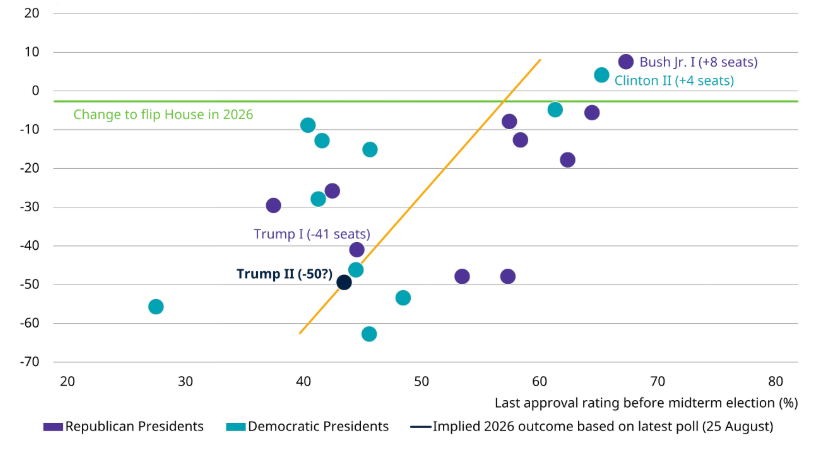
Midterms are typically treated as a referendum on the sitting president. The president's party has lost House of Representatives seats in all but two midterms since World War II and Republicans lost 41 seats in US president Donald Trump's first midterms in 2018.
The current approval ratings of Trump (the New York Times' aggregation of polls conducted by dozens of different organisations says 60% of voters disapprove of the president) could produce a similar result this November, well beyond the two-seat margin Republicans can afford to lose in the house, Brown said.
Change in US House of Representatives seats in midterm elections since 1946
Source: The American Presidency Project, Macrobond, Schroders Economics Group. 21 Aug 2026
The Senate presents a tighter contest, since only around a third of seats are up for election.
Brown said the states involved matter as much as the national mood, with Democrats needing a net gain of four seats while defending their own ground. Competitive races in North Carolina and Maine offer opportunities, Brown noted, but Republicans remain marginal favourites to hold the chamber.
"Either way, Republicans are all but certain to lose their trifecta (combined control of the White House, House of Representatives and Senate) in November," the economist explained. "A split Congress remains the most likely outcome, but the Senate is finely balanced enough that a Democratic sweep would hardly come as a surprise."
For investors, this will shape how intense fiscal fights and sector scrutiny become over the next two years.
A Democratic house alone would let the party frustrate the administration's agenda through investigations and blocked legislation, while a Republican Senate would still act as a defensive barrier for the White House, Brown said.
That combination would bring greater oversight, more political noise and a higher risk of fiscal confrontation, but only limited scope to reverse the administration's broader policy agenda.
A full Democratic sweep would tighten those constraints further, Brown argued, intensifying investigations and scrutiny of sensitive sectors and appointments. Trump would still retain his veto and executive authority, so a Democratic sweep would therefore constrain the administration rather than fundamentally alter policy direction.
"For investors, the difference is likely to be one of degree rather than direction. Either scenario of a split Congress or a Democratic sweep would increase political friction in Washington," Brown said.
"The latter would simply amplify those pressures. As a result, the most important market consequences are likely to stem not from the election result itself, but from the policy confrontations that follow."
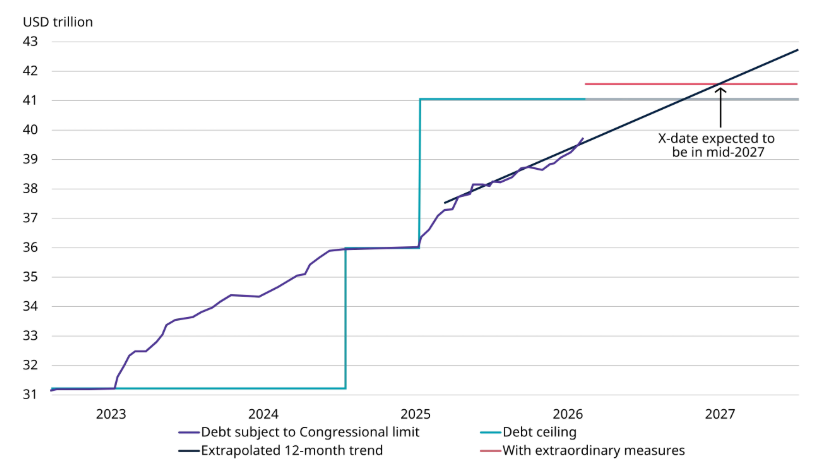
The debt ceiling looks set to become an early flashpoint for the new Congress. US federal debt is now above $40trn, with the Treasury's extraordinary measures likely to run out, or reach the 'X-date', around the middle of 2027.
Partisan divide could set up debt ceiling standoff in 2027
Source: Macrobond, Schroders Economics Group. 21 Aug 2026.
A Democratic house would gain leverage over any agreement on debt and control of the Senate would strengthen that position further.
"But investors should be wary of assuming that gridlock automatically means fiscal restraint. Initially, markets may conclude that the loss of the Republican trifecta would make another large tax or spending package more difficult, potentially bringing some near-term relief to treasuries," the economist said.
"That reaction would be understandable. Historically, divided governments have often been associated with fewer opportunities for deficit-financed stimulus. But this time could prove different."
The fault lines around fiscal policy are already visible. Republicans want higher defence spending, while Democrats want to reverse the Medicaid cuts in the administration's One Big Beautiful Bill.
Given how confrontational recent fiscal negotiations have become, neither side may be willing to give much ground, making a compromise that accommodates both demands more likely than either side retreating. By Schroders' estimates, such a compromise could widen the deficit by around 1% of GDP.
This creates a two-stage risk for treasuries, Brown warned. Yields could fall initially after the election as investors price in less near-term fiscal expansion, before reversing higher as the debt-ceiling negotiation approaches and attention shifts to the cost of the eventual compromise.
"The key issue is not the additional borrowing itself, but what it signals about fiscal discipline," Brown said.
If political compromise increasingly produces larger deficits rather than consolidation, investors may demand a higher term premium to hold long-dated treasuries, which could result in a structurally steeper yield curve.
Equity markets have generally welcomed divided government, Brown noted, on the view that legislative gridlock lets companies operate with fewer policy surprises. Yet congressional composition has historically had little bearing on aggregate US market performance, with earnings, growth, inflation and rates mattering far more.
He argued that the more credible implication of the midterms is therefore greater dispersion between sectors, rather than a materially different outcome for the market as a whole. Extending Democratic control to the Senate would put committees in both chambers under the party's reach, broadening the oversight available through the House alone.
"By controlling the House, the Democrats will be able to launch investigations and hold hearings. But extending their reach to the Senate would broaden that oversight by putting committees in both chambers under the party's control," Brown finished.
"The resulting scrutiny could be particularly important for politically sensitive sectors such as energy, healthcare and technology. Consistent with this, our analysis suggests these sectors have often traded alongside changes in betting odds for Senate control."