






As tech giants ramp up borrowing to fund the AI infrastructure boom, one bond manager thinks something in the market’s pricing has to give.
Shalin Shah, co-manager of Royal London Corporate Bond, said: “We look across a spectrum of secured corporate and securitised assets and one area that is increasing in weight very quickly is hyperscalers – they’re issuing more debt and they will go to every currency possible.”
The likes of Alphabet, Microsoft and Oracle have issued bonds across the dollar, sterling and more to fund their AI build-out, with Shah noting that some of them are “getting to interesting levels of spread against a balance sheet that is relatively robust [with] huge earnings coming through in support”.
However, not all of this spending will pay off, as “some of it will have to get written off”.
That is the area Shah is looking at. Spreads on hyperscaler debt, typically AA-rated, are “very elevated versus other companies, whether it’s across utilities [or] telecoms”.
“It feels like something has to change,” he added. “Either other parts of the sector […] will have to widen to catch up a bit or eventually the spreads on the hyperscaler area will have to come in.”
Below, he reflects on his broader investment process and how this translates across other opportunity sets.
What is your investment process?
We identify inefficiencies within sterling credit markets, which are increasing in number over time
There are some long-established ones – for example, the fact that the market focuses a lot more on benchmarks as more money goes to passive strategies – as well as newer inefficiencies around ETFs [exchange-traded funds]: as the largest weightings in an index are typically with the companies with the most debt, a significant weight of money is being pushed towards these [more indebted] companies.
That’s the wrong starting point for building a portfolio. We look beyond corporate bond indices.
We are agnostic to what a benchmark looks like and that leads to very active positioning against an index – typically we might be more than 20–30% in secured debt and underweight in more cyclical triple-B names, whether consumer cyclicals or industrials, where there's no real protection against downgrade when things start to go wrong.
Another inefficiency we exploit is the fixation on ratings; the market treats ratings as an effective building block for structuring portfolios, but a rating is simply telling you the probability of default over a relatively short timeframe. We take advantage of that by looking at how much money we get back if there is a default.
How do you manage risk in the portfolio?
You could have a senior unsecured bond that looks very attractive because it's senior. But actually, when you most need that seniority, often it's gone. The reason is that if the company starts to deteriorate, they don’t call you as a senior unsecured bondholder – typically they’ll call the banks.
The banks will look for collateral and grab the best assets, in case lending goes wrong. All the best assets then get sucked away from you, and suddenly you’re left with a junior claim against a bank.
As an example of what we do instead, during 2020 we were invested in Mitchells & Butlers, the pub company. Because we lent on a senior secured basis, secured on a pub estate, the equity owner had to put in more equity to cure against potential waivers that we would give, reducing the risk to us as bondholders, despite the fact that we already had a lot of security over assets we could claim if things went wrong. If they had to hand the keys in, we had huge amounts of collateral backing our bonds.
What have been your best and worst calls in recent months?
Let's start with the worst calls: Thames Water and Mobico, where we held some hybrid bonds. They impacted the portfolio by just under 50 basis points (bps) of performance combined. Both also paid income, which helped offset some of that.
There is definitely a pathway out for Mobico through selling businesses and reducing debt over time – but it’s highly levered. Thames Water is in a similar situation.
But the reality is what happened with Thames Water led to a ‘throw the baby out with the bathwater’-situation across the whole water sector. A lot of the mid-tier water companies saw their spreads blow up significantly, and we were able to offset a lot of the loss from Thames Water by being active around other names in the sector.
On the upside is Legal & General. It had a 2044-call bond that we knew was a challenge. Its terms didn’t allow L&G to use it as capital for much longer from 2026 due to changes in Solvency II regulations and it got taken out through a tender at par around the back end of 2025, with the rest taken out at the beginning of January 2026.
When we sold it at par, that was a negative spread – a coupon of 5.5% to 2044, when gilt yields were above 5.5% – and we still got 100 back much earlier. That was over 2% of the fund.
How does the UK sterling bond market compare to the US right now?
Sterling has stayed a relative safe harbour – whether that’s due to the level of supply from technology companies and hyperscalers or the increasing weight of private debt and private markets, with technology being a key focus there too.
This is because there have been much larger debt piles in the US, both in the corporate bond index and in private debt markets, while the UK tends to have a strong legacy of real-world infrastructure, social housing – real-world assets and the ability to finance them and the delivery of relatively stable cash flows. I think that’s a positive for investors.
What do you do outside of fund management?
We have some team badminton going on [at work] which I organise for every week. I also have two young children who keep me busy.
Performance of the fund vs sector over 10yrs
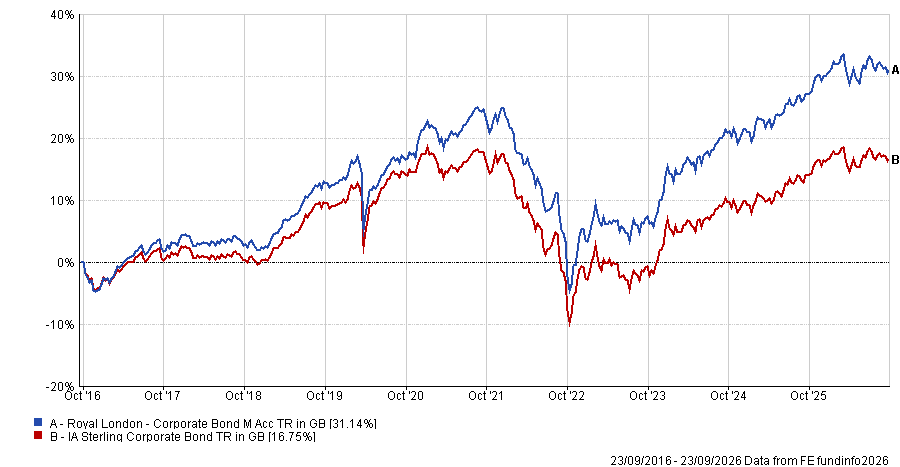
Source: FE Analytics