






The past quarter has been “one of the most brutal” of Fidelity fund manager Kristian Atkinson’s career, but investors are a long way from a “wipeout”, according to the firm's data.
Bond investors are nursing heavy losses after a tough three months. As a result, today US 10-year bond yields stand some 110 basis points (bps) higher than they were at the start of the year. There have been similar rises in the UK (90bps) and Europe (German 10-year bond yields are up 70bps), but the broader move in yields is largely a result of the US, he said.
“There's a combination of factors that is driving that change in yields,” said Atkinson. Perhaps the most significant is the fiscal situation in the US, with the government running an “extremely large deficit despite being pretty close to full employment”.
This has led to forecasted issuance of $2trn and an interest bill of around $1trn per year, figures he described as “eye-watering”.
A second, more positive rationale, however, is the prospect of higher rates. The fixed income manager, who co-runs several funds including the £1bn Fidelity MoneyBuilder Corporate Bond portfolio, noted that the Federal Reserve will be able to focus on inflation as economic growth should be underpinned by the productivity increase that will result from AI.
A third reason is the fact that there will be less guidance coming from the Fed going forward under chair Kevin Warsh, which gives the market “a little bit more of a free run to push up prices”.
The final aspect of the current surge in yields is the Iran war, which has increased oil prices and added to inflationary pressures.
However, there are two reasons for bond investors to be optimistic. First, yields are much higher. Indeed, since 2020, the percentage of the bond market yielding more than 4% has risen significantly.
At the start of the decade, just 2% of the global investment-grade market yielded more than 4%, while 56% of the high-yield universe was above this hurdle rate. Today, those figures stand at 91% and 98%, respectively.
There are a couple of reasons why this is important. Firstly, investors at the start of the decade were “pushed out of the risk spectrum” and therefore were “underallocated” to fixed income.
“We’re seeing the pendulum, if you like, swinging back to fixed income to a certain extent,” he said. This momentum shift is due to the higher yields on offer, as income is the main driver of returns in the asset class over time.
The second is the improvement in the wipeout yield, which measures how much yields would need to rise (and therefore the price to fall) for capital losses to wipe out a year’s worth of income.
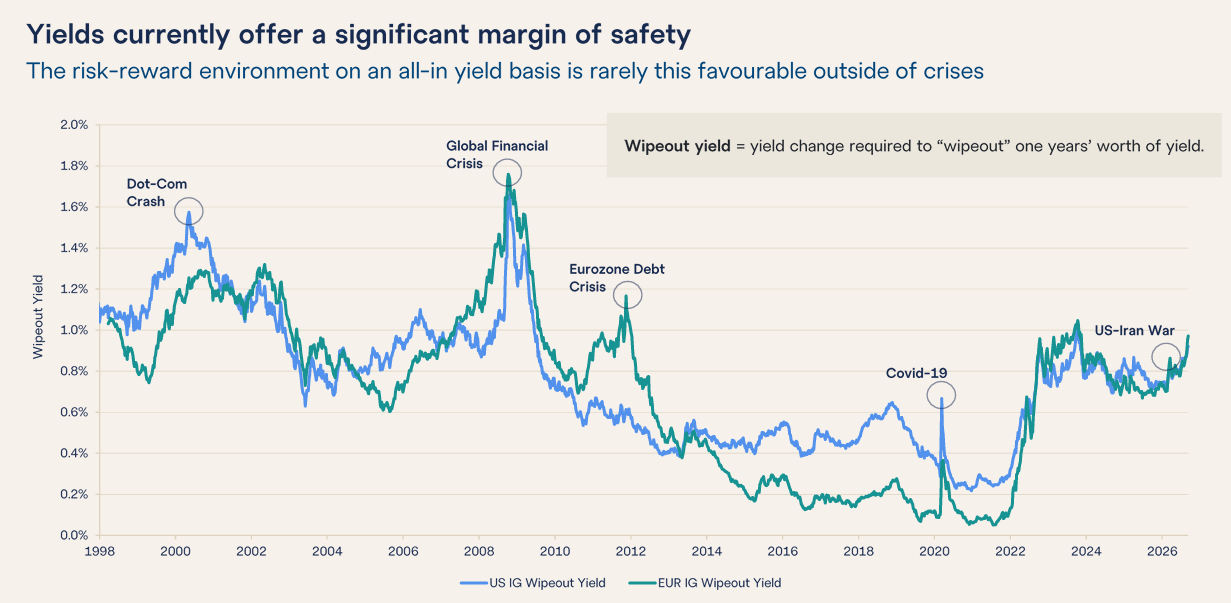
Source: Fidelity
The green line, which represents the European investment grade wipeout yield, hit a low in 2022, when yields only needed to climb 10 basis points for investors to miss out on an entire year’s worth of income.
“The same number for the US wasn't much better, barely above 20 basis points,” said Atkinson, as represented by the blue in the chart above. “It didn't take much to wipe out a year's worth of performance from a yield change,” he said.
Today, however, this has jumped significantly to almost 100 basis points in both cases, a level that it has only reached on a handful of occasions throughout history.
“Look back over the longer-term history and you can see that the only time we've really ever beaten that is during periods of crisis: the eurozone crisis, the global financial crisis and the dot-com crash: those are the only times when we had a better wipeout yield than we have today,” said Atkinson.
These wipeout yields are “pretty attractive” unless investors believe we are about to enter a crisis, which is the only time yields tend to move with the volatility required for investors to lose one year's worth of income.
“It's going to take an awful lot of yield increases, either through spreads or through government bond yields, to wipe out our carry, and that sets us up in quite a nice position going forward to generate a positive return,” he said.
However, when allocating to fixed income, he recommended a breadth of options across credit and government bonds. Currently, spreads on credit are low, meaning investors are not being paid much for taking on extra risk.
He could justify this by highlighting that corporate balance sheets are in “excellent shape” and therefore “you can make the case that corporates look better” than government bonds.
Additionally, most institutional investors only care about the all-in yield. So although much of the return is made up from the government bond yield (with little additional coming from the credit risk), corporate bonds do offer a slightly higher yield and so remain popular among larger investors.
“The counterpoint to that, of course, and we're seeing exactly that in the French market at the moment, is when government balance sheets become stressed, they tend to lean quite heavily on corporates, and the corporates that they will lean on usually are domestic. So it will be the banks, it will be the utilities, the ones that can't literally pack up their business and move somewhere else,” he said.
“So I can make counterarguments both ways. Would I be all in on credit at the moment? No. I think spreads are too tight to do that. But would I have some? Absolutely.”