






Active exchange-traded funds (ETFs) are growing in popularity across Europe and account for more than 10% of professional portfolios that use them, according to data from CoreData Research on behalf of Fidelity International.
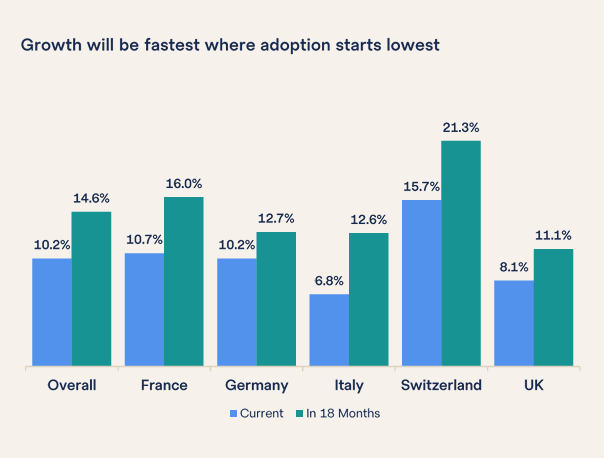
The firm surveyed 310 professional asset allocators currently using or planning to use active ETFs across Europe and found that the current allocation to the wrapper stands at 10.2%. Over the next 18 months, this is expected to rise to 14.6%.
In the UK, the adoption has been slower, at 8.1%, compared with other countries such as Switzerland, France and Germany, as the chart below shows.
Source: Fidelity International, CoreData Research
Angele Spiteri Paris, senior research consultant at CoreData Research, said all asset allocators surveyed agreed on one point: ETFs are going to be a bigger part of their portfolios. “It’s not even a question,” she said.
Globally, assets in actively managed ETFs have surpassed $2.4trn, although much of this is in the US where there are tax advantages.
In the US, big banks can swap ETF shares for the stocks or bonds the fund owns rather than for cash. Because the fund hands over these holdings instead of selling them, it doesn’t have to report a gain. So ETF investors rarely get surprise tax bills from the fund, as can happen with mutual funds. They still pay tax on their own gains when they sell their shares.
However, Samantha Ricciardi, head of Europe, the Middle East and Africa (EMEA) at Fidelity, noted that growth of the vehicle in Europe is accelerating, even without the tax benefits. The firm expects the active ETF market in Europe alone to be worth $1trn by 2031, while she suggested the total market could reach $4trn by 2030.
She said: “I really believe that active ETFs serve a purpose because it is a more innovative way for people to be able to invest.”
Stefan Kuhn, head of ETF distribution for EMEA at Fidelity, added: “If you also look at the acceleration of ETF growth, both on passives but even more on active, it’s mind-boggling.”
Currently, there are three different product types: benchmark-aware strategies that aim to stay within a 1-2% deviation from an index; high-conviction funds that aim for 3-4% deviation; and discretionary funds that can invest without reference to an index.
Neil Davies, head of ETFs at Fidelity, said: “The rise of active ETFs is one of the most significant global trends in the investment industry. What started as a niche concept has now become a rapidly expanding segment.”
With active ETFs set to become a much larger part of the investment landscape, Trustnet looks at the benefits to the wrapper for investors outside the US.
Source: Fidelity International, CoreData Research
Transparency
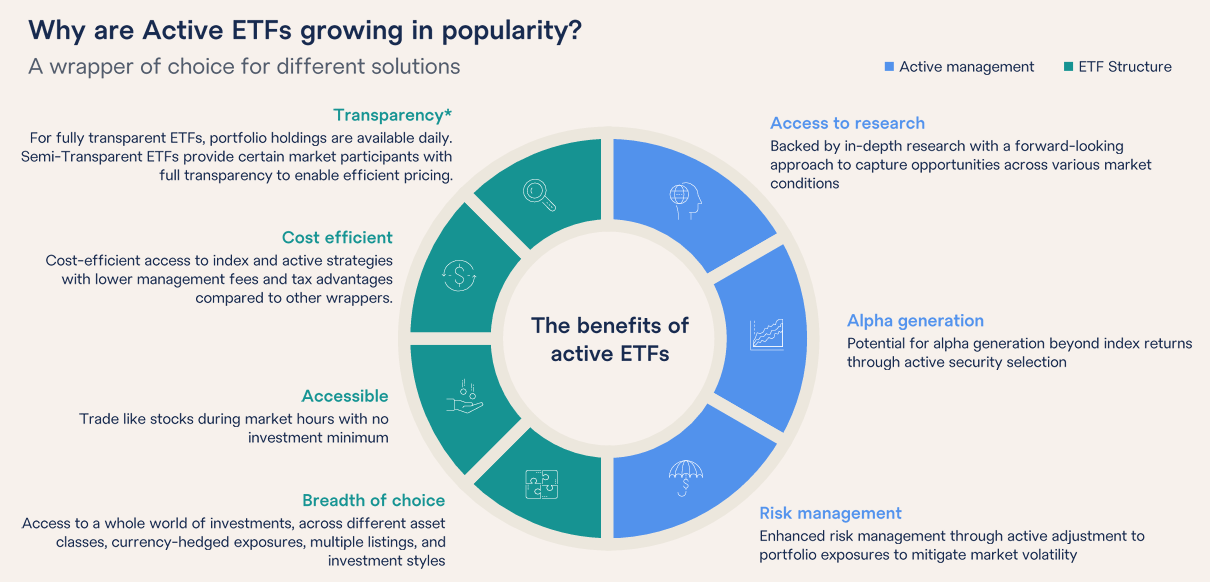
The first is transparency, as ETFs have to be more open with their allocations. For fully transparent ETFs, portfolio holdings are available daily. Semi-transparent ETFs, meanwhile, provide certain market participants with full transparency to enable efficient pricing.
Chris Lo, head of research-enhanced strategies at Columbia Threadneedle, said: “Having that full transparency means a lot to some investors.”
Mutual funds, meanwhile, are only required to provide a top 10 holding update monthly in their factsheets, with full listings offered in annual and semi-annual reports.
Accessibility
The second, and potentially most useful pillar, is that they trade like stocks during market hours with no investment minimum, so they are available for all investors who can trade them more frequently than they can a mutual fund, where withdrawals can take days.
Lo said: “Being able to trade at any point in time, is more critical for retail investors than it is for institutional investors. If you’re someone like me or my mom, who wants to get out at 11 am, you can [put the] trade in and that gets executed.”
Kuhn added that the products are also easily replicable across different jurisdictions. Trading on exchanges means that larger investors can “access them from every country within Europe”, making them easy to add into mandates held in different countries.
Familiarity
Kuhn also noted that the products are more recognisable to investors, who are often recommended to invest in passive tracker funds to begin with. These are often in the form of ETFs, meaning the language used is familiar to investors.
“Most users of active ETFs are coming from passive ETFs. People are very knowledgeable about the ETF as a wrapper and they want to move away from the pure passive exposure,” he said.
Davies added: “I’ve got the large institutional asset allocators who have been sophisticated users of passive ETFs that are now using actively managed ETFs.”
Cost
One aspect that may not be the benefit that it appears, however, is cost. While ETFs are cheaper, this is because the market is largely made up of cheap tracker funds.
Lo noted that in Europe, lower fees and tax advantages are less of a draw than in the US.
“In Europe, I would say you take away that cost and tax efficiency. What you get is the other benefits,” he said.