






There are four ways the artificial intelligence capital expenditure boom could end, ranging from a win-win scenario to one where AI labs fail to generate profit despite their massive investment, says AJ Bell investment director Russ Mould.
Spending across Alphabet, Meta, Microsoft, Amazon, SpaceX, Oracle, Coreweave and Nebius – the sector’s heaviest hitters – has risen from $32bn in 2016, equivalent to 8% of combined sales, to a forecast $971bn this year, or 46% of sales, Mould said.
Analysts forecast that figure will climb even higher, to $1.3trn in 2027 and $1.4trn in 2028.
AI hyperscaler capex
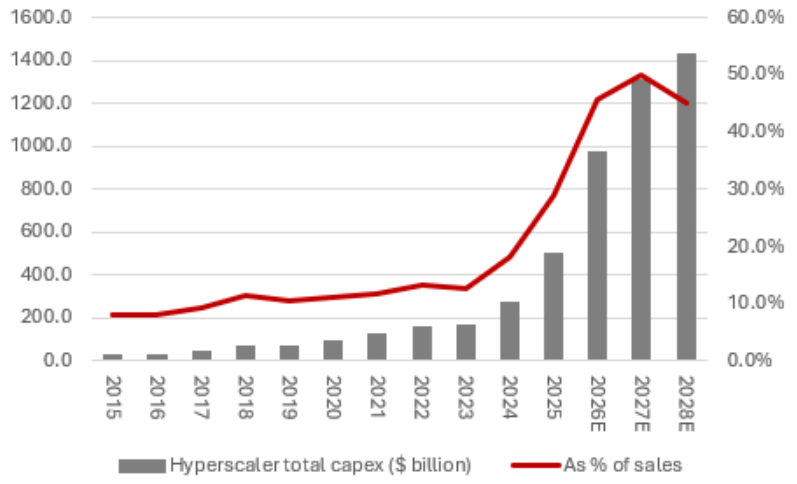
Source: AJ Bell, company accounts, Marketscreener, analysts’ consensus forecasts. *Alphabet, Amazon, Coreweave, Meta Platforms, Microsoft, Nebius, Oracle and SpaceX
“The sums involved are huge and debts are piling up, so the stakes are high, should anything unexpected go wrong,” Mould said.
However, despite the AI boom driving much of the stockmarket’s gains and shoring up economic growth in recent years, there are signs that investors are becoming nervous about the trade.
The latest Bank of America Global Fund Manager Survey found that being long global semiconductors – a common AI ‘picks and shovels’ play – is seen as the most crowded trade, cited by 45% of October’s respondents. Fund managers are now net 37% overweight technology, the highest level since August 2020.
Investors are closely split on whether an AI bubble will form in 2027, with 45% expecting one and 42% not. The survey also found that AI hyperscaler capex is now seen as the most likely source of a systemic credit event, cited by 39% of respondents, ahead of government debt at 28% and private credit at 24%.
However, 57% of fund managers do not expect AI firms to reduce capex in the coming six months. That said, this is a big reduction from the survey’s responses to this question last month, as shown below.
Will an AI hyperscaler announce a capex cut in the next six months?
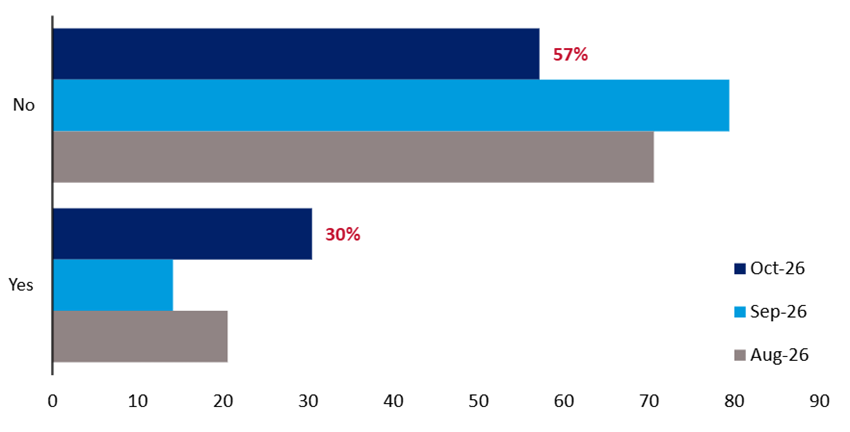
Source: Bank of America Global Fund Manager Survey – Oct 2026
AI labs might be hoping that capex can start to slow. Some analysts interpreted September’s calls from Anthropic’s Dario Amodei, OpenAI’s Sam Altman and SpaceX’s Elon Musk for the speed of AI frontier development to slow down as signs that they want to spend less or secure government investment.
“Either way the current capex boom will, in time, be followed by a surge in depreciation costs, as data centres go live and deploy their silicon chips, computing power, and water and energy infrastructure, with the result that revenues must also rise quickly to cover the costs,” Mould added.
A Columbia University paper estimated that AI revenues need to hit $3.5trn by 2032 to provide a return on the investments and spending which the hyperscalers and AI labs have committed to. This is around 9% of US GDP, almost matching US consumers’ annual consumption on food.
“None of this means demand will disappoint or that the AI boom is going to fizzle, although it means the risks to the hyperscalers, and investors in them or lenders to them, are greater,” Mould said.
“This is because free cashflow is withering; capital intensity, in terms of fixed assets on the balance sheet, is growing; debt is accumulating, to perhaps add financial gearing to increased operational gearing and thus greater swings in earnings relative to changes in revenues; and competition is hotting up, as the hyperscalers emerge from the oligopolistic, or even monopolistic, areas of dominance into a new arena where they are battling each other for supremacy.”
Mould laid out four scenarios for how this could resolve.
In the first, the capex boom continues even as hyperscaler cashflow keeps deteriorating, forcing more borrowing or equity raises to fund the suppliers that currently benefit most.
“The risk here, therefore, is that capital markets rebel and either charge steep interest rates on the debt or low valuations for the equity, to reflect the increased risk. Or they just refuse to hand over any fresh cash, if they feel the potential returns may be inadequate relative to the risks, with the result the spending finally has to stop,” Mould said.
He compared Nvidia’s vendor financing to arrangements used by Cisco, Alcatel, Lucent and Nortel during the dot-com telecoms boom, which worked well until customers began to default.
Iain Fulton, investment director, global equity at Amova Asset Management, said: “Both Anthropic and OpenAI will need to generate significantly more revenue or return to the markets for huge amounts of additional funding. This raises serious questions over just how sustainable, or how substantial, that funding is going to be.”
Fulton added remaining performance obligations (RPOs, which are contracted future revenues for services that have not yet been delivered) already exceed $2trn across Alphabet, Amazon and Microsoft, and cited Goldman Sachs research suggesting LLM developers may need $1trn in revenue to justify that spending.
“Investors should therefore be wary of assuming that the current pace of AI infrastructure investment can continue indefinitely. We may already be approaching the peak in capex assumptions,” he said.
“This all matters because the RPOs are helping to underpin earnings expectations across the AI hardware supply chain. OpenAI represents a material credit-risk consideration within the AI investment cycle.”
In AJ Bell’s second scenario, capex continues as free cashflow surges after AI delivers genuine productivity gains across governments, companies and consumers. Here, the dangers lie in competition between the labs and the LLM developers as supply surges and token prices collapse, similar to what happened with fibre and broadband demand during the tech, media and telecoms bubble of 1998-2000.
Mould noted that broadband demand eventually exceeded expectations in that earlier boom, but a surge in supply still wiped out many early movers. He warned a similar collapse in token prices could hurt profits given that many compute, power and water contracts are agreed at fixed long-term prices.
The best-case scenario, in AJ Bell’s view, sees demand rocket while hyperscalers calibrate capex precisely to maximise profit. “The danger here is this jackpot attracts more competition, although by then the early-mover advantage could be too great to overcome,” Mould said.
He added that regulatory intervention or customer pushback could follow, though neither has yet disrupted the dominant positions built up by Microsoft, Alphabet and Meta.
The worst-case scenario sees capex cut and cashflow stay weak because demand disappoints or competition erodes margins, leaving users of AI to capture the benefits rather than its providers.
“This situation is not as far-fetched as it sounds. US corporate earnings, as benchmarked by the total recorded by members of the S&P 500, have grown at a compound annual growth rate of 6.4% over the past 20 years and by 6.7% over the past 40, despite all of the benefits offered by technology to wider economic growth,” Mould explained.
Identifying which scenario is unfolding matters because markets tend to move before the shift becomes visible in company accounts, he added.
He pointed to token and GPU prices as potentially useful indicators, as well as corporate commentary on productivity gains. Companies talking about AI benefitting their productivity and profit would be a positive, and vice versa.
“The most obvious of all would be a change in trajectory at the AI hyperscalers’ capex budgets,” Mould continued. “Not one of them has announced a cut as yet and they have offered a succession of upgrades instead, with the upcoming quarterly results season the latest test here.”
Performance of SOX
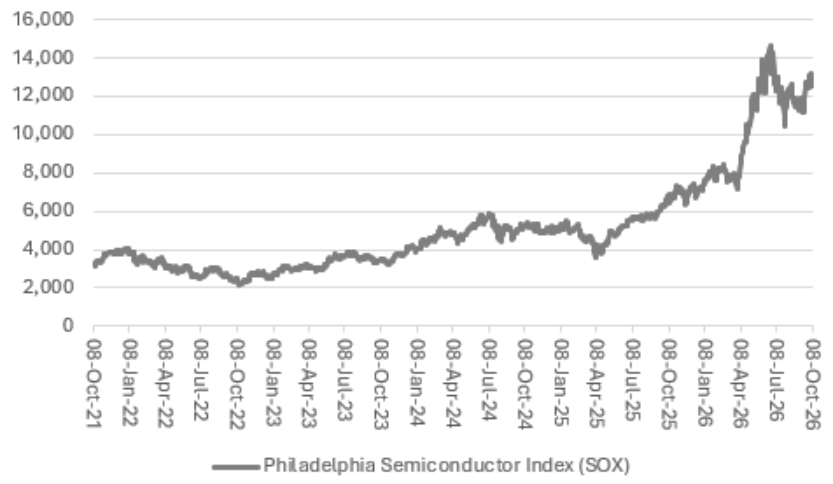
Source: AJ Bell, LSEG Refinitiv
As silicon chip and semiconductor production equipment firms are among the key beneficiaries of the spending boom, any slowdown at Nvidia, Micron, AMD or Broadcom, for example, could be a sign that AI spending is about to cool or fall.
This means the Philadelphia Semiconductor index (known as the SOX) could be a useful gauge of sentiment in this space and has acted as one before.
“The SOX was very quick to respond to the launch of ChatGPT in November 2022 and stumbled when the release of DeepSeek R1 initially challenged the narrative of more spending, more compute, and more power with its cheaper, open-source model in early 2025,” Mould noted.
“The emergence of that rival only served to fuel further spending by the American hyperscalers, to the benefit of the SOX index and its 30 members.”