






A healthy UK stock market is an integral part of a healthy economy, according to Anthony Cross, co-manager of the Liontrust UK Growth fund, but the UK loses too many early-stage businesses to overseas markets.
“We need to make sure they stay in the UK – not just for the obvious reasons of employment and the knock-on impact on accountants, lawyers and other professional services – but because we want them to grow and be headquartered here,” Cross said.
Instead, successive governments have let the stock market “wither”, with public listing and active money into the domestic market dwindling.
For the market to “prosper”, he noted that money needs to be encouraged back into it.
As the Budget creeps closer, one much-discussed solution backed by Cross – echoing London Stock Exchange chief Julia Hoggett – is tying tax incentives for ISAs and pensions to UK-focused investment.
“If we don’t invest enough in our own economy and the growth of our own businesses, we’re not going to prosper – pensions won’t be that exciting and people won’t have much in their ISAs,” he said.
However, Cross said that the bigger problem is the complexity of the financial system.
“We shoot ourselves in the foot far too much in this country,” he said. “We have got a massively overcomplicated tax regime; we are probably all taxed too much and we have too much regulation.”
Cross argued for deregulation. “We need to get finance moving within the UK, simplify tax, reward work, tackle the welfare bill and shift economic activity out of the public sector into private enterprise – this country can do it, but we need to really focus on achieving it.”
Below, Cross reflects on navigating the UK investment market.
What is your process?
When I joined Liontrust in 1997, I spent the first three months developing the investment process we now use across Liontrust UK Growth, Liontrust UK Micro Cap, Liontrust Smaller Companies and Liontrust Special Situations.
It is based off the idea that intangible assets – intellectual capital or knowledge assets – have become very important for companies to create barriers to competition and pricing power. If a business has this and the parameters for structural growth, we expect it to become a long-term compounding business.
We also like businesses with high contracted recurring income. That can be in areas like fee-based wealth management, sometimes contracting services like contract catering – Compass Group – and it could be software companies selling under subscription, so Sage Group gets a tick there.
Are there any areas you won’t invest in?
There are certain areas where you won’t find us investing – for example, we don’t own housebuilders and we don’t own building contractors. We have little in retailing, or competitive high street retailing, and we don’t own bricks-and-mortar real estate businesses.
We will own service companies – we own Savills, we own Rightmove – but we don’t own office block owners or retail property owners.
Relative to the FTSE All-Share or FTSE 100 weightings, you also won’t find us in retail banks and mining companies.
Why has the fund lagged the sector average over one, three, five and 10 years?
It comes down to style and size.
The past four or five years have been tough for a quality investment style – especially compared to value. It wasn’t that value just went up following Covid while quality sat still; quality came down a lot too.
Another headwind is that, compared with the FTSE All-Share, the fund is overweight mid-caps and that little bit of small-cap – both of which have underperformed the FTSE 100 over the past few years, which has been powered by a narrow number of stocks.
Although we accept the fund has been underperforming, we don’t feel that the rationale for the types of businesses we own should change.
Performance of the fund vs benchmark and sector over 10yrs
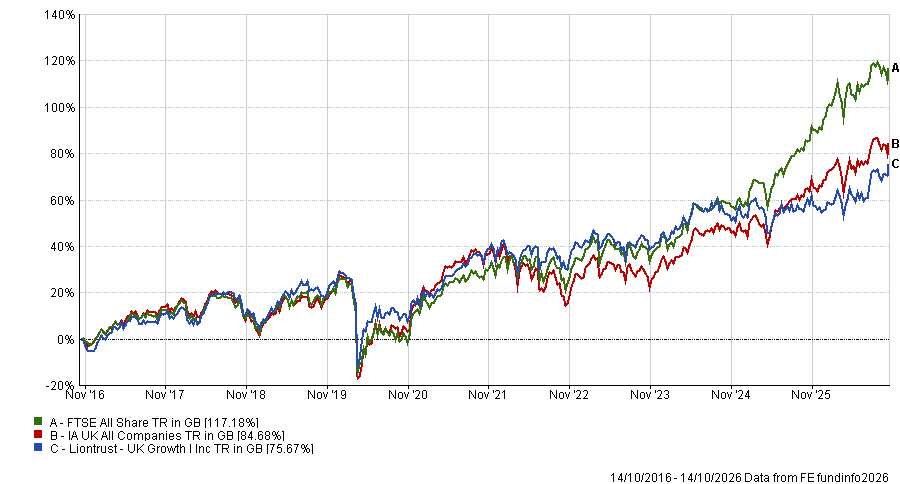
Source: FE Analytics
What have been your best and worst calls?
Unsurprisingly, two of our biggest contributors over the 12 months to the end of August 2026 are Shell and BP, which have clearly benefited from shifts in the oil price given everything going on in the Middle East – but this is not an unexpected or particularly interesting story.
But Moonpig is an interesting one. We have owned it since 2021, buying at around £3.30 – and the lowest level we bought stock at was around £1.07 in December 2022, so it had a big de-rating after Covid.
We were averaging down on it quite happily because we could see the characteristics of the business we like. It sells cards, but it’s basically a technology business with a huge database, scale advantages and plenty of opportunity to grow.
It’s done well for us – the total return from Moonpig over the past 12 months has been 50%.
Then RELX has struggled. We don’t necessarily think it’s a bad call, as we still own it. It has been much caught up in the perception that AI is going to disrupt, compete against or eat into its business.
It has leading products in legal services, legal publishing, scientific publishing and risk analysis, so we think it’s got very defendable moats – its ownership of intellectual property and data sets is powerful and very difficult for AI to replicate. If you’re a lawyer, you need RELX; you’re not going to get that from an AI bot.
It was down 20% over the 12 months. It has had quite a nice bounce in the past few months but February was brutal for these sorts of companies.
What do you get up to outside of fund management?
I travel up and down to London a lot but I’m a countryside person at heart – I enjoy fishing, have an interest in farming, dogs, horses, that sort of thing.