


Usually issues come from out of the blue. No one could see them coming. But when it comes to AI, the problems are staring investors in the face. The problem is, no one seems to want to acknowledge they are there.
Instead they are looking at one thing: markets going up and up.
Just look at the circular financing problem in the US. This isn’t new. In fact, it’s been a known issue for over a year. Nvidia invested $30bn in OpenAI, essentially giving it the money to build datacentres. In return, OpenAI will stuff them full of equipment from Nvidia. Essentially, Nvidia is making chips and financing its own buyers, creating its own demand.
When one ultimately fails, the whole ecosystem could collapse as all are closely intertwined. And it is not just these two. It is hard to find an AI stock that isn’t financially linked to another.
Nvidia has also committed up to $10bn to Anthropic, the company behind Claude. Microsoft is offering up to $5bn. In return, Anthropic has agreed to buy $30bn of computing capacity from Microsoft’s Azure cloud and has agreed to use Nvidia’s latest chips.
But it is not even just an equity story, the problems have bled into the world of bonds too, as these companies have had to take out debt to finance their extreme capital spending.
Companies that once had huge cash piles are now coming to the market asking for loans. In fact, Marcus Weyerer of Franklin Templeton told Trustnet this week that, of the hyperscalers, it is only Microsoft that is still making positive free cashflow.
In any other industry this would be viewed as a disaster: turning a profitable, cash generating, debt free business into a leveraged one in the hope of one day being able to justify spending. So why not when it comes to AI? Possibly because people have one eye (if not both) on the future potential returns.
Investors already have a blueprint for a collapse. In Korea, Samsung and SK Hynix make up around 48% of the KOSPI index, which is down 30% from its June high despite both companies announcing record profits over the summer.
Performance of index YTD
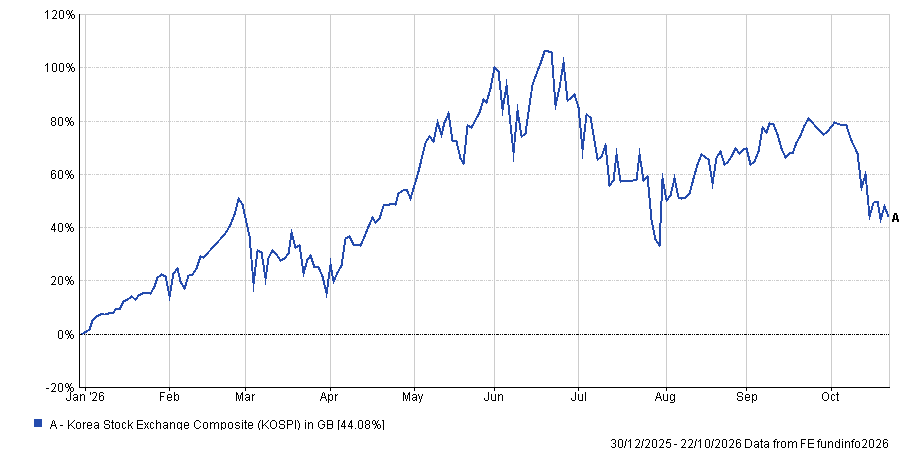
Source: FE Analytics. Returns in sterling.
Yet why would investors look over there when other parts of the AI chain are performing so well? Surely this is just an isolated incident? Maybe. But is it worth the gamble if you’re wrong?
Surely one can hope that with all of this going on investors are displaying some level of caution. Nope. Just look at the IPO market. SpaceX became the world’s largest ever stock market launch despite making huge losses when it raised $75bn earlier this year, giving it a $2trn valuation.
Yet much of its market capitalisation is predicated on the firm making money from building datacentres in space. No one, not even chief executive Elon Musk, truly knows how far away we really are from this being credible.
Even if it can, there is already a race to build datacentres right here on the earth and humans have a tendency to get overexcited about these things and build too many in the first place. Will space data stations even be required? Or does it just sound cool?
Anthropic is the next big test. It told investors this month it has been profitable for a whole six months, which apparently is good enough nowadays. If it gets its asking price it would leapfrog the Musk-led stock to become the most valuable company at IPO in history.
Potentially two record IPOs in one year, both from the same sector and at a time when nothing else outside of AI matters. If that’s not a sign we’re at the peak then I don’t know what is.
Look, I am not stating that this is the end of the AI ride. There are so many reasons to believe that the nascent technology will be the gamechanger everyone expects it to be and the naysayers will be laughed at.
But if things go wrong, this time around investors won’t be able to say they couldn’t see it coming. The signs are there. Issues exist. We just need to stop looking the other way for fear that doing so will make us look stupid.
Jonathan Jones is editor of Trustnet. The views expressed above should not be taken as investment advice.