


Investors will accept their funds making a loss if the market is also down but they are less willing to miss out on the upside, according to Lisa Wang, head of EMEA investment strategy at Franklin Templeton.
It has been several years since a sustained bear market. While Covid and the interest rate hiking cycle of 2022 both produced difficult times, they were relatively short-lived.
To find the last time investors suffered a prolonged bear market, it could be argued one has to go back to the global financial crisis of 2008. Back then, investors were much more focused on drawdowns, having suffered one of the worst crashes in living memory.
Wang said: “There was so much focus on ‘how do I protect my portfolios more’. How do we protect and make sure that we don't have more than ‘X’ percentage of drawdowns?”
At this time, custom mandates were built, incorporating things like put options (financial contracts that give a buyer the right to sell an asset at a predetermined price before a specified expiration date) into portfolios.
These were expensive, with Wang noting that clients asked for them even though they were “paying 7% a year on them” because sentiment was so pessimistic. “That doesn’t always make a lot of rational sense, but people were so focused on drawdowns,” she said.
But this level of worry about protecting on the downside has not been the case since. Covid was the next significant market event following the global financial crisis and was a sharp but short drawdown. From 20 February 2020 to 23 March 2020, the S&P 500 dropped 25.5% in sterling terms.
While clients praised managers who avoided the downside, attention quickly turned to making sure they did not miss out on the recovery, which ended up being arguably the bigger risk for investors.
Performance of S&P 500 in H1 2020
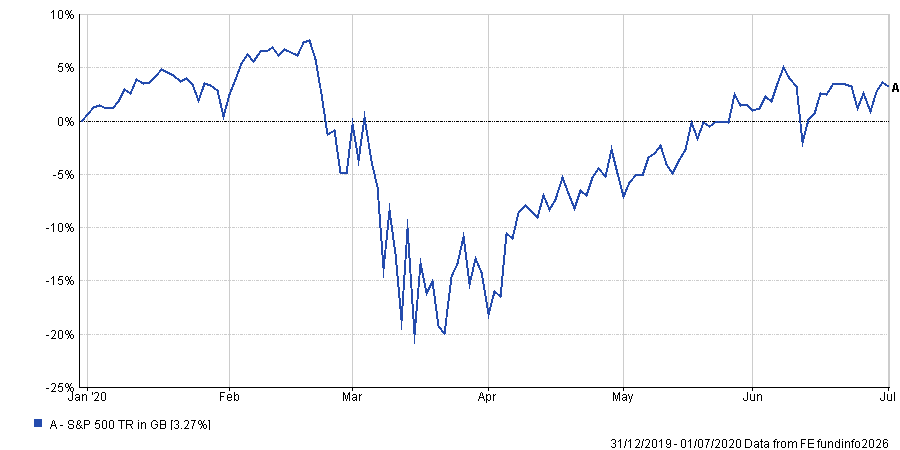
Source: FE Analytics. Returns in sterling.
“Covid was a sharp drawdown but it was a very, very quick V-shaped recovery. If you weren't in those first few days of that V-shaped recovery, which was something like 50% of your recovery period, you were just way behind,” Wang said.
The S&P 500 rose 11.3% in three days from 23-26 March 2020. To the start of July, those who invested on 23 March were up 28.9%, while missing the first few days and investing on 26 March netted a gain of just 15.8%.
The S&P 500 then dropped from this brief peak until its new floor was hit on 1 April. From 1-6 April, the index was up a further 9%. Missing these first few days of the recovery had a similar effect: returns from 1 April 2020 to the start of July stood at 26.2%, while those who put cash in following the initial upswing on 6 April were up 15.5%.
Because of this, Wang said clients were more concerned about their investment managers getting back into the market quickly than they were about how well they predicted (and protected from) the initial fall.
“If you didn't get back in quickly enough, that felt more painful [to investors]. I think the mentality is that if the benchmark and everybody else is suffering, we're all suffering,” she said.
As a result, sitting on the sidelines when everybody else is making money is “more painful” than making a loss to some investors.
Wang described two competing fears: “the fear of losing money versus the fear of missing out”. Whichever is stronger, she said, her team keeps checking how its risk allocation compares with the benchmark.
AI has been a big driver of this, she noted, as markets have risen significantly on the back of a handful of tech winners who now dominate global benchmarks.
This has increased concentration, which may lead some to question whether valuations have become stretched. Yet it is tough for investors to avoid them when these stocks continue to perform so strongly.
Wang said that if the team feels markets are frothy and wants to take down risk, it looks at how much of the portfolio’s active risk to remove. In other words, how willing it is to be different from the benchmark.
“That helps us to be a little bit more measured,” she said, adding that it also stops the portfolio straying too far from the benchmark in either direction.