


Climate change is not just an environmental issue but a retirement one, with the path the world takes to address global warming set to have a direct and material impact on the size of pension pots by 2050.
This is according to recent research conducted by Standard Life and Robeco, which explored what retirement could look like in 2050 under three different climate scenarios.
The research, which combines climate modelling with retirement planning insights, maps out three possible futures for the same saver: a 42-year-old in 2026 earning £40,000, with £40,000 already saved and contributing 10% of their salary until retiring in 2050. The variables that change between scenarios are economic growth, investment returns and inflation – all of which are shaped by the degree of global warming.
In the most optimistic scenario – where global warming is kept below 2°C – strong public institutions, investment in healthcare and infrastructure as well as declining inequality create conditions for a comfortable later life.
In the middle scenario, current trends continue but adaptation is slow and systems come under increasing strain.
In the worst case – warming above 3°C – fragmented institutions, intensifying climate hazards and widening inequality make retirement significantly harder.
The financial impact of worse climate conditions is stark. An illustrative pension pot reaches £276,0000 in the most resilient scenario but just £215,000 in the most exposed – a difference of £61,000.
The impact of different climate scenarios on pension pots
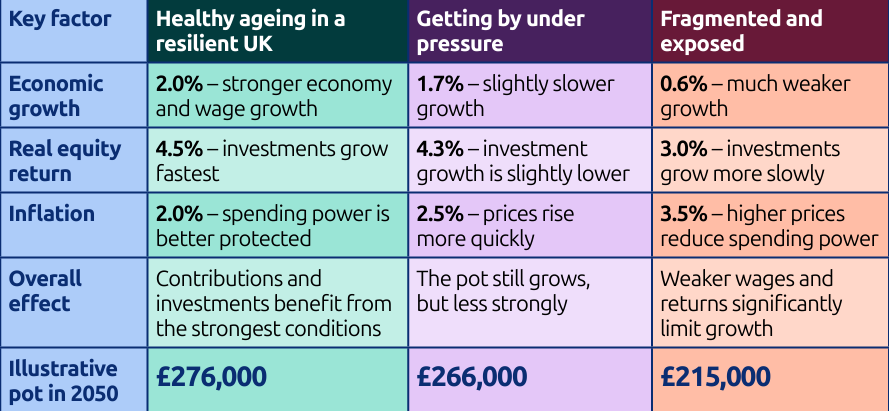
Source: Standard Life, Robeco. The figures are shown in today’s money, after allowing for inflation, so they indicate what each pot could buy rather than simply the cash amount displayed in 2050.
Yet translating the long-term nature of climate risk into day-to-day investment and retirement planning decisions remains a divisive challenge – with financial planners and pension providers approaching the issue from very different vantage points.
Chris Gray, independent financial adviser at Forrester Boyd Wealth Management, said he always asks clients if they want to include any ESG-related screening – “and 19 out of 20 don’t”.
“If clients ask and probe in this area then I am open, but I don’t push it because I’ve seen it done before and when returns are poor (like they have been between 2022-2026), it’s us that must bear the brunt,” Gray said.
He noted that he has invested a third of his own portfolio ethically, “but I’m in the fortunate position where every penny doesn’t count”.
Gray accepted that much of the more recent outperformance of unscreened portfolios is likely boosted by the strong performance of AI, which is heavily featured in popular tracker funds, however this doesn’t change how he views retirement planning for his clients.
“Most people accept that climate change happens, but we live in a selfish world where many of us aren’t prepared to change our own habits for the wider good,” he said.
For pension providers managing money for thousands of members decades away from retirement, the long-term nature of climate risk makes it less of an abstract concept and more a financial reality.
Maeve O’Connor, responsible investment manager at Nest, said the pension provider integrates climate considerations throughout its investment process “because we view climate change as a financially material, system-level risk that can affect economic growth, financial markets and investment returns across our entire portfolio”.
It informs decisions across asset allocation, fund manager selection and oversight, stewardship and policy advocacy, she said.
“We are also exploring climate scenario analysis that incorporates potential tipping points to better understand how resilient our portfolio may be under a range of climate pathways,” O’Connor added.
Shipra Gupta, investments stewardship lead at Scottish Widows, also said climate change is a financially material long-term risk accounted for within the pension provider’s broader investment process.
“We assess physical and transition risks through climate metrics and scenario analysis, incorporate relevant considerations into manager selection and oversight and use stewardship to challenge companies on their approach to climate risk,” she said.
“We have also increased climate integration across listed equities, corporate bonds and private markets.”
Climate and other sustainability factors are not considered in isolation. Gupta said decisions must continue to reflect expected risk-adjusted returns, diversification, liquidity, costs and members’ investment horizons.
There is often debate about whether prioritising ESG-related themes and screening will limit possible returns – for pension providers, who are tasked with maximising returns for their end beneficiaries, this can be seen as a potential breach of their fiduciary duty. But many pension providers don’t agree.
O’Connor said: “We do not see a conflict between fiduciary duty and addressing climate risk – our responsibility is to act in members’ best financial interests, which means considering risks that could affect long-term returns, even where markets may not fully price them today.”
Reflecting on the £61,000 figure cited in the Standard Life and Robeco research, Gupta said this reinforces the importance of pension providers building default funds that are resilient across a range of plausible futures.
Scottish Widows Lifetime Investment – the provider’s workplace default proposition – incorporates climate and other financially material sustainability factors across its bespoke listed-equity and corporate bond strategies, she said.
“For members in Lifetime Investment Plus and Lifetime Investment Extra, the strategy also includes allocations to private markets [11% and 23% respectively), broadening diversification and providing access to longer-term opportunities across areas including private equity, infrastructure and private credit,” Gupta added.
Despite their differing perspectives on how much weight to give climate risk in retirement planning conversations, all three agreed on one thing: diversification remains the most reliable tool for protecting retirement savings against any long-term uncertainty – climate-related or otherwise.
“A blend of active and passive investments, mixture of sectors and regions will help – we can diversify away climate risk in the way we diversify away most other risks,” Gray said.