


Insurance is not a particularly good industry to invest in overall, according to Nick Martin, manager of the Polar Capital Global Insurance fund, but done well it can create excellent returns.
In many cases, insurance companies are barely able to make back their cost of capital, Martin said, as pricing is difficult to get right. Become too optimistic and offer low prices, then claims can soon wipe out profits. But pessimists will struggle to attract customers.
“It’s an industry where there are a lot of banana skins,” said Martin. However, it can also be incredibly lucrative. Just ask Warren Buffett, who built his Berkshire Hathaway empire on the back of the industry.
Founded as a textile manufacturer, insurance was the key building block of the modern Berkshire Hathaway, one of the world’s most famous investment houses. Buffett shifted toward insurance when National Indemnity became available in 1967. It gave him a float of cash which he was able to invest.
“When it is done well, companies can generate some excellent returns over multiple periods. You only have to look at what Berkshire Hathaway and what Warren Buffett did in the early years, particularly. Arguably Berkshire was built off the bedrock of insurance. That was really the secret sauce in many of those earlier decades,” he said.
But the industry is not full of identical businesses, which allows active managers to make a real difference. At least that is the thesis behind Polar Capital Global Insurance.
As Martin said: “The competition for a well-run insurer is mediocre at best and that gives [our holdings] a chance to outperform.”
The fund has a good track record of this. It has been the second-best fund in the IA Financials and Financial Innovation sector over one and five years. It is also second since Martin started on the fund in 2001, returning 1,116% over this time – almost three times the MSCI World/Insurance benchmark and 400 percentage points ahead of broader global stocks.
Performance of fund vs sector and benchmark and MSCI World since manager start
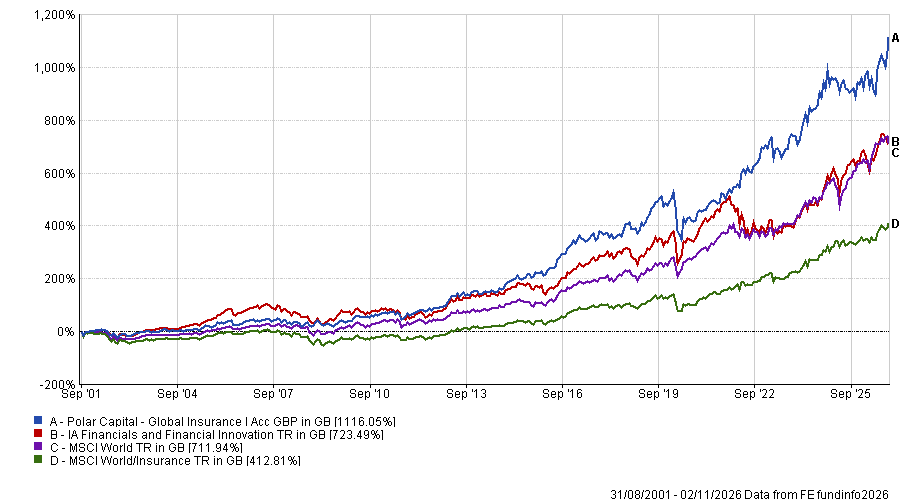
Source: FE Analytics
Polar Capital Global Insurance could also be viewed as a differentiator. It has a 0 correlation to the Bloomberg Global Aggregate bond index, while its correlation to equities stands at 0.49.
Part of this is what the fund invests in. Martin has very little in life insurers, which tend to be one of the more popular options for generalist funds aiming to increase their financials exposure.
Non-life insurance, such as building and commercial insurance, works particularly well in a rising bond yield environment – as has been seen recently. Typically, these companies are cash rich from new policies and invest this in short-dated bonds with a maturity of around two-to-three years. This gives liquidity for claims but also provides a return.
“Rule of thumb for our portfolio is that a 1% change in investment yield is worth 2% a year on return on equity, or on book value growth,” said Martin.
“So at a time like now, with rising bond yields, that’s a very nice tailwind to earnings going forward. There’s a slight mark-to-market hit to investment portfolios as those bond yields rise, but it’s very much short-term pain and long-term gain.”
It would be fair to assume the opposite was also true – that falling yields would be an issue for these companies. However, this is not the case as non-life insurers reprice annually.
This allows these insurers to change the underwriting prices based on the investment and financial market environment they find themselves in.
An example of this would be home or car insurance, which tend to be renewed annually. However, Martin noted that he tends to invest more in commercial insurers than personal insurers as these tend to be “highly commoditised”, with the provider offering the lowest price tending to win.
“In the UK, it’s the poster child for competition with price comparison sites. You don’t get that to the same extent in many other markets. So, to some extent, it’s a little bit of a race to the bottom, because you can have one or two aggressive companies in the market at any one time [who could take] up a lot of business. They’re likely to have issues down the line, but that leads to a very highly competitive market,” he said.
Where he does have exposure to these areas, he has focused on companies that have a niche, such as a business that specialise in classic and performance car insurance.
Meanwhile, Chubb and Hiscox offer high-net-worth homeowners insurance, which is “very different from the home insurance that most of us buy” as these people can be insuring multiple homes at once with “some nice paintings on the wall and nice bottles of wine in the wine cellar”. This means they need a bespoke service and are prepared to pay a little bit extra for a better service, said Martin.
Meanwhile, on the commercial side he likes large commercial properties such as planes and oil rigs, as these are often underwritten by multiple insurers, not just one firm.
This means there is a lower likelihood of “one or two rogue underwriters” hoovering up contracts but unable to pay out if too many claims occur, which can be happen in personal insurance.
“Therefore you get a bit more stability there. So it tends to be more profitable in the commercial world than in personal and the more specialist you get in terms of your risk, the more chance you’ve got to do well,” said Martin.
Right now, the industry could be called upon more than ever, with “spiralling risks in the world all the time”. Whether it be the return of war in the Middle East and Europe, or a changing climate causing more radical weather events such as El Niño, the industry is crucial to keeping the world ticking.
“The job of the insurance companies is to help take away that [risk]. Everyone hates volatility. If you could pass that off to somebody else, that’s seen as a very big thing and who you’re passing it off to is often an insurance company,” he said.
“I think often it gets forgotten that insurance underpins everything that happens in the global economy. It’s the oil that greases the wheels of world trade. Your ships don’t sail, your planes don’t fly or, to be more topical, your datacentre doesn’t get built without insurance.”
As a result, while the industry is seen as steady, typically growing in line with GDP plus a little bit, currently he sees insurance companies able to grow twice as fast as the global economy.
Perhaps the biggest concern in this environment, however, is insurance companies becoming greedy and taking on too many contracts that are claimed at once.
Martin noted: “It’s the old thing with Buffett: you’ve got to be greedy when others are fearful, and vice versa. And insurance is an industry that lends itself to more emotion. That greed and that fear can lead to both opportunity and peril, depending on where you are.
“This is a get-rich-slow, compounding-returns-over-time, don’t-make-mistakes kind of industry.”