


With households continuing to move into higher income brackets, multinational companies deepening their presence and domestic financial conditions improving at pace, India’s domestic growth story seemingly remains lost on foreign investors.
They’ve spent much of the past two years reducing exposure to the country, with India’s weight in the MSCI Emerging Markets Index falling from 20% in August 2024 to 11% by August this year.
We believe that the disconnect is clear. And it’s creating an increasingly interesting opportunity for long-term investors focused on domestic stocks.
If fundamentals continue improving while positioning remains subdued, there’s meaningful scope for stronger earnings delivery and a substantial rerating over time.
There are three areas where India’s strengthening fundamentals are particularly clear.
Rising incomes, low penetration
India’s consumer opportunity has always been linked to its enormous population. But the nuance sits in what happens when portions of that population move up the income ladder.
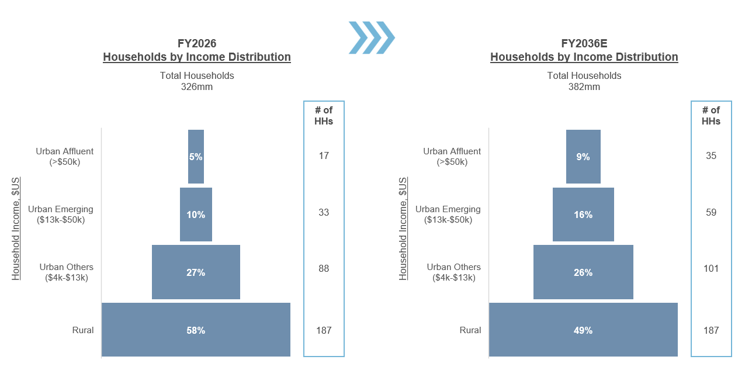
The number of urban households earning between $4,000 and $50,000 a year is projected to rise from 121 million as of March 2026 to 160 million by 2036. Those urban households earning more than $50,000 are expected to double, from 17 million to 35 million.
Source: Chikara
That creates two powerful, concurrent dynamics: millions more households can spend on products and services previously out of their reach; and many of those categories still have very low penetration, leaving plenty of room for structural growth as incomes rise.
We’re already seeing this play out. Nykaa has built a beauty and personal-care platform serving tens of millions of women, despite penetration across the country remaining low. Eternal, meanwhile, has helped create a quick-commerce market capable of delivering tens of thousands of products within minutes. This is where the scale of India’s opportunity really starts to show.
Quality companies can continue growing for years simply by increasing penetration as household incomes rise. And that can be especially powerful in underpenetrated categories, where leading companies have the potential to grow well ahead of the wider economy as those markets mature.
Deepening global business role
AI is another area where foreign investor concerns may be obscuring what’s happening on the ground.
Foreign investors appear to be worried that automation could undermine India’s traditional IT-services model. But what we’re seeing is a broader shift towards higher-value activity.
Global capability centres (GCCs), offshore hubs set up by multinational companies to handle functions such as technology, finance, analytics and R&D, added around 200,000 net employees in the financial year to 2026, compared with 110,000 net additions for traditional IT services. India now has more than 2,100 active GCCs, generating around $98bn in export revenue.
Services exports also rose 13.4% year-on-year to $38bn in July, while companies including Amazon, Microsoft, Google and Eli Lilly have announced substantial commitments to India.
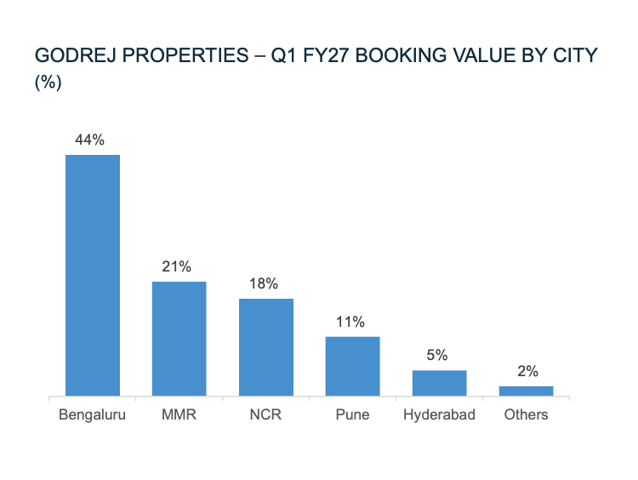
The impact reaches beyond the technology sector itself. In Bengaluru, where 37% of India’s GCC workforce is based, the growth of high-skilled, well-paid employment is supporting demand for housing and other services. Godrej Properties, for example, reported 25% year-on-year growth in Bengaluru booking values in the first quarter of this financial year.
Source: Chikara
The more interesting question is what new industries, jobs and domestic demand AI and global investment are helping to create alongside the traditional IT sector.
For individual companies exposed to those trends, that can translate into a much broader and longer-lasting growth opportunity.
A more resilient financial backdrop
India’s domestic growth story is also being supported by a stronger financial position than headline concerns around oil might suggest.
Higher oil prices do increase pressure on the current account. But much of the recent strain on India has instead come from the capital account, including foreign equity selling and multinational companies reducing stakes in listed businesses.
That distinction is key because capital flows can change relatively quickly.
The Reserve Bank of India’s latest foreign-currency deposit programme has already helped bring significant capital back into the system, while the economy’s sensitivity to oil has also declined materially over the past two decades.
At the same time, Indian household wealth has risen sharply. Total household assets increased from around $11.3trn in March 2023 to $16trn by March 2026, with gold accounting for almost a quarter of that wealth.
Importantly, that wealth is becoming more usable. Organised gold-backed lending has expanded rapidly, allowing households to turn part of a traditionally idle asset into collateral that can support borrowing, spending and investment.
That gives households greater access to credit and strengthens the domestic financial system in the process.
A widening opportunity
The picture emerging from all three areas is of a domestic economy running ahead of investor sentiment.
With foreign positioning already much lighter than it was two years ago, any improvement in sentiment would come from a relatively low starting point.
If earnings and domestic growth continue to hold up, that leaves room for a far more constructive reassessment of Indian equities. If that gap begins to close, the upside could be meaningful.
Andy Draycott is portfolio manager of the Chikara Indian Subcontinent fund. The views expressed above should not be taken as investment advice.