


Quality investing has made a storming comeback in the past month, but 30 good days do not necessarily mean that the market is giving up on growth.
The quality investment style was popularised in the post-financial crisis era, when low interest rates meant bonds paid little and investors were forced into high-quality, cash-compounding dividend stocks as bond proxies.
These stocks defined the quality style for more than a decade, with managers able to make huge returns. FE fundinfo Alpha Managers such as Terry Smith and Nick Train became synonymous with the investment theme and were popular among investors, enjoying years of inflows.
Things have turned in the post-Covid era. David Hood, head of central investment solutions at RBC Brewin Dolphin, noted the past few years have been difficult for quality managers as interest rates have risen, impacting high-quality, dividend-paying stocks.
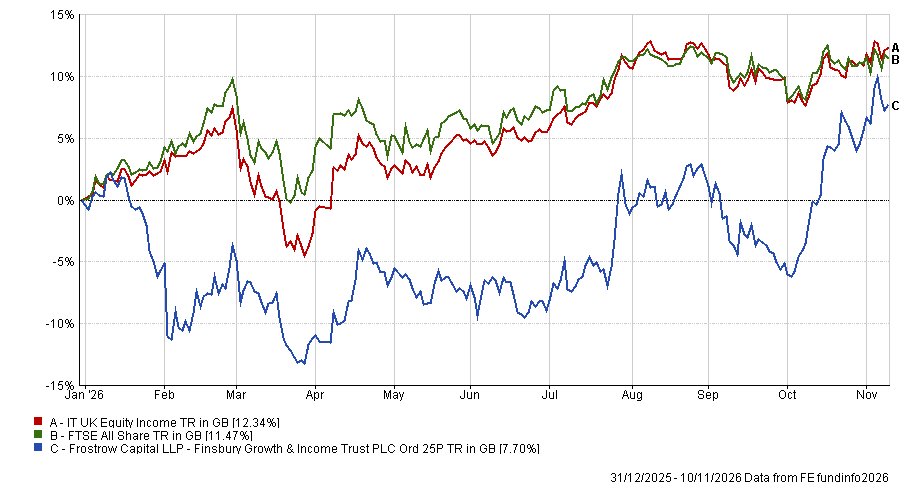
That was until last month. In October, Train’s funds shot to the top of the charts. His Finsbury Growth & Income trust, for example, made a net asset value (NAV) total return of 12.6%, while the share price total return was a touch lower at 11.8%. This compares with its FTSE All Share benchmark’s 1.1% total return.
Performance of trust vs sector and benchmark YTD
Source: FE Analytics
“October turned out to be a strong month for absolute and relative performance. In fact, looking back at the monthly returns of the company, we calculate that the NAV return of 12.6% is the highest since 2009. In terms of relative performance, it is the best month that the company has had since Lindsell Train was appointed investment manager in December 2000,” wrote Train in the trust’s November monthly factsheet.
Hood noted that the rotation away from the AI theme currently underway “could easily prompt a further relative surge in performance”, as could a fall in yields if economic growth concerns come to the fore.
“The risks to the investment style are the familiar ones around energy supply shocks and stubborn inflation,” he said.
The question for investors is whether the latest trend is a short-lived phenomenon or one that will continue into the future.
Below, Trustnet asks experts whether the short-term growth recovery can become more sustained and if there is merit in adding a quality-growth-style fund to a portfolio right now.
Is quality staging a long-term comeback?
Chris Fernyhough, director at Freyr Investment Management, said “one month doesn’t make a trend”, noting there were two main factors behind the resurgence of quality last month.
The first was the sharp tech sell-off, with fears of a rate rise by the Federal Reserve and concerns over AI funding hitting the sector hard.
“Second, the ‘AI losers’ were re-rated. Some data-rich compounders that had been sold as disruption victims bounced hard,” he said, and the market started to view proprietary data as an advantage rather than a liability.
“After a multi-year de-rating, valuations leave room for this to run. Three things could derail it: renewed AI enthusiasm pulling money back into tech, higher yields hurting long-duration stocks or the disruption narrative coming back,” he concluded.
For Jack Roberts, investment analyst at IBOSS, the switch out of growth names is more than just an October story, having started over the summer. Since then, investors have revisited areas of the market that were overlooked during the strong performance of AI-related shares.
“Healthcare and software & services, two sectors often associated with quality-growth investing, had significantly lagged broader markets over the previous three years. As valuations became more compelling, investors across a broader range of investment styles began reassessing these businesses, creating opportunities for active managers to selectively add exposure,” he said.
However, he warned that a resurgence in enthusiasm for AI-related stocks or renewed concerns that AI could disrupt existing business models could once again weigh on these sectors, which would bring the quality resurgence to a halt.
Should investors buy quality funds?
Roberts noted that just because the style has had a good month, it does not necessarily mean investors will want to plough into the style.
“The recent recovery in some quality growth stocks does not automatically mean it is time to back traditional quality managers. Quality stocks and quality managers are not the same thing,” he said.
“As valuations have fallen, some businesses in sectors such as healthcare and software have become attractive to value, blend and quality investors alike. Different managers will apply different definitions and approaches when it has come to defining what quality means. As a result, investors may be better served by managers who have demonstrated an ability to adapt and seize opportunities across different market environments,” he noted.
Fernyhough highlighted Train’s fund as an option, suggesting that now could “potentially” be the time to start adding to quality funds “in stages” – a move he described as “reasonable”.
“October was a great month for the fund. However, this is a concentrated portfolio, and the case depends on AI adoption turning into real revenue growth, not on sentiment alone,” he noted.
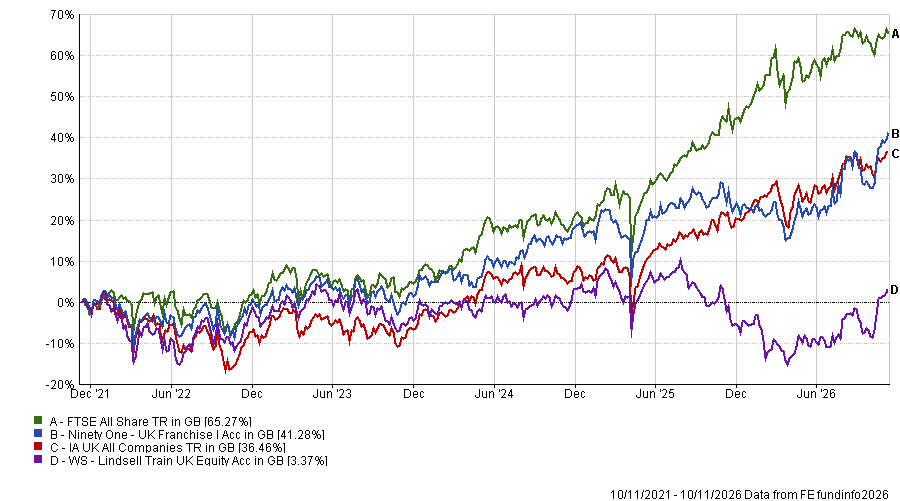
Hood looked elsewhere. In the firm’s models, the global manager research team prefers Ninety One UK Franchise strategy for UK quality exposure.
The fund has bested the Lindsell Train UK Equity fund over one, three, five and 10 years, although it is behind in the very short term.
Performance of funds over 5yrs
Source: FE Analytics