


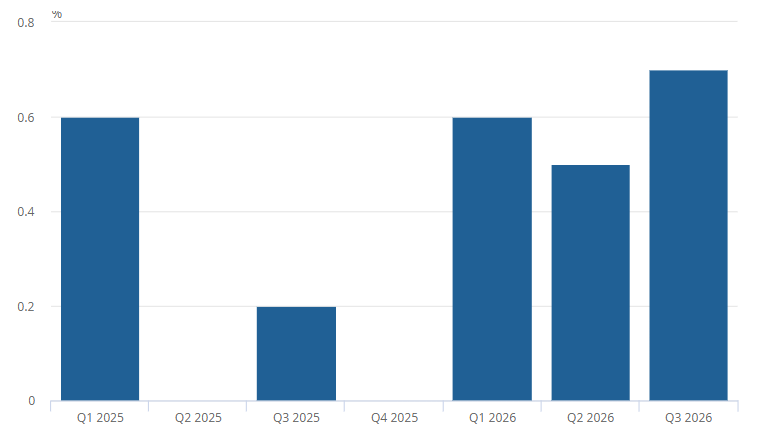
UK gross domestic product (GDP) grew by 0.7% in the third quarter of 2026, up from 0.5% in the second quarter, with the information and communication sector contributing the most to the increase.
The Office for National Statistics (ONS) said output in the information and communication sector rose by 2.1% in the third quarter, driven mainly by a 4.4% increase in computer programming, consultancy and related activities.
“This industry has been the largest driver of GDP growth across 2026, with evidence that many of the businesses reporting the largest increases in turnover are involved in activities related to artificial intelligence and cloud computing,” the ONS added.
“However, because of the nature of our data collection, it is difficult for us to quantify the exact impact of these types of activities on turnover.”
Real GDP Q1 2025 to Q3 2026
Source: ONS
Beyond the tech-led gains, the wider economy also expanded. Output in the services sector as a whole grew by 0.9% in the quarter, the production sector grew by 0.1% and construction output fell by 0.7%.
Within production, manufacturing was the only positive contributor, rising by 0.9%, with the largest gain coming from computer, electronic and optical products, which were up 4.6%.
On the expenditure side, household consumption grew by 0.6% and gross fixed capital formation rose by 1.7% in the quarter. GDP was 1.9% higher than in the same quarter a year earlier, while real GDP per head rose by 0.7% in the quarter and by 1.7% over the same period.
George Brown, senior economist at Schroders, said: "Britain's economy is proving surprisingly difficult to knock off course.
"Growth has remained resilient despite higher energy prices, with business investment doing the heavy lifting amid the AI build-out. The labour market recovery also appears to be gathering pace and could increasingly bring households into the recovery too."
Sarah Coles, head of personal finance at AJ Bell, added that it has been “the less visible back-office work that has delivered” in 2026, with administrative and supportive services seeing strong growth. These areas expanded strongly, according to the ONS, up by 4.1% in the third quarter.
"These areas are benefitting from the increasing adoption of AI,” she explained. "The wider investment world is clearly shaken by concerns that the AI revolution may not produce sustainable profitability in a way that justifies the enormous investment spend. However, on the ground, gradual adoption appears to be continuing to deliver improvements."
Not all commentators expect the pace of growth to continue, however.
Felix Feather, economist at Aberdeen, said: "UK growth remained remarkably resilient in the third quarter, with GDP expanding by 0.7%. September's 0.2% rise also shows the economy entered the autumn with a little more momentum than expected. But we doubt this pace will last.
"Higher energy bills will increasingly squeeze households' real incomes over the winter, while tighter monetary policy will also weigh on activity. We therefore expect growth to slow meaningfully into 2027."
Monthly GDP figures published alongside the quarterly estimate showed growth of 0.2% in September, following no growth in August, a downward revision from the 0.1% growth previously reported. July's growth of 0.4% was unrevised.