


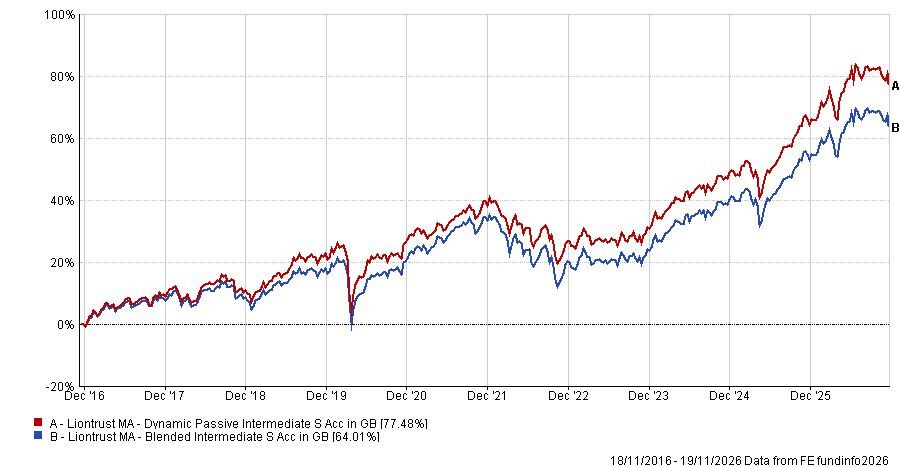
Active managers are behind but they are not defeated, according to John Husselbee, manager of the Liontrust multi-manager range, who said that the difference in performance between his passive-only range and his blended funds is to be expected.
He is head of multi-asset at Liontrust and co-manager on several of the firm’s funds, including the Dynamic Passive range and Blended range (which blends active and passive investments), alongside James Klempster.
Both invest with specific risk tolerances in mind and sit in the IA Volatility Managed sector. As investors go up the risk spectrum, returns improve. However, so does volatility.
“The momentum has all been in those passive vehicles,” he said, noting there is a “very simple” explanation: large-caps have outperformed mid- and small-caps, an area where active management has tended to focus.
“In one way, it’s reassuring. The passive funds [have done] what they’re designed to do,” he said.
Performance of funds over 10yrs
Source: FE Analytics
Despite the overwhelming performance of his passive range, Husselbee is unwilling to throw in the towel when it comes to active management.
Although passives are winning, “that doesn’t mean to say that we’re giving up”, he said, noting that things can change quickly. A football fan, Husselbee likened it to being three-nil down in a game with 10 minutes still to play: “We might be behind, but we don’t feel we’re losing. We’ve [still] got 10 minutes”.
Using the Liontrust MA Blended Intermediate fund as a bellwether for his range, below Husselbee explains when he chooses active over passive, how his Blended funds are currently split and how the debate between the two has changed over the years.
What is your process?
We start with the long-term strategic asset allocation to deliver on the level of volatility. All the funds sit within risk bands. That’s long term, so 15 years looking out.
From that, quarter by quarter, with a 12-to-18 month view, we look to basically do tactical asset allocation. That’s very much driven by valuations, fundamentals and things that feel like they’ve got out of kilter.
When we implement, not only are we diversifying across asset classes, but also countries and regions, and blending investment styles as well. For [Liontrust MA Blended Intermediate], there is a blend between active and passive.
How do you decide when to go active?
We will pay for active where we think it’s worthwhile. First of all, it’s concentration in the market. Secondly, it’s the percentage of stocks that are outperforming the index. And the third element is the dispersion amongst stocks within the index of the returns.
We look at that on a quarter-by-quarter basis, for each of the major equity markets that we cover. Clearly you want low concentration, you want high dispersion, and you want a lot of stocks outperforming the index. That’s the active management opportunity today.
When it comes to manager selection, our view is to very much have a blend of managers. It’s diversification. For many years, markets have been so concentrated but now we firmly believe that diversification is back and you want it at all levels of the portfolio.
Currently, we have 54% of our funds in active managers and 46% in passive.
How has the dynamic between active and passive funds changed?
In the past we used to use passive as a diversifier. Today, we’re using active management as a diversifier. It seems to have totally turned, which I find quite interesting.
We’ve been pointing out the challenges of the concentration in markets and, as such, in the passive vehicles for a very long time. At some point that will come home to roost.
What do you look for in active managers?
Typically we categorise them into growth, value, quality, small-cap, and maybe momentum as well, depending on the market and on the availability.
We are looking for a philosophy, a process and a style that is consistent. We’re looking for credibility in their investment style and then we’re looking to blend those managers together.
We’ll take a view in terms of where a style has underperformed and how we should tilt. But it is a tilt, and it’s not an all-in. We’re not going all-in on growth. We’re not going all in on momentum.
What have been your best and worst holdings this year?
Our best performance has come from outside of the US. So that’s been UK equities, emerging markets and Asia. The other thing that has performed well is high yield. Despite the fact that we’ve seen bond yields rise more recently, we’ve had some good performance out of high yield, which is still showing a very positive return, simply because of the coupon.
We’ve made money overall from our tactical asset allocation and from fund selection. However, where we have been weaker is in US equities. To some extent that is probably a reflection our view of being underweight the US, but also we have had probably more challenges with our US fund managers.
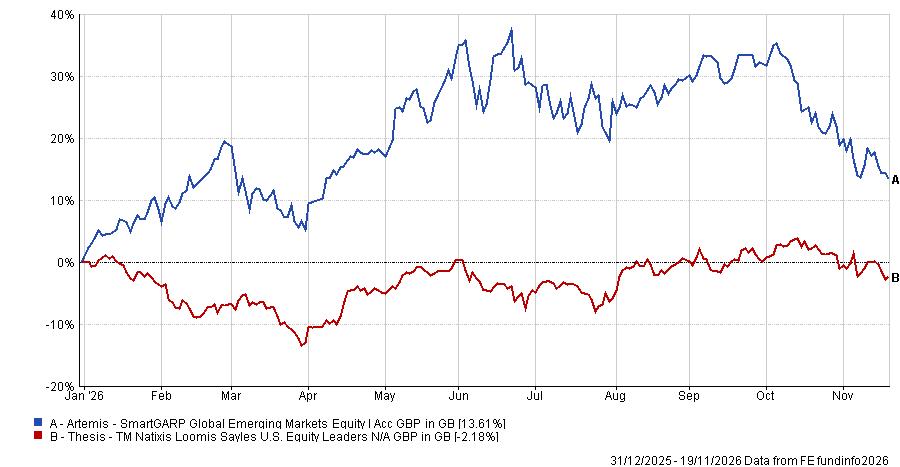
[Husselbee was unable to provide individual fund holding performance. In the fund’s half-year report to the end of June, however, emerging-market funds were highlighted as strong performers. Trustnet research shows Artemis SmartGARP Global Emerging Markets Equity has been the strongest of the fund’s holdings in this area so far in 2026, up 14.4%. On the downside, the report highlighted TM Natixis Loomis Sayles U.S. Equity Leaders as a “detractor”. It is down 2.2% year-to-date.]
Performance of funds YTD
Source: FE Analytics
What do you do outside of fund management?
Despite the fact that my children are both grown up and are married and have families, I still do quite a lot on a one-to-one basis with them. I tend to do a lot of sports with my son and with my daughter we do comedy. With my wife, we eat out and go on holiday.