






A Federal Reserve pivot towards looser policy to calm the current tech-led sell-off might offer only temporary relief to markets, according to Schroders chief economist David Rees.
In recent weeks, the Nasdaq 100 and S&P 500 have both fallen more than 10% below their previous highs, putting them in correction territory. Because global markets are so concentrated around AI, equities in South Korea, Taiwan and Japan have also fallen heavily.
Rees said: “The deepening correction is probably due to a confluence of factors. There is certainly no shortage of candidates. After all, for investors with one eye on locking in performance for the year, tech has clearly had a good run and there is some uncertainty about how much impact the Democrat sweep will have in slowing down the rollout of data centres. The insatiable appetite of hyperscalers to borrow to fund heavy capex has also brought greater scrutiny of likely future returns on investment.
“These factors have some merit in isolation but it is probably the framing of the red-hot macroeconomic backdrop and rising real interest rates that are to blame for the severity of the accelerating market correction.”
US growth and inflation data have kept beating expectations and September's rate rise settled early doubts about the Fed's inflation-fighting credentials under Kevin Warsh, he noted. Speculation that rates could rise by 50 basis points in December has deepened the correction.
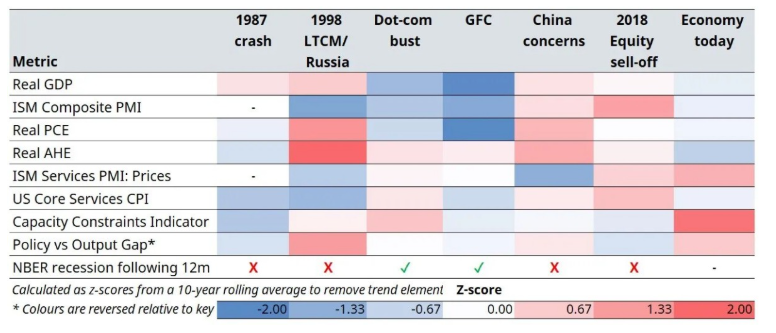
But previous market routs have led the Fed to turn dovish, a pattern known as the ‘Fed put’. Schroders compared growth, inflation and real rates across several episodes and its heat map below suggests the Fed has become more willing to react to market falls despite solid economic activity.
Lessons from past Fed puts
Source: Schroders
According to Rees, a weak economy gave the Fed an easy case for a pivot around the 1987 crash and the bursting of the dot-com bubble. The later dovish turns, over hard-landing fears in China and in 2018/19 when markets fell on worries about rate rises and a tariff war, came with the US economy growing strongly.
He added: “The Fed could, of course, still blink. As our analysis shows, it has bowed to market pressure before, even when the economy itself was not obviously in trouble. And it appears to have become increasingly sensitive to market volatility over time.”
However, Rees argued that a pivot would be a mistake.
Private final sales are up 5% year-on-year and the output gap is around 2% of GDP. The Fed made insurance cuts last year after soft payroll prints, even as the wider labour market stayed relatively healthy.
Schroders warned at the time that the cuts could stoke inflation without lifting real growth and Rees said that concern increasingly looks justified. So-called supercore inflation has accelerated this year, he added, and leading indicators suggest it may not peak until mid-2027 at the earliest.
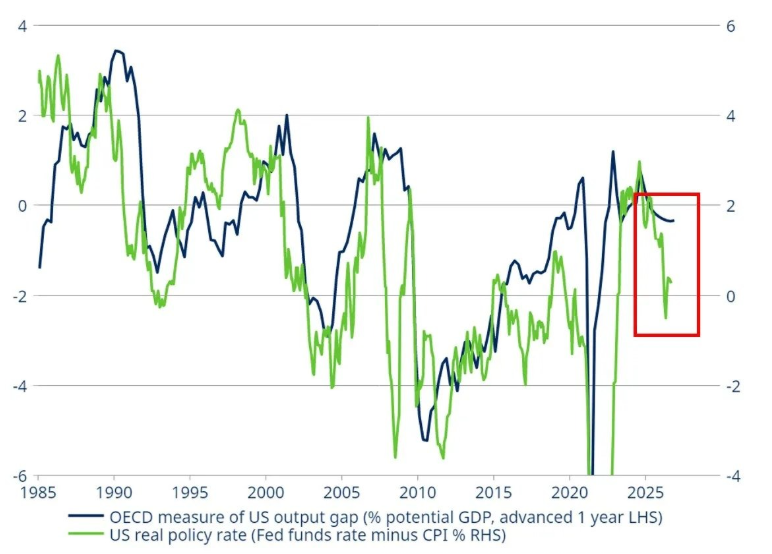
“In other words, the key difference this time around is that the Fed is confronting high and rising domestic inflation at a time when real interest rates appear too low, just as investors are looking for a dovish tilt to provide insurance against falling markets,” the economist said. “That is a very different backdrop from previous episodes when deteriorating markets gave policymakers room to ease.”
Policy needs to become more restrictive for inflation to return sustainably to target, he added, and a pivot made too soon could loosen financial conditions that arguably still need to tighten.
The Fed enters this bout of volatility with real rates that are already too loose
Source: LSEG Datastream, Schroders
Rees also said this sell-off differs from past broad routs because it is concentrated in AI-driven stocks. The equal-weighted S&P 500 has held up much better and is still trading in line with Schroders’ composite of the ISM PMIs. An AI bust would probably do less damage to the wider economy than feared, he said.
Schroders estimates the AI build-out has added around 0.4 percentage points to US growth over the past year. Rees said that may be an upper bound, because the estimate counts all software and power infrastructure investment as AI.
Fed research suggests households spend 1 cent of each extra dollar of equity wealth, against around 5 cents for housing, which implies equity holdings added roughly 0.2 percentage points to growth. Reversing that gain would weigh on growth but not enough to derail the economy, he said.
Even so, a Fed put would not be unambiguously positive, Rees said. A dovish shift could bring near-term relief but also revive doubts about the Fed's inflation-fighting credibility.
For equities, he expects a positive first reaction. The S&P 500 rose an average 5% in the three months after previous Fed puts and lower rate expectations would support valuations, with the long-duration growth stocks hit hardest in the sell-off likely to benefit most.
“A successful Fed put could eventually broaden the rally to cheaper, more cyclical stocks. But we suspect any rebound would prove short-lived if the pivot merely replaced fears over tighter policy with concerns about more persistent inflation,” he added.
The picture for US treasuries is less clear-cut, Rees said. A Fed pause should push short-dated yields lower as investors price out tightening, starting with a broad rally in duration.
“But beyond that initial reaction, turning dovish despite above-potential growth and persistent inflation could quickly see investors demand higher inflation and term premia further along the curve,” the economist explained.
“With the US debt dynamics also considerably weaker than during previous Fed puts, concerns over fiscal sustainability could amplify the pressure on long-term yields. That could ultimately push long-dated yields higher even as the front-end rallies, resulting in a steeper yield curve.”
The US dollar may not follow the usual pattern either. Lower rate expectations have historically weighed on the greenback, but dollar flows have become more sensitive to the AI trade. When Jensen Huang returned as Nvidia chief executive, a sharp rally in AI stocks lifted the dollar with it, unlike in a typical risk-on episode. A Fed put could revive AI enthusiasm in the same way, he said, supporting the dollar even as rate expectations fell.
“The bottom line is that a Fed put might offer only temporary relief. If growth and inflation data remain firm, in a game of cat and mouse markets could soon begin pricing a more hawkish Fed back in, potentially setting off the same chain of events all over again if investors start to fret about tighter financial conditions,” Rees finished.
“Breaking that cycle may require either a sell-off severe enough to materially weaken the economy, or clearer evidence that growth and inflation pressures are rolling over. Until then, markets could remain unusually choppy.”