






Tariffs dominated headlines and market sentiment in 2025, with Liberation Day alone wiping an estimated $8trn off global markets. Calm eventually returned but the episode left clear winners and losers, with countries adopting a more conciliatory stance rewarded on the tariff front.
It may be a new year but tariffs are firmly back on the agenda, with US president Donald Trump hiking levies over Greenland discussions. It’s a timely reminder of the merits of safeguarding portfolios against the continued weaponisation of global trade.
At first glance, Asia may not look like an obvious refuge. Its reputation as the world’s factory floor is well earned, underpinned by enviable economic growth rates. Yet it’s precisely the region’s domestic and regional growth story that provides the strongest insulation from global trade shocks.
Asia now accounts for more than half of global GDP and is expected to house 60% of Fortune Global 500 companies by 2040, according to McKinsey. It’s also tipped to host two-thirds of the global middle class by 2030, with its wealthy, digitally savvy consumer base driving soaring demand for technology, fintech, healthcare and clean energy.
In turn, that means a narrow US-centric lens risks overstating Asia’s vulnerability. Only four of the top 10 goods exporters to the US (measured as a percentage of GDP) are based in Asia, with Mexico, Canada and Ireland having a larger exposure than Taiwan, South Korea and Japan.
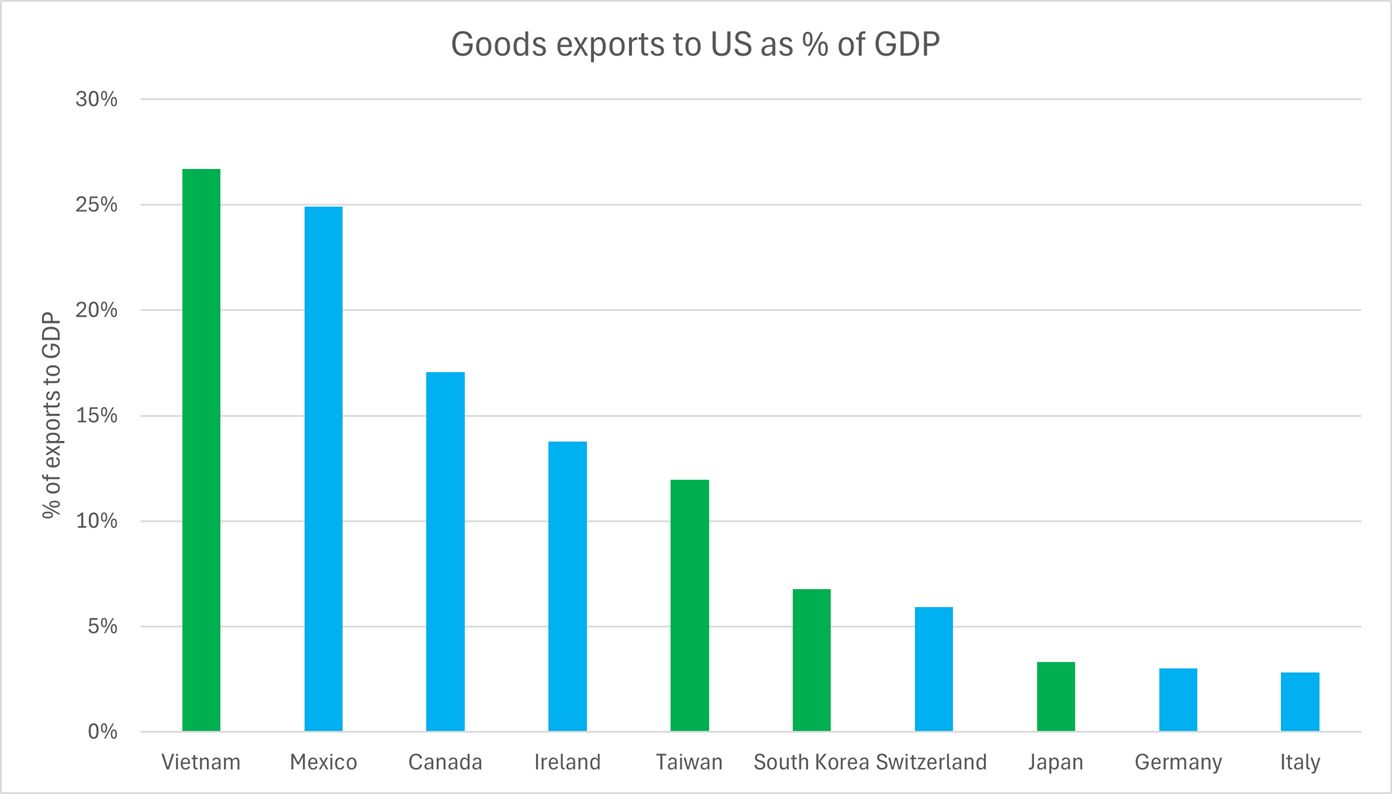
Source: IMF & Statista, based on largest goods exporters to US in 2024.
And as one door closes, others may open. Countries have responded proactively to rising trade tensions by forging new alliances and re-routing supply chains, with intra-Asian trade a key beneficiary.
Over the past 25 years, China has overtaken the US to become the largest trading partner for many countries globally. It’s also reduced its reliance on the US export market: while around 15% of exports still head to the US, this is lower than combined exports to Hong Kong, Vietnam and Japan.
Heightened geopolitical tensions have accelerated this broader realignment, with Asian economies preserving their neutrality to maintain trade links with both East and West. Differential tariffs have also favoured some Asian countries, as well as driving an increase in domestic sourcing.
Anti-US sentiment can also be a powerful weapon in stimulating domestic consumer demand, with China’s e-commerce giants launching multi-billion-dollar initiatives to help export-focused manufacturers pivot towards domestic sales.
The found decade
Japan is a case in point. Exports account for less than 20% of GDP and the country’s expertise in high-value-added products, such as industrial robotics and precision engineering, makes it easier for companies to land tariffs on end customers.
After decades of stagnation, Japan is also benefiting from powerful structural tailwinds: the economy has moved from deflation to modest inflation, wage growth is improving and monetary policy is gradually normalising.
At the same time, corporate reform is reshaping company behaviour, with boards increasingly focused on capital discipline, improving returns on equity and enhancing shareholder value.
Schroder Japan targets companies pursuing company-specific strategies such as restructuring and improved capital allocation, rather than relying on macroeconomic tailwinds.
The portfolio is tilted towards domestically focused businesses, reducing exposure to tariff volatility while providing access to the world’s third-largest consumer economy.
There’s also a meaningful allocation to smaller companies, offering attractive valuations and superior earnings growth to larger-cap peers.
The trust has delivered a 90%-plus return over the past five years, including a 40% return in the past year, alongside a healthy dividend yield of 3.4%.
Big can be beautiful
China may be one of the largest exporters to the US by value but this is largely a function of being the second-largest global economy. After a prolonged post-Covid slowdown and property sector weakness, 2025 marked a turning point.
Beijing has deployed a broad economic support package aimed at stabilising key sectors and restoring confidence in the private sector. Early signs suggest it is gaining traction, with China reinforcing its leadership in technology, industrial automation and renewable energy.
The unveiling of the low-cost artificial intelligence (AI) model DeepSeek illustrated this expertise, wiping around $1trn off the market capitalisation of US technology firms and triggering Nvidia’s largest ever single-day loss.
Baillie Gifford China Growth offers relative insulation from US-China trade tensions, with around 80% of revenues generated domestically, helping to underpin a one-year return of 40%.
Insights from the managers’ recent trip highlighted that US restrictions have not derailed China’s growth trajectory, with companies adapting through domestic substitution in supply chains and the platform economy continuing to drive disruptive growth.
The trust points to Chinese platform companies doubling aggregate profits since 2021, despite their combined market capitalisation halving over the same period, in stark contrast to the Magnificent Seven.
Two very different funds but both provide access to the long-term Asian growth story, alongside a meaningful counterweight to tariff risk and geopolitical uncertainty. If 2026 continues in the same vein as 2025, that balance may prove particularly valuable.
Jo Groves is an investment specialist at Kepler Partners. The views expressed above should not be taken as investment advice.