






ISA Season Special · Part 2 of 5
With the 5 April ISA deadline approaching, investors face the familiar challenge of deciding how to deploy their £20,000 allowance. Interactive investor (ii) has built portfolios using its own Quick-start funds, designed to suit different investor types while keeping costs low and access simple.
The passive core
We begin with the core allocation. Alex Watts, senior investment analyst at ii, chose the Vanguard LifeStrategy range to serve as "a good core, basic building block".
Performance of fund against index and sector over 1yr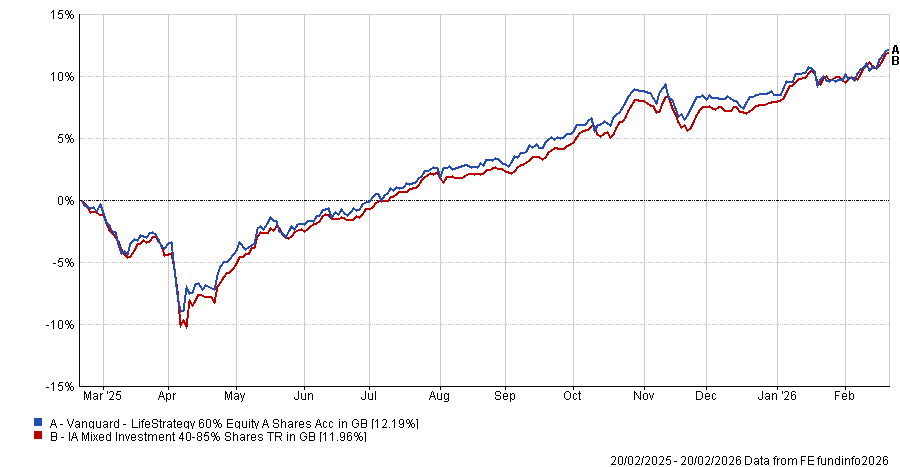
Source: FE Analytics
The fund range provides investors with a simple and effective solution for accessing global markets. Launched with a focus on minimising costs, keeping the asset split between shares and bonds constant and not trying to time the market, it caters to investors across the risk spectrum, from 100% equities to 20%, with the remainder invested in global bonds.
By keeping the asset mix stable and fees minimal – recently cut from 0.22% to 0.2% – investors can avoid having to make frequent allocation decisions. The recent reduction in UK home bias to 20% further diversified the range’s global exposure, aligning the portfolio more closely with broad equity and bond markets.
"Vanguard's passive, low-cost approach continues to appeal and offers investors great value for money,” Watts said.
The active bond sleeve
Investors looking to add sophistication can layer on active elements, particularly in the bond allocation.
“While passive bond funds can be incredibly cheap, bond markets are less efficient than equities," he noted.
"Actively managed bond funds allow managers to make top-down macro decisions, adjust credit quality, duration, geography and sector allocation, and carry out issuer-level analysis and active trading tactics. This can help capture opportunities that passive trackers may miss."
For this purpose, he recommended the Pimco GIS Global Investment Grade Credit fund led by Mohit Mittal, Pimco’s CIO of core strategies. It aims to maximise total returns and outperform the Bloomberg Global Aggregate Credit index, holding at least two-thirds in diversified IG corporate bonds.
Performance of fund against index and sector over 1yr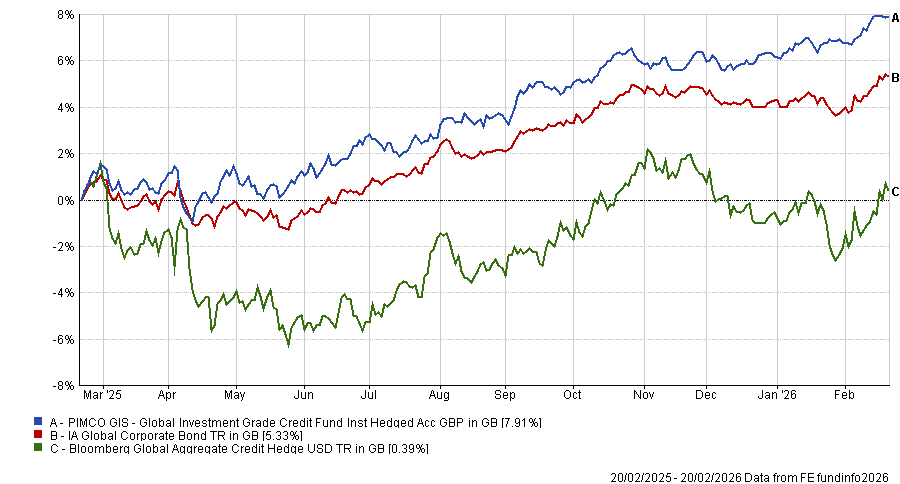
Source: FE Analytics
Mittal combines top-down macroeconomic positioning with in-depth regional and issuer analysis. The fund currently comprises over 1,400 issuances, diversified across geography, credit rating and duration, allowing up to 15% in below-investment-grade securities. The current yield is 4.6% and the ongoing charge 0.49%.
Adding this active bond element can benefit portfolios with longer time horizons or investors seeking income, as it complements LifeStrategy’s passive exposure while retaining risk discipline.
The active equity sleeve
As for equities, Watts opted to complement Vanguard LifeStrategy’s passive and market-cap weighted exposure (dominated by the largest global companies) with the Dodge & Cox Global Stock fund, which follows a bottom-up, global value approach.
"The fund invests in established companies appearing undervalued relative to their long-term fundamentals, rather than chasing the largest tech names dominating indices,” he said.
Performance of fund against index and sector over 1yr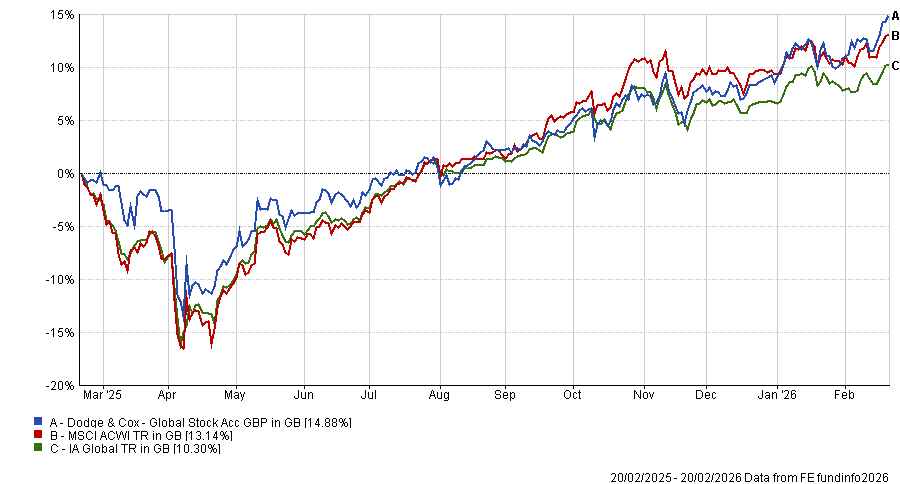
Source: FE Analytics
Allocating to actively managed funds is not inherently riskier than market-cap weighted index investing, Watts stressed. For example, Dodge & Cox Worldwide Global Stock is slightly less concentrated in its top 10 stocks than its MSCI ACWI benchmark and has exhibited less volatility than the index over the past year.
"However, active funds can bring increased risk via concentration, the hurdle of higher ongoing costs, or the possibility that a style, such as value investing, falls from favour and drags on performance,” he said.
Dodge & Cox’s approach results in a portfolio that is underweight US equities (49% versus 64% in the MSCI ACWI index) and underweight technology, while overweighting financials and healthcare. Its top holdings differ significantly from the benchmark, providing a differentiated exposure.
The percentage weighting
Even for a simple portfolio such as this, investors should adjust allocations to reflect their own risk tolerance, time horizon and desired level of monitoring.
“As a general framework, a hands-off investor may consider 60-70% in LifeStrategy, with the remainder split across the active options," Watts suggested. "More engaged investors might increase active bond or equity exposure depending on confidence in the managers and the desired diversification from global indices.”
For example, a moderately cautious investor might hold the majority in LifeStrategy, add a smaller allocation to Pimco GIS IG Credit for yield and risk-adjusted returns, and take a modest stake in Dodge & Cox for equity differentiation. A capital growth-focused investor might overweight Dodge & Cox, complementing the LifeStrategy core, and retain Pimco for fixed income stability, he concluded.
“The combination of a strong passive core with targeted active additions allows investors to build portfolios that suit their risk appetite and investment horizon. LifeStrategy offers simplicity, low cost and broad market access, while Pimco GIS IG Credit and Dodge & Cox Global Stock provide the opportunity for active return enhancement and diversification.”
| Fund | Size | Sector | 5yr return | OCF | Allocation |
| Vanguard LifeStrategy (example 60% Equity) | £18.5bn | IA Mixed Investment 40-85% Shares | 39.3% | 0.20% | 65% |
| Dodge & Cox Global Stock | £5.1bn | IA Global | 81.2% | 0.63% | 20% |
| Pimco GIS Global Investment Grade Credit | £5.2bn | IA Global Corporate Bond | 4.1% | 0.49% | 15% |
Source: ii, FE Analytics.
Previously in the series: AJ Bell's perfect portfolio
Next week: We continue with best-buy picks from our third platform ahead of the 5 April ISA deadline.