






Defence stocks surged on Monday as investors absorbed the implications of the Iran conflict, which saw the US and Israel strike airports, military bases and commercial infrastructure across the Gulf.
The UK’s BAE Systems, Germany’s Hensoldt and the US’s Lockheed Martin and Northrop Grumman were among the companies rallying hard yesterday as investors flocked to defence companies amid the conflict. Markets have opened on a more downbeat note today, with even defence stocks in the red.
Tom Bailey, head of research at HANetf, said the joint US and Israeli strikes on Iran and Iran’s retaliation against US bases, Isreal and Gulf states such as Bahrain, Qatar, the United Arab Emirates, Kuwait, Jordan and Oman showed “how quickly regional confrontation can widen”.
“The rules-based order that once imposed a degree of restraint on state behaviour is over,” he added.
The strategic significance of where Iran chose to strike matters as much as the fact that it struck at all, Bailey added. He noted that airports and commercial sites in “countries that have long marketed themselves as stable, apolitical global trading and tourism hubs” have been hit.
Thousands of flights were cancelled as airports in Dubai, Doha and Abu Dhabi closed. These Gulf states have spent decades building their modern economies on a reputation for political neutrality and commercial safety, which could be under threat now.
“In our increasingly volatile geopolitical world, proximity to a hostile power with missile and drone capability carries real risk,” Bailey said.
Performance of global aerospace and defence stocks vs global equities over 12 months
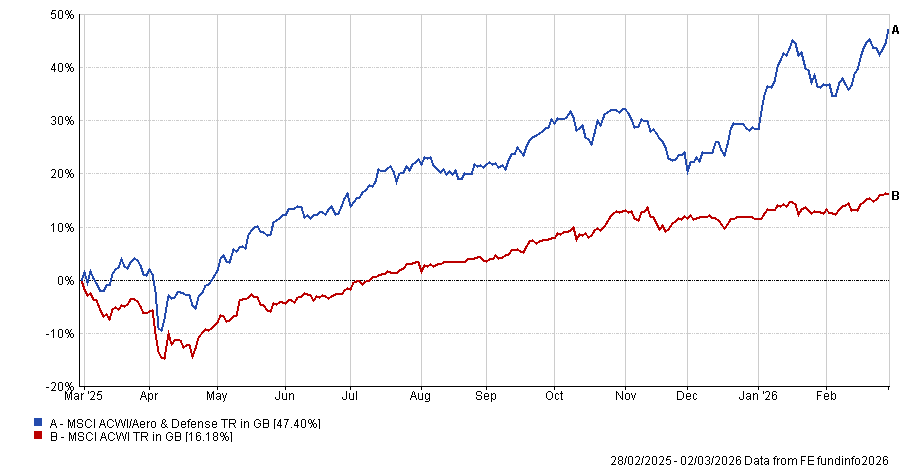
Source: FE Analytics. Total return in sterling.
On the lessons that can be learned by those investing in defence stocks, HANetf’s head of research argued that the missile defence picture offered some reassurance.
All ballistic missiles aimed at Gulf states appear to have been intercepted. Bailey said this would “strengthen confidence in existing missile defence systems”, specifically Patriot systems produced by RTX and THAAD systems produced by Lockheed Martin.
“Patriot and THAAD systems appear to have performed well,” he said, adding that Gulf states are likely to respond by upgrading and expanding these capabilities, while nations without comparable systems will have drawn uncomfortable conclusions about their own vulnerability.
The reassurance, however, was partial. Ballistic missile interception masked a more troubling development: some drones got through.
“The events over the weekend also demonstrated that high-end anti-missile systems alone are not sufficient in our new age of drone warfare,” he said.
“Several drones were able to penetrate the defences of Gulf states. These drones are relatively low-cost, mass-produced. Even high interception rates do not eliminate the possibility of damage if deployed at scale.
“A single drone can cost just a few tens of thousands of dollars to produce but traditional air defence systems use intercepting missiles worth several millions.”
This cost asymmetry is the defining tactical problem that the weekend brought into sharp focus. Bailey said it shifts more attention toward “dedicated counter-drone capability” in shorter-range air defence, detection networks and electronic warfare.
Among established contractors, he pointed to Thales, which already collaborates with the UAE on radar and air-surveillance systems as potentially well positioned, and Rheinmetall, which has previously partnered with Emirati defence entities on short-range air defence systems designed specifically to counter drones.
Pure-play counter-drone companies represent a more concentrated expression of the same theme. Bailey noted that DroneShield, the Australian company whose systems detect, track, and neutralise hostile drones using radar, radio-frequency and AI-enabled software, rose over 6% during Monday’s early trading.
The economics of its proposition are central to the investment case. “With drones being cheap to produce and often deployed at mass scale, governments need cheap ways to neutralise these threats,” he explained. “To reduce this asymmetry in cost, solutions from companies like DroneShield will play a key role in future air defence.”
The lesson extends well beyond the Gulf. Bailey said the wider lesson from the Iran conflict and the weekend’s events is that countries within striking distance of a hostile power with the capacity to deploy drones at scale are vulnerable.
This has significant implications for eastern and central European states that are within range of Russian loitering munitions.
Bailey finished: “Both credible anti-missile and counter-drone defences are vital in our world of greater geopolitical volatility.”
HANetf is an investor in a wide range of defence businesses through its range of defence ETFs, including the Future of Defence UCITS ETF, Future of European Defence Screened UCITS ETF, Future of Defence Indo-Pac ex-China UCITS ETF and Future of Defence Screened UCITS ETF.