






Less than 5% of funds have made a positive return in the time since the US and Israel launched their initial strikes on Iran two weeks ago, FE fundinfo data shows.
The US and Israel launched coordinated strikes on Iran on 28 February 2026 and have been targeting military infrastructure across Tehran, Isfahan province and Kharg Island, Iran's principal oil export hub. Early strikes killed supreme leader Ayatollah Ali Khamenei and the US Senate subsequently voted against restricting military action, leaving the conflict without a defined endpoint.
Iran responded by effectively closing the Strait of Hormuz, cutting off a shipping lane through which roughly a fifth of global oil supply passes and driving energy prices sharply higher. Iran's new supreme leader, Mojtaba Khamenei, and foreign minister Abbas Araghchi have both rejected ceasefire talks, with Araghchi stating Tehran is "ready for a long war."
Performance of asset classes since 28 Feb 2026
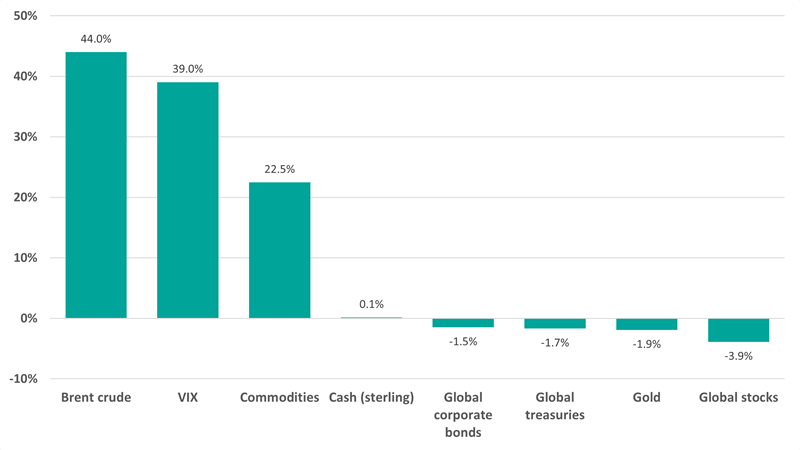
Source: FinXL. Total return in sterling between 28 Feb and 15 Mar 2026
Since then, commodities have surged – led by energy commodities – while the MSCI AC World index has fallen 3.9% as investors have dumped risk assets amid growing geopolitical risk.
Both government bonds and corporate bonds have also posted losses over the past two weeks. Luke Hickmore, investment director for fixed income at Aberdeen Investments, recently explained why bonds have not acted as a safe haven (spoiler: inflation risk).
Within stocks, investors have largely been selling what had done well just before the Iran crisis – meaning Japan, Europe and emerging markets have been hit hardest. US stocks, which lagged behind in 2025, have held up best, although are still in negative territory.
Energy is the only industry to have made gains over the past two weeks, with the MSCI AC World Energy index gaining 5.5% as oil and gas prices soared. Materials stocks have fallen the most, down 10% as investors bet that slowing growth will lead to less demand for raw materials.
Performance of fund sectors since 28 Feb 2026
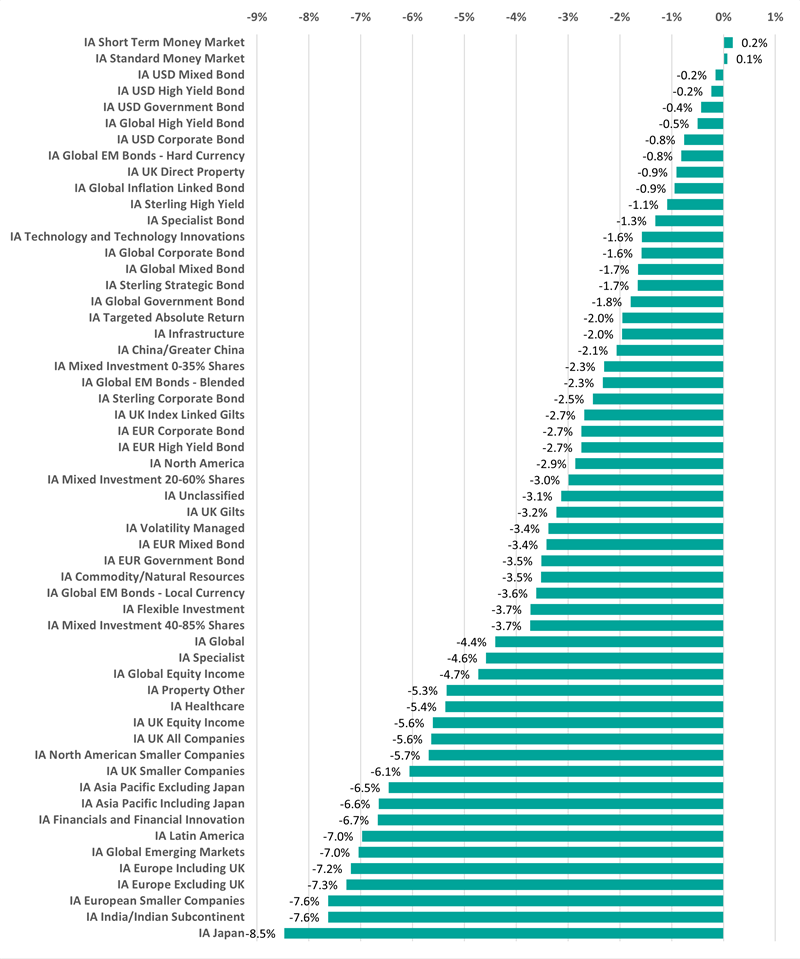
Source: FinXL. Total return in sterling between 28 Feb and 15 Mar 2026
Among the 56 sectors in the Investment Association universe, the average fund in just two – IA Short Term Money Market and IA Standard Money Market – have made a positive return. Fixed income sectors are next in line, but have made losses.
Dan Coatsworth, head of markets at AJ Bell, said investors should not be surprised that lower-risk investments such as bonds have made a loss in recent weeks, as they are not necessarily supposed to rise in such environments.
“Only money market funds and shares in non-life insurance companies have truly preserved investors’ capital since the Middle East crisis unfolded, when looking at investments one might expect to offer some ballast in difficult times,” he said.
“While this might sound gloomy, the key takeaway is that so-called lower-risk investments in general have been useful during the latest market wobble. They have provided stability, which is often an underappreciated factor. Investing should be viewed as a long-term pursuit and remains an attractive way to make money along the way, and the current environment has shown the importance of having a blend of assets to ride out the ups and downs.”
The biggest average losses among the Investment Association’s fund sectors follow the patterns noted above with Japan, European and emerging market peer groups posting the highest average losses.
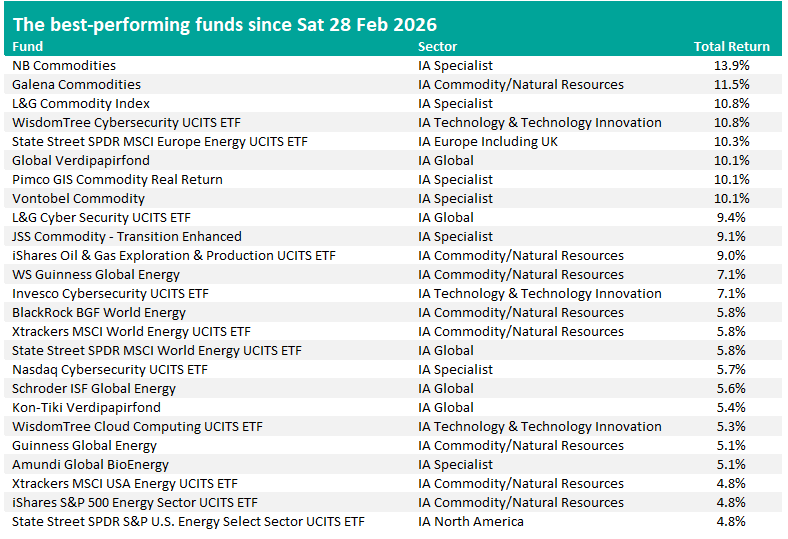
Source: FinXL. Total return in sterling between 28 Feb and 15 Mar 2026
Just 249 funds – or 4.6% of the 5,464 in the Investment Association universe – have made a positive return since the US/Israeli strikes started on Saturday 28 February. The 25 with the highest returns can be seen in the table above.
As would be expected given the information above, relatively few themes can be found among these funds.
Commodities and more specifically energy, are the most obvious ones, reflected in the double-digit gains of NB Commodities, Galena Commodities, L&G Commodity Index, State Street SPDR MSCI Europe Energy UCITS ETF, Pimco GIS Commodity Real Return and Vontobel Commodity.
Joost van Leenders, senior investment strategist at Van Lanschot Kempen, said: “How oil prices evolve will primarily depend on the length and scope of the conflict. We expect oil prices to remain slightly higher and more volatile for the next few weeks as the conflict is deepening and creating ongoing geopolitical uncertainty. The de facto closure of the Straits of Hormuz could have especially major implications for oil and gas prices.”
Cybersecurity is the other main theme in the above list of funds. Iran has a well-documented history of state-sponsored cyberattacks on US networks and the US Cybersecurity and Infrastructure Security Agency has highlighted Iranian-linked attacks on poorly secured internet-connected devices as an ongoing concern.
WisdomTree Cybersecurity UCITS ETF, L&G Cyber Security UCITS ETF, Invesco Cybersecurity UCITS ETF and Nasdaq Cybersecurity UCITS ETF are some of the funds making positive returns after investors backed the companies that protect against this threat.
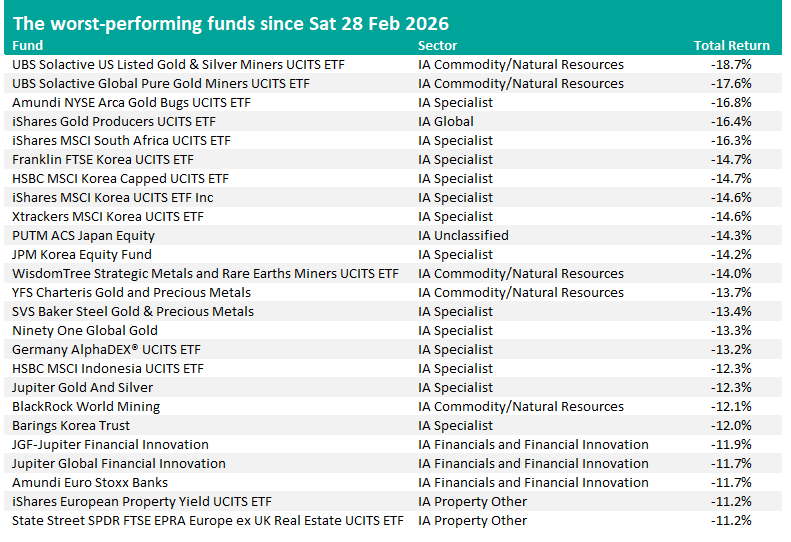
Source: FinXL. Total return in sterling between 28 Feb and 15 Mar 2026
Of the 95.4% of funds that have failed to make a positive return over the past two weeks, those with a focus on gold equities have tended to fall the most. Gold was among the best-performing assets of 2025 but has come under pressure in recent weeks.
Matt Britzman, senior equity analyst at Hargreaves Lansdown, explained: “The prospect of elevated energy prices, sticky inflation, and the knock‑on impact of higher interest rates is proving a bigger concern for investors right now. Neither of those are particularly supportive for holders of a non‑productive asset like gold, which doesn’t offer any income to offset higher rates.”
Korean equity funds are also among the biggest losers of the past two weeks. This is another market that topped the performance rankings last year only to be hit with immediate profit-taking when the conflict in Iran started.