






You don’t have to search very hard to land on an actively managed emerging market fund that counts Taiwan Semiconductor Manufacturing Company (TSMC) among its top 10 holdings, such is its status as an indispensable linchpin of the global AI supply chain.
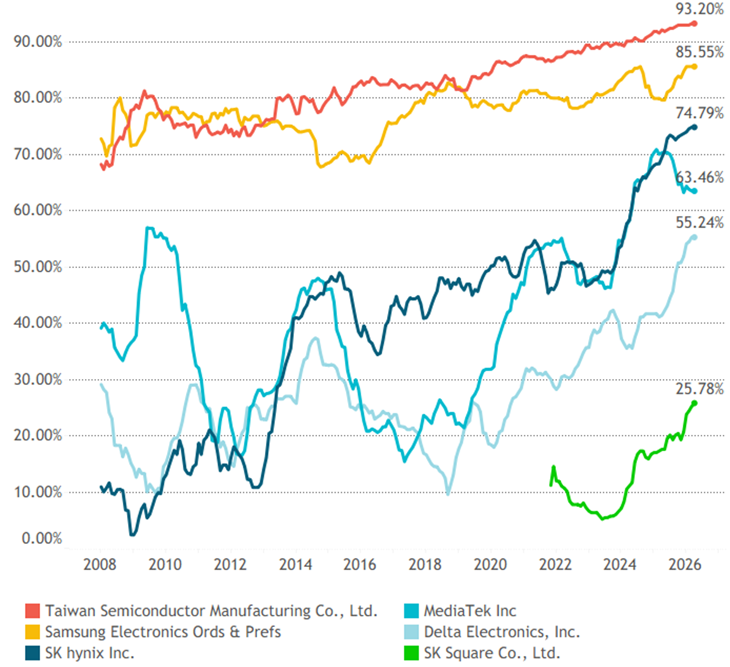
The percentage of actively managed emerging market funds that own TSMC has grown to over 90% in 2026. Similarly, other increasingly popular stocks such as Samsung Electronics and SK Hynix have surged to feature in over 70% of these portfolios.
Percentage of active emerging market funds invested in certain tech stocks
Source: Copley Fund Research, Neuberger
TSMC manufactures most of the world’s most advanced logic chips, while the South Korean businesses dominate the memory chips needed to power AI systems, making all three central to the AI build-out.
But not every emerging market-focused investor feels comfortable owning the same stocks as everyone else.
Vera German and Juan Torres, co-managers of Neuberger Emerging Markets Equity, don’t own any of these three stocks. It is a concentrated fund of between 40 and 45 holdings and is completely benchmark-agnostic, meaning the geographic and stock weights can deviate compared to peers.
Torres said: “It’s not that we have anything against AI – it’s an amazing technology and has already changed the world, there’s no doubt about that – it’s just that we’re not willing to price in growth in perpetuity for many of these companies.
“I also find it very difficult to understand that everyone needs to own the exact same names that you also find in the passives – it can’t be that the same stock fits every single style: value, growth, compounder, quality, all of them.”
Torres instead attributes mass ownership to the fact that TSMC, SK Hynix and Samsung all make up a big portion of fund managers’ selected benchmarks – “so they can’t afford not to own it”.
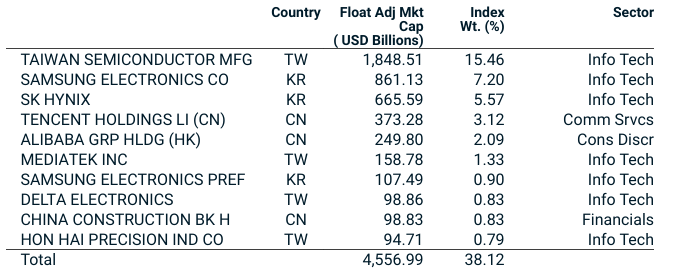
As of the end of July 2026, TSMC, Samsung Electronics and SK Hynix made up over a quarter of the MSCI Emerging Markets index combined.
Top 10 constituents of MSCI Emerging Markets
Source: MSCI
Such concentration in a narrow group of stocks also comes with a lot of risk, the managers warned.
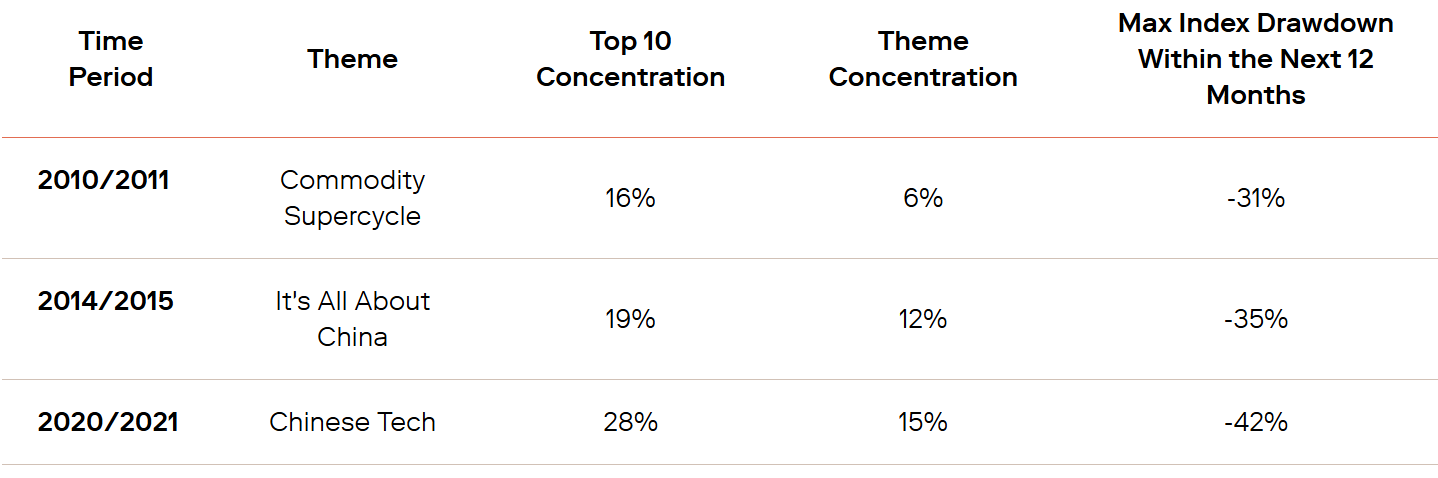
In research published by German and Torres earlier this year, they analysed periods in emerging market history in which index returns were driven by a narrow cohort of companies.
As shown in the table below, in each instance, as concentration increased so too did drawdowns.
Emerging market equity market drawdowns following major thematic periods
Source: Bloomberg, Neuberger. Data as at 1 June 2026.
That being said, the current outperformance of the three companies in question means not owning them is proving painful.
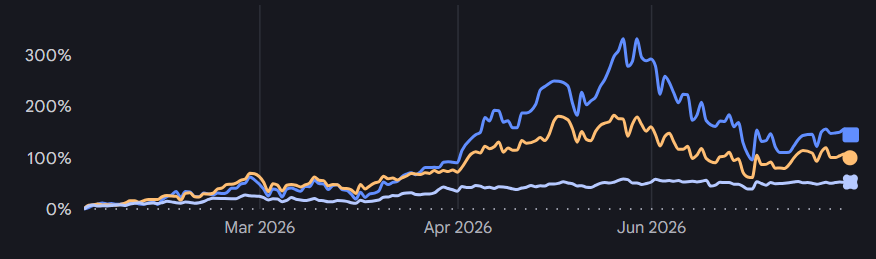
As shown in the graph below, year-to-date (28 August 2026), SK Hynix (blue) has logged a 144% share price growth, while Samsung (orange) is up 100% and TSMC (white) is up just shy of 53%.
Stock price performance change YTD
Source: Google Finance
“It’s always difficult to watch something you don’t own, which is a massive benchmark component, going up by 6% every day,” German admitted.
“But we’ve seen this movie before and we gain some comfort from the fact that market dynamics, by and large, follow similar patterns over time.”
Indeed, when positions in AI-focused plays like Samsung and SK Hynix are being sold off, German said they are positioned to benefit due to holding more defensive stocks, such as Korean snacks manufacturer Orion.
“So even if AI stocks are the only game in town until the end of the year, we’re quite comfortable providing the diversification that clients want and, ultimately, buying very attractive securities that should perform over the next three to five years,” she said.
German also emphasised the importance of providing investors with fund options in their portfolios that ensure diversification. Emerging market equities have typically proven a popular way to diversify away from developed markets or, more specifically, the US.
German said: “But if you look at the correlations of TSMC, SK Hynix and Samsung, they are not most closely correlated with their own domestic markets but with Nvidia, Broadcom and the big semiconductor stocks in the US.
“If you’re buying an emerging market fund with big benchmark weights, you’re not actually diversifying anything but doubling down on exactly the same trade that already exists in your book.”
Reluctance to own India
Alongside steering clear of big AI players across emerging markets, German and Torres have yet to invest in Indian stocks.
Despite India being a large, broad and deep market, German noted they have historically not been able to find a prospective investee company that would give them the appropriate risk-reward for the portfolio.
Over the past 18 months or so, Indian stocks have suffered a huge devaluation, both in local and dollar terms, predominantly driven by the region’s lack of AI trade.
The lack of AI-related trades is a reflection of the fact India has a very small proportion of the population doing very high-tech jobs – and those jobs, namely in software, are under pressure, German said.
While German and Torres have looked at Indian IT outsourcing firms – as they are getting cheaper – they so far feel the share price declines don’t fully reflect all the potential uncertainty and risk to those companies’ business models.
Across other sectors in the region, the relative opportunity set has yet to stack up in favour of buying an Indian stock versus a different one, they added.
India’s petrochemical companies are one such example, as they currently represent good value relative to other Indian stocks, according to German.
“But if you look at the petrochemical space in general across emerging markets, you realise you can buy much cheaper petrochemical companies in the Middle East, Thailand and Korea,” she said.
However, she also believes that India has a bigger fundamental issue that has yet to be resolved.
“It has a very large, very young population still working rural agricultural jobs but, if you want to move to the next stage of development and really start building that middle class, which will consume and save and get you into a development cycle, those people need manufacturing jobs, preferably,” German said.
“So India remains a zero for us at the moment, but we are naturally starting to look at more as the market suffers.”
Instead, German and Torres highlighted other regions in which they are finding good value.
These include frontier markets, where many operationally strong companies trade at steep discounts simply because they carry little benchmark weight to attract attention, and South Africa, where strong metals prices have yet to filter through to a still-pressured consumer. Brazil is another area of focus, where German and Torres expect election year volatility to throw up buying opportunities.
“Emerging markets is an amazing asset class because it’s very inefficient and it’s a great place to do price discovery and alpha generation,” Torres said.
“But it’s also a very risky asset class, so you should never get carried away – no matter how enticing the story is – and overpay for an asset, because things happen.”