



Past performance does not predict future returns. You may get back less than you originally invested. Reference to specific securities is not intended as a recommendation to purchase or sell any investment.
Softcat has been a core holding for the Sustainable Future funds since 2016 and is a champion of UK small and medium enterprise (SME) digitalisation and cyber security. Despite pedestrian performance in the last few years, the shares have risen roughly 437% from our first purchase. The financial performance, which has been nothing short of extraordinary, has driven this incredible return. Revenues have grown +309% over the past decade, while free cash flow has increased an even more impressive +367%. Crucially, almost all of this growth has been organic, with just one tiny acquisition in the company’s 33‑year history. This performance is world‑class — outperforming both the Nasdaq and the S&P 500 since listing in 2015 — and showcases the very best of UK entrepreneurship.
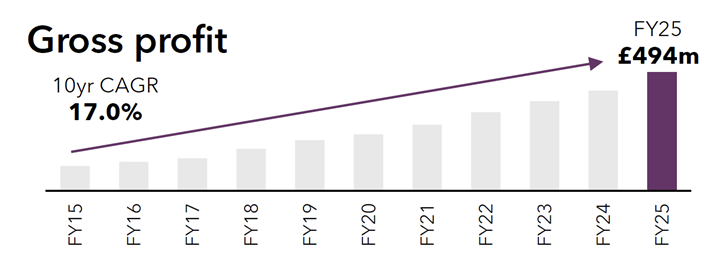
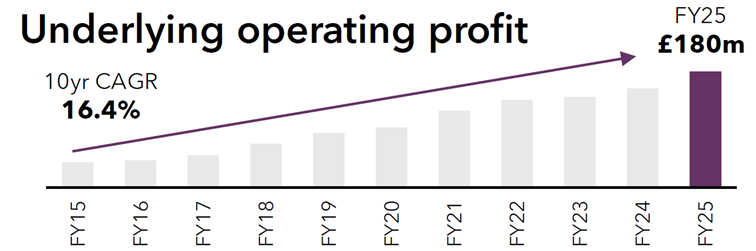
Source: Softcat annual report 2025
What Softcat does — and why it matters
Softcat is a value‑added IT reseller (“VAR”) which helps organisations choose, procure and manage all the technology they need to operate effectively and securely. It acts as the trusted middle‑man between leading global technology vendors — including Microsoft, AWS, Cisco, Dell and many others — and customers across every sector of the UK economy, from SMEs to large enterprises and public‑sector bodies. Softcat guides its customers through an increasingly complex technology landscape, covering everything from software licensing and cloud services to hardware, networking and cybersecurity. And rather than simply selling products, Softcat layers on expert advice, hands‑on implementation and ongoing managed services, becoming a long‑term technology partner to both public and private‑sector clients.
Softcat sits squarely within two of our long‑term sustainability themes — Enabling SMEs and Enhancing digital security. By helping smaller organisations become more productive, resilient and secure, Softcat directly strengthens the backbone of the UK economy, while its growing cybersecurity capabilities support safer digital infrastructure across society. The sustainability story runs deeper too: Softcat’s people‑first culture, exceptionally high employee engagement and best‑in‑class customer satisfaction underpin a long‑term approach that favours relationships over short‑term transactions. These themes also align with powerful structural growth drivers: global technology spending has historically grown 2–3x faster than GDP, and even when the UK’s economic backdrop is far from rosy, organisations cannot defer essential IT investment. The sharp rise in high‑profile cyberattacks, alongside the rapid acceleration of AI — bringing both extraordinary opportunities and significant new risks — further cements technology as non‑discretionary spend. Taken together, these forces should continue to drive sustained, long‑term demand for Softcat’s expertise across software, cloud, infrastructure and cybersecurity.
Culture: Softcat’s compounding advantage
A defining feature of Softcat, and the bedrock of our long‑term conviction, is its culture. The culture was shaped from the very beginning when the company was founded by Peter Kelly in 1993, who remains the largest shareholder, and then significantly developed under long‑standing former CEO Martin Hellawell. Hellawell embedded a distinctive ethos of hard work and fun, blending professionalism with a vibrant energy that became the company’s hallmark. This culture has remained Softcat’s greatest intangible asset: a place where employees (often eager young graduates, new recruits are called “Soft-kittens”) are empowered, extensively trained and rewarded through a model that links customer impact directly to personal progression. Employee Net Promoter Scores in the 60–66% range and satisfaction levels above 90% stand head and shoulders above the average UK company and testify to the people-focused culture. Most mainstream investors overlook qualitative factors such as culture, preferring metrics that are easier to model. In our experience, how you treat your employees and customers is a fantastic leading indicator of success over the long-term and the current CEO, Graham Charlton, certainly understands this. Put in Softcat parlance, he “bleeds purple”.
Financially, Softcat remains one of the UK’s most attractive businesses: a capital‑light model, minimal working capital requirements, modest capex resulting in consistently high returns on equity of around 40%. Combining the strong returns on capital and excellent organic growth rates turns Softcat into a free cashflow growth machine – even when the economic backdrop in the UK isn’t particularly rosy.
Softcat is a business where culture and sustainability are competitive advantages; a company that respects its people, serves customers with integrity, uplifts SMEs, enhances digital resilience and compounds capital with remarkable consistency. As we look ahead to the next decade, we believe Softcat is exceptionally well‑positioned to deliver durable, high‑quality growth. We think the current share price doesn’t reflect future prospects, nor it seems do the Board who have recently announced their first ever share repurchase.
Read, watch and listen to more insights from Liontrust fund managers here >
KEY RISKS
Past performance does not predict future returns. You may get back less than you originally invested.
We recommend this fund is held long term (minimum period of 5 years). We recommend that you hold this fund as part of a diversified portfolio of investments.
The Funds managed by the Sustainable Investment team:
-
Are expected to conform to our social and environmental criteria.
-
May hold overseas investments that may carry a higher currency risk. They are valued by reference to their local currency which may move up or down when compared to the currency of a Fund.
-
May hold Bonds. Bonds are affected by changes in interest rates and their value and the income they generate can rise or fall as a result; The creditworthiness of a bond issuer may also affect that bond's value. Bonds that produce a higher level of income usually also carry greater risk as such bond issuers may have difficulty in paying their debts. The value of a bond would be significantly affected if the issuer either refused to pay or was unable to pay.
-
May encounter liquidity constraints from time to time. The spread between the price you buy and sell shares will reflect the less liquid nature of the underlying holdings.
-
May invest in smaller companies and may invest a small proportion (less than 10%) of the Fund in unlisted securities. There may be liquidity constraints in these securities from time to time, i.e. in certain circumstances, the fund may not be able to sell a position for full value or at all in the short term. This may affect performance and could cause the fund to defer or suspend redemptions of its shares. May invest in companies listed on the Alternative Investment Market (AIM) which is primarily for emerging or smaller companies. The rules are less demanding than those of the official List of the London Stock Exchange and therefore companies listed on AIM may carry a greater risk than a company with a full listing.
-
May, in certain circumstances, invest in derivatives but it is not intended that their use will materially affect volatility. Derivatives are used to protect against currencies, credit and interest rate moves or for investment purposes. The use of derivatives may create leverage or gearing resulting in potentially greater volatility or fluctuations in the net asset value of the Fund. A relatively small movement in the value of a derivative's underlying investment may have a larger impact, positive or negative, on the value of a fund than if the underlying investment was held instead.
-
Do not guarantee a level of income.
The risks detailed above are reflective of the full range of Funds managed by the Sustainable Investment team and not all of the risks listed are applicable to each individual Fund. For the risks associated with an individual Fund, please refer to its Key Investor Information Document (KIID)/PRIIP KID.
The issue of units/shares in Liontrust Funds may be subject to an initial charge, which will have an impact on the realisable value of the investment, particularly in the short term. Investments should always be considered as long term.
DISCLAIMER
This material is issued by Liontrust Investment Partners LLP (2 Savoy Court, London WC2R 0EZ), authorised and regulated in the UK by the Financial Conduct Authority (FRN 518552) to undertake regulated investment business.
It should not be construed as advice for investment in any product or security mentioned, an offer to buy or sell units/shares of Funds mentioned, or a solicitation to purchase securities in any company or investment product. Examples of stocks are provided for general information only to demonstrate our investment philosophy. The investment being promoted is for units in a fund, not directly in the underlying assets.
This information and analysis is believed to be accurate at the time of publication, but is subject to change without notice. Whilst care has been taken in compiling the content, no representation or warranty is given, whether express or implied, by Liontrust as to its accuracy or completeness, including for external sources (which may have been used) which have not been verified.
This is a marketing communication. Before making an investment, you should read the relevant Prospectus and the Key Investor Information Document (KIID) and/or PRIIP/KID, which provide full product details including investment charges and risks. These documents can be obtained, free of charge, from www.liontrust.com or direct from Liontrust. If you are not a professional investor please consult a regulated financial adviser regarding the suitability of such an investment for you and your personal circumstances.
Understand common financial words and terms See our glossary


