






For investors seeking attractively valued opportunities in the UK market, both Fidelity Special Situations and Artemis UK Select likely merit serious consideration.
The two strategies share a lot in common and have moved in near lockstep, with a correlation score of 0.91 over five years and 0.93 over one and 10 years. Both take a value approach to UK investing and follow bottom-up, stock-picking processes that lean into recovery stories and mispriced opportunities.
They are also both co-managed by long-tenured FE fundinfo Alpha Managers and supported by well-established investment teams. Artemis UK Select has been co-managed by Alpha Manager Ed Legget and Ambrose Faulks since 2015, while Fidelity Special Situations has been managed by Alpha Manager Alex Wright since 2014 alongside Jonathan Winton since 2020.
The market has recognised this consistency, with both featuring prominently on major best-buy lists, including those from Bestinvest and Hargreaves Lansdown. The Artemis fund was also the most purchased fund by Bestinvest clients in February 2026.
While the two funds share many characteristics, their approaches begin to diverge once you look under the bonnet.
Jason Hollands, managing director at Bestinvest, said the Fidelity fund is “arguably a more classic ‘value’ fund, whereas the style bias on Artemis UK Select is more nuanced”.
The most immediate distinction is portfolio construction. Fidelity Special Situations typically holds between 80 and 100 stocks, offering broad diversification and greater exposure to the small- and mid-cap end of the market. Artemis UK Select, by contrast, runs a more concentrated portfolio of 40 to 50 holdings, with a tilt toward mid- and large-cap companies.
Ben Yearsley, director at Fairview Investing, said: “A wrong call in a 40-stock portfolio is more damaging than in an 80-stock portfolio.” Conversely, the right call is more rewarding, he added.
Another point of difference is the use of short positions. Hollands said both funds have the flexibility to take selective shorts, “providing an additional tool to express negative views on overvalued shares”. However, he added that the Artemis fund appears to make greater use of this practice at the moment, currently running four short positions, whereas Fidelity Special Situations has none.
These structural contrasts contribute to a slight divergence in volatility. Artemis UK Select has been the more volatile strategy over the past decade at 19.4%, compared with 15.6% for Fidelity Special Situations.
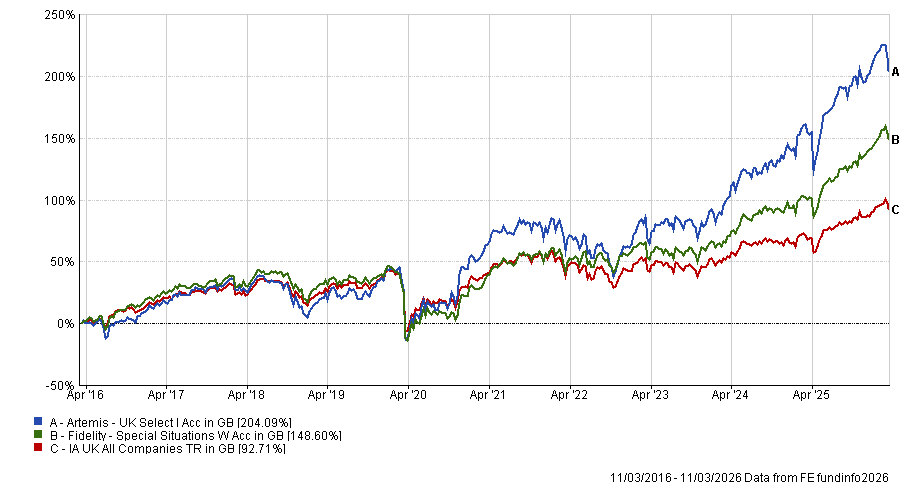
This volatility is reflected in performance. Artemis UK Select has been the stronger long-term performer on a discrete-year basis, delivering top quartile returns in the IA UK All Companies sector in six of the past 10 years. Its weaker years have tended to be more painful, however. The fund made a 19.7% loss in 2018 – a deeper drawdown than both Fidelity Special Situations and the sector average. It also lagged in 2022, with a 9.8% loss versus the sector’s average 9.1% decline.
Fidelity Special Situations has achieved first quartile returns in the sector in three of the past 10 years. However, while Artemis UK Select posted a first quartile gain of 5.7% in 2020, Fidelity Special Situations lost 12% against the sector average decline of 6%.
Over the longer term, Artemis’ higher-risk approach has been rewarded, with the fund generating an annualised alpha of 3.24 over the past decade, ahead of Fidelity’s 2.35, as well as a higher information ratio of 0.6 versus 0.5.
Performance of both funds vs the sector over 10yrs
Source: FE Analytics
But which would the fund selectors pick?
Joseph Hill, fund research analyst at Quilter Cheviot, said they invest in Fidelity Special Situations.
He said the Fidelity fund “plugs investors into different drivers of growth”, thus reducing the risk of a single position having a big impact on performance.
With only around 40% of the fund currently invested in FTSE 100 companies, the managers “can generate alpha through strong stock selection among medium-sized and smaller companies where reduced analyst coverage adds to the opportunity for active managers”.
“The significant proportion of the fund invested outside of larger companies means it could stand to benefit from further interest rate cuts to a greater extent than some peers,” Hill added.
Meanwhile, Yearsley said he has owned Fidelity Special Situations in his SIPP “for many years” but noted he would “marginally” lean toward the Artemis fund if he had to choose between them – “but it’s a coin toss”.
However, for most, rather than producing a clear winner, they would prefer to hold the pair as complementary expressions of UK value.
Hollands said he currently holds both funds in his own portfolio, noting that “the funds are sufficiently differentiated to be paired together as a UK value allocation within a portfolio”.
“The two funds are not mutually exclusive,” he said. “They reflect different expressions of value investing in the UK and could even sit alongside each other in a well-constructed portfolio, offering complementary exposure to distinct parts of the market.”
Meanwhile, Chris Metcalfe, chief investment officer at iBoss, said they have held funds managed by Leggitt from Artemis and Wright from Fidelity for many years, adding that, in the case of Artemis UK Select and Fidelity Special Situations, “we are fundamentally investing in the manager”.
“Were either to move, we would very seriously consider following them,” he said, noting that, in this particular instance, he wouldn’t choose one fund over the other.
“At iBoss, we hold more funds within each sector than many of our peers, so these sit alongside five other holdings within the IA UK All Companies sector,” Metcalfe said.
“Their inclusion is not about diversification for its own sake but about complementary styles within a carefully constructed allocation.”