






UK inflation was unchanged last month but this is seen by many as already being irrelevant, as the figures were collected before the US-Israeli attack on Iran sent energy prices sharply higher.
The Office for National Statistics (ONS) said consumer prices index (CPI) inflation held at 3% in the 12 months to February 2026, unchanged from January. However, the underlying price data was collected before the Iran conflict began on 28 February.
Core CPI, which excludes energy, food, alcohol and tobacco, rose to 3.2% in February from 3.1% in January. Services inflation eased to 4.3% from 4.4%, its lowest rate since March 2022. Goods inflation held at 1.6%.
Clothing and footwear was the largest upward contributor to the annual CPI rate, rising 0.9% in the 12 months to February, up from no change in January. Motor fuels provided the largest downward offset; petrol averaged 131.6p per litre in February, its lowest since June 2021.
Grant Fitzner, chief economist at the ONS, said: “The largest upwards driver was the price of clothing, which rose this month but fell a year ago. This was offset by falls in petrol costs, with prices collected before the start of the conflict in the Middle East and subsequent rise in crude oil prices.”
CPI inflation over 10yrs
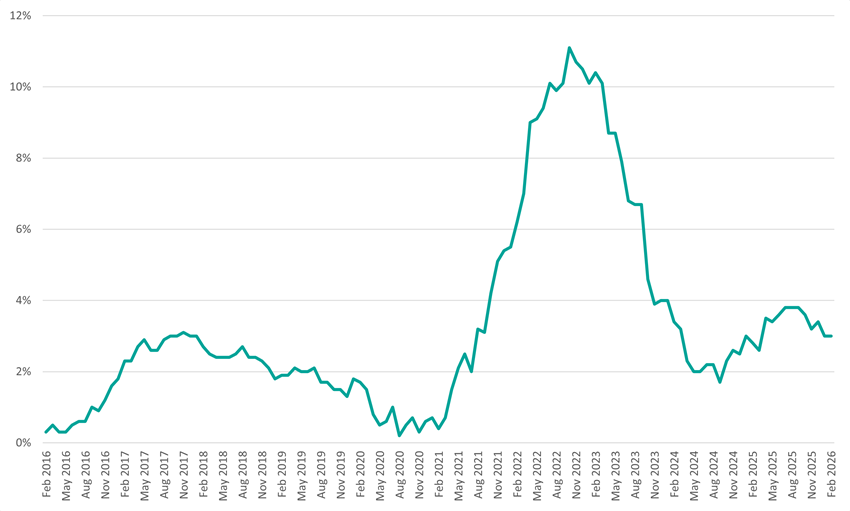
Source: ONS
Alcohol and tobacco inflation fell to 3.6%, its lowest rate since February 2022. Food and non-alcoholic beverages inflation eased to 3.3% from 3.6%, the lowest since March 2025.
Susannah Streeter, chief investment strategist at Wealth Club, said: “February’s inflation snapshot shows the calm before the storm of higher prices.
“What a difference a month makes. Even though oil has retreated from the frighteningly high levels hit over the past few weeks, Brent crude is still hanging stubbornly around $100 a barrel and gas prices remain highly elevated.”
She added that higher energy prices risk being passed on by companies to consumers and that core CPI’s rise to 3.2% indicated underlying price pressures that are “set to intensify”.
Chris Beauchamp, chief market analyst at IG, said the data “comes from a different time, before Donald Trump decided to upend the global economy and spur a new wave of inflation”.
The Bank of England held interest rates at 3.75% at its most recent monetary policy committee (MPC) meeting. Before the conflict, the Bank had forecast CPI falling to just over 2% in the second quarter of 2026 but now expects 3% in Q2 and potentially 3.5% in Q3 if the energy shock persists. The MPC next meets on 30 April.
Emma Wall, chief investment strategist at Hargreaves Lansdown, said: “Today’s print is not the influential one it usually is for bond and equity pricing. Instead, the Iran war, oil prices and where inflation may go from here, dominates.”
Wall added that the Iran conflict will impact next month’s inflation data but predicted this will be transient. She therefore does not expect it to force the Bank of England’s hand, forecasting the next rate decision to be “a pause before returning to the cutting cycle” rather a hike.