






Investing is a long-term proposition at the best of times, but there are certain strategies that genuinely require a set-and-forget mindset. While these types of assets come with the potential for big rewards, they can also flop in the short term, meaning investors will need patience and nerves of steel to ride out any fluctuations.
With the end of the tax year upcoming, now is the time to put money away in an ISA. For those looking toward future goals (rather than needing the cash in the short term), getting money invested as early as possible is the best way to start achieving significant returns.
The next port of call is to choose the right funds. On this front, Trustnet asked fund pickers which portfolios should be on the radars of those with a long time to invest and an appetite for risk.
Simon Woodacre, fund research analyst at Quilter Cheviot, chose the Scottish Mortgage investment trust. Known for its growth-heavy approach to markets, the trust is managed by FE fundinfo Alpha Manager Tom Slater and Lawrence Burns, who invest in a combination of public and private companies from across the globe.
“The portfolio managers typically hold investments for long periods with limited turnover, making it suitable for those happy to ride out the ups and downs that can inevitably come with a higher risk investment,” said Woodacre.
“The trust focuses on businesses at the forefront of technological change, which are expected to grow into pioneering companies capable of compounding returns over time”, he said, highlighting businesses such as Claude AI maker Anthropic and Elon Musk’s SpaceX.
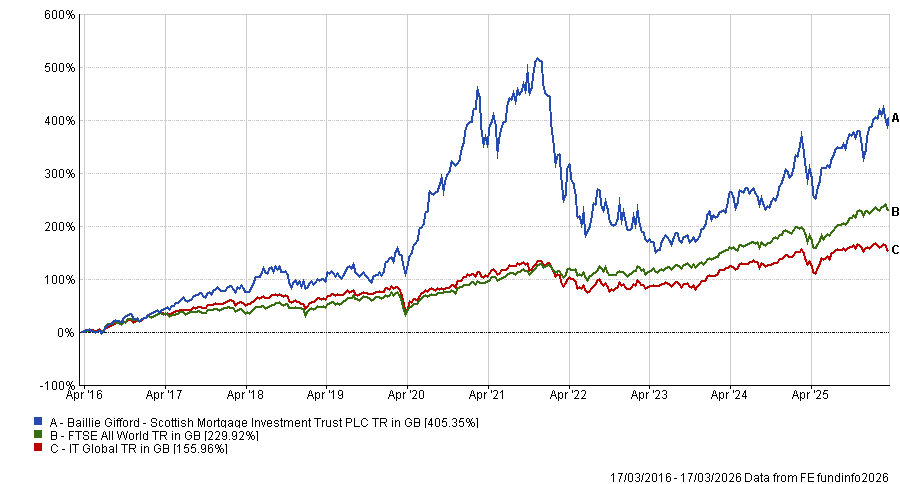
However, recent performance has been lumpy. The trust is the best performer in the IT Global sector over the past decade but suffered significant drawdowns in 2022, losing investors 45.7% in 12 months. It was the best fund in the peer group in 2025, making 24.7%, and has been in first or second place in four of the past 10 years.
Performance of trust vs sector and benchmark over 10yrs
Source: FE Analytics
“Within a portfolio, Scottish Mortgage should primarily act as a source of alpha generation, though should any investor begin to become uncomfortable with the volatility profile, it should be balanced with less volatile investments,” Woodacre concluded.
Elsewhere, Chris Metcalfe, managing director at IBOSS, selected a fund investing specifically in Asian countries with his selection of M&G Asian.
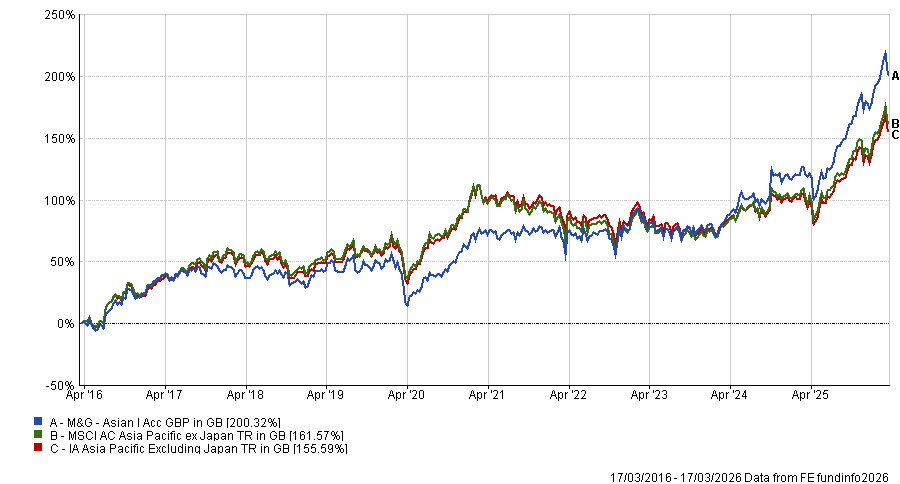
“Managed by veteran Dave Perrett since 2017, this fund has an outstanding track record,” he said. Indeed, over the past 10 years it has tripled investors’ money, a top-quartile return in the IA Asia Pacific Excluding Japan sector.
Performance of trust vs sector and benchmark over 10yrs
Source: FE Analytics
“We have long been overweight to the Asian region and it's an area we favour active management in our Core range. Although the fund has an excellent cumulative performance, it also has produced very strong risk-adjusted returns as well, meaning the investor is being well rewarded for the risk taken as measured by volatility,” said Metcalfe.
“We consider the fund to have more of a value style in outcome, though it styles itself as neutral. We feel that sometimes too much emphasis is placed on pigeonholing funds, when it’s the outcome that ultimately matters for the client.”
The remaining three picks were all targeted at emerging markets. Emma Wall, chief investment strategist at Hargreaves Lansdown, suggested JPMorgan Emerging Markets Growth & Income, managed by veteran Austin Forey and John Citron.
“It is one of the best ways for investors to access the growth in developing economies,” she said.
The managers utilise a team of more than 100 investment professionals across nine countries, giving them on-the-ground coverage in a lot of the markets, which she said was “invaluable given the vast range of countries, cultures and companies within the investable universe”.
“Emerging markets are likely to be volatile – as we have seen in recent market activity – but over the long term this trust offers diversification and growth opportunities.”
Meanwhile, Jason Hollands, managing director of Bestinvest, went for Templeton Emerging Markets Investment Trust. It was launched in 1989, run formerly by veteran investor Mark Mobius, with current managers Chetan Sehgal and Andrew Ness in charge since 2017 and 2018 respectively.
“The managers take a patient, pragmatic approach, seeking companies with sustainable earnings power that they believe are mispriced. The portfolio is well diversified by stock, sector and geography.”
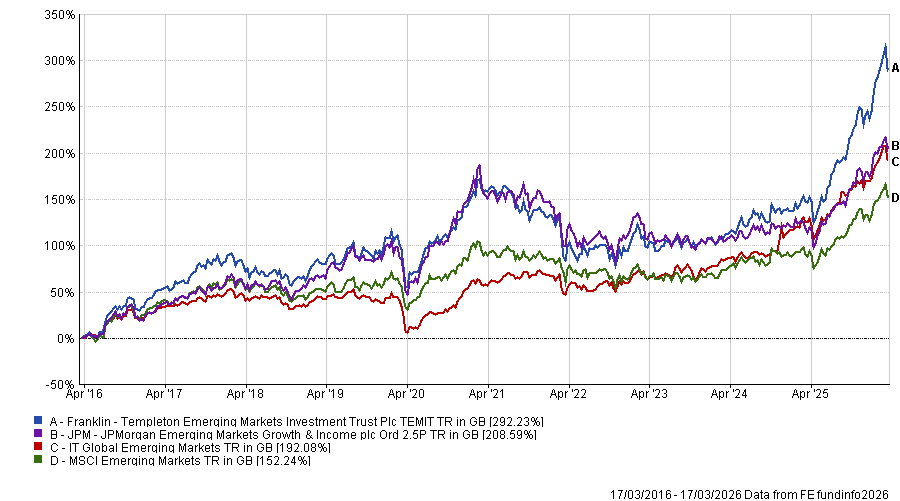
The two trusts are the best and second-best performers in the IT Global Emerging Markets sector over the past 10 years, with Templeton Emerging Markets up 292.2% while JPM Emerging Markets Growth & Income has made 208.6%.
Performance of trusts vs sector and index over 10yrs
Source: FE Analytics
For an open-ended option, Scott Heaney, investment research analyst at Titan Square Mile, selected Redwheel Next Generation Emerging Markets Equity, which is headed by Alpha Manager James Johnstone.
He and his team conduct both macroeconomic and thematic research as well as bottom-up fundamental analysis, which is a “key benefit” in an asset class that is “typically under researched and underrepresented in indices”.
“This offers a level of diversification and access to areas of emerging markets which may be absent from other mainstream emerging market funds,” Heaney said.
However, he noted that the emerging markets are not without their risks, making the asset class suitable for long-term investors. He noted that this fund in particular can be even more volatile as its exposure to smaller emerging and frontier markets “carry additional uncertainty”.
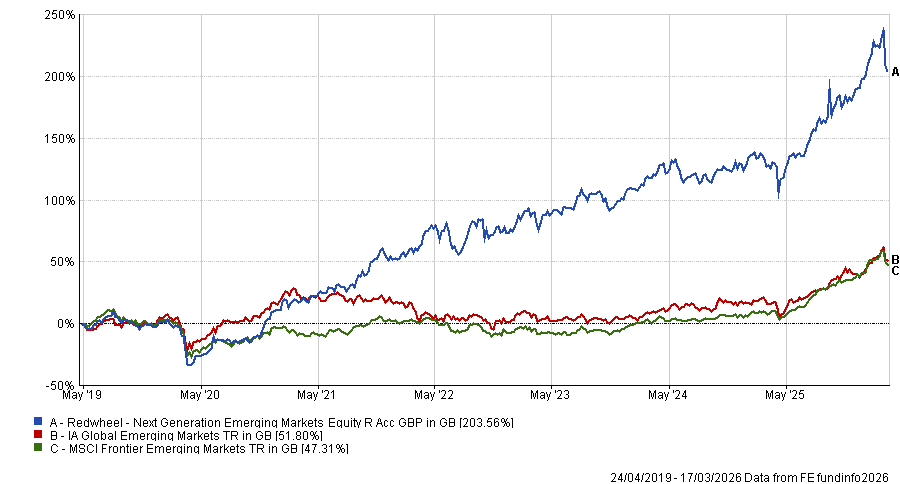
Redwheel Next Generation Emerging Markets Equity has been the best performer over the past five years in the 154-strong IA Global Emerging Markets sector, up 148.7%, as well as since its launch in 2019.
Performance of trusts vs sector and index since launch
Source: FE Analytics
“Whilst it has delivered strong absolute and relative performance since inception, and investors in the fund have been compensated for the risk taken, this is a volatile strategy and performance should be expected to be very variable at times,” Heaney concluded.