






European equities have delivered mixed results over the past decade, with different parts of the market leading at different times. Against this backdrop, it has been challenging for active managers to deliver outperformance year after year.
Yet a select group of actively managed funds beat the index more often than not over the decade.
Trustnet has looked at which actively managed IA Europe ex UK funds most frequently beat the MSCI Europe ex UK index – the most widely used benchmark in the sector – over the past 10 calendar years. As shown in the table below, 10 achieved this in at least seven years.
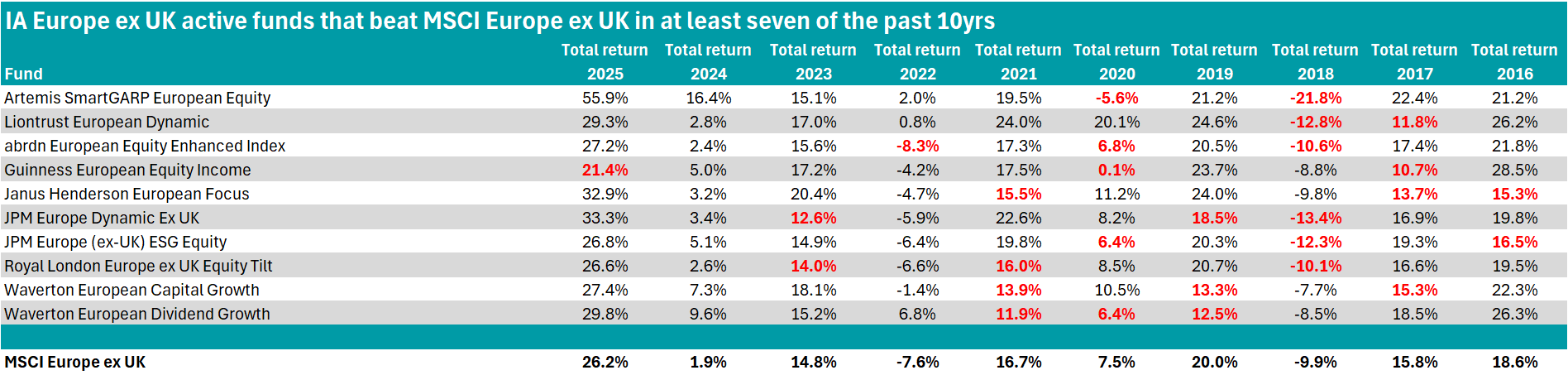
Source: FE Analytics. Figures highlighted in red represent years in which a fund underperformed the MSCI Europe ex UK.
Of course, consistency does not mean smooth returns every single year, as several strategies posted some of the strongest gains in the sector in certain years while appearing among the weakest in others.
Artemis SmartGARP European Equity stands out most clearly. The £1.7bn fund, which is managed by FE fundinfo Alpha Manager Philip Wolstencroft, delivered the strongest return of the 10 funds in 2025, gaining 55.9% – the highest return in the entire sector that year. It also topped the table in 2024 and 2017.
However, the same quantitative ‘SmartGARP’ approach that drove the European fund’s gains – a process which screens for undervalued companies with improving fundamentals – failed to prop up performance during more difficult markets. Artemis SmartGARP European Equity posted the biggest loss of the 10 funds in both 2018 and 2020, losing 21.8% and 5.6% respectively. Its 2018 return was the weakest of the whole sector.
Over the full decade to the end of February 2026, however, it delivered the strongest return of the group, gaining 282.3%.
Similarly, Guinness European Equity Income posted the strongest return of the 10 funds in 2016 with a 28.5% gain and was among the weaker performers in 2017.
Managed by Will James, the fund applies a strict quality filter focused on companies with high and sustained returns on invested capital. The managers currently favour industrials and financials and have previously highlighted their reluctance to participate in the resurgence of European defence stocks.
The £2.5bn Liontrust European Dynamic fund also features prominently in the decade’s strongest years. It posted the best return of the 10 funds in 2019, 2020 and 2021, gaining 24.6%, 20.1% and 24% respectively, although it was among the worst performers in 2017.
Managed by Alpha Managers James Inglis-Jones and Samantha Gleave, the concentrated, high-active-share portfolio has attracted significant inflows and been recognised for its strong information ratio.
RSMR analysts described the fund process as “distinct” and “consistently implemented”, while City Asset Management added the fund to its buy list in 2023, citing its ability to perform in both value- and growth-led markets.
Janus Henderson European Focus led the group of 10 funds in 2023 with a 20.4% gain, placing it among the top 10 performers in the entire sector that year.
The fund, now managed by Marc Schartz and Robert Schramm-Fuchs following John Bennett’s retirement in 2024, blends large-cap blue-chip holdings with mid-cap names to form a 30-40 stock portfolio.
The fund was identified as one of 22 in the sector that delivered top returns over one, three, five and 10 years.
Bestinvest analysts have highlighted the management team’s “pragmatic approach” and the fund’s ability to invest early in high conviction ideas.
Passive funds
Several passive funds in the IA Europe ex UK sector also delivered notably consistent results, with a number of them outperforming the MSCI Europe ex UK index more frequently than many of their actively managed peers.
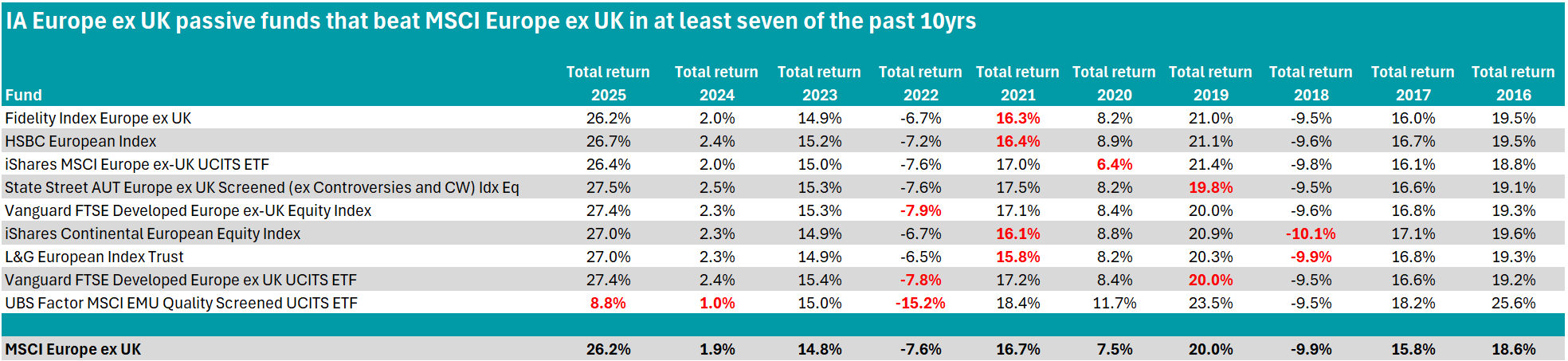
Source: FE Analytics. Figures highlighted in red represent years in which a fund underperformed the MSCI Europe ex UK.
Passive funds are designed to replicate the performance of their chosen index as closely as possible for a much lower fee than actively-managed funds – so repeated outperformance can indicate other factors are at play.
First, some of the strategies do not replicate the MSCI Europe ex UK index used in this analysis. For example, HSBC European Index tracks the FTSE Developed Europe ex UK index, which has slightly different country and sector weightings. These variations can lead to small but persistent performance differences.
Second, last year model portfolio service provider Sparrows Capital told Trustnet that any passive fund that consistently outperforms the index it is designed to track warrants an “amber flag”, as this may indicate that the strategy is behaving more active than intended.
Third, some passive funds generate additional revenue by lending out shares to short sellers. The income from securities lending can provide a modest performance boost relative to the benchmark.
Finally, even passive funds that aim to replicate the benchmark can differ slightly in how they weight individual constituents, which can also accumulate over time and contribute to outperformance.