






The technology sector has been a powerful engine of global equity returns for more than a decade and the recent surge in AI has given it fresh momentum.
With digital innovation, semiconductor demand and AI-enabled productivity shaping the next phase of market leadership, investors may be looking for more direct exposure within their portfolios. The question, however, is which specialist strategies are best placed to capture it.
Two of the most established options in the IA Technology & Technological Innovation sector are the €27.4bn Fidelity Global Technology fund and $12bn Polar Capital Global Technology fund, both of which have grown substantially over the past few years as investor appetite for dedicated tech exposure has accelerated.
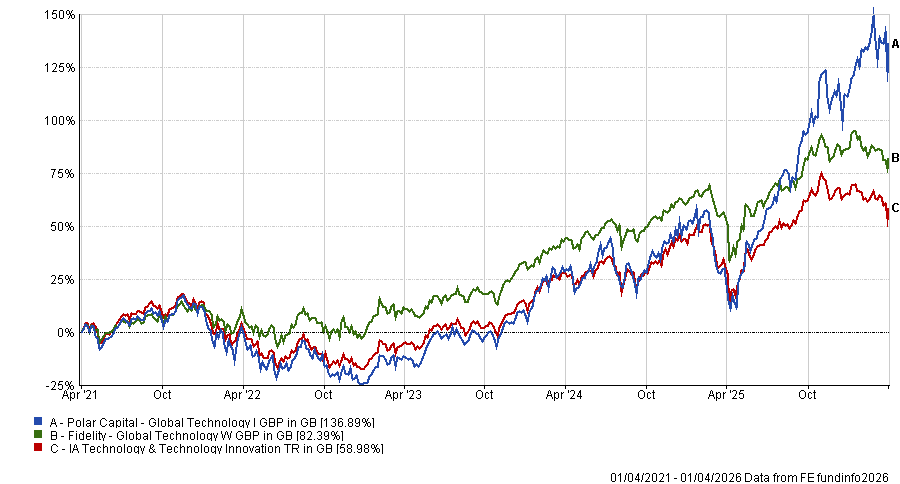
Both have also delivered top-quartile returns in four of the past 10 calendar years. The Polar Capital strategy has logged stronger returns since 2023, due to its more explicit AI tilt, while the Fidelity fund has tended to offer stronger downside protection – most notably in 2022, when it fell 13.5% compared with Polar Capital Global Technology’s 31.7% drop and the sector’s 27.5% decline.
Performance of the funds vs sector over 5yrs
Source: FE Analytics
Polar Capital Global Technology is run by a deep bench of sector specialists, blending top-down thematic views with bottom-up stock selection to formulate its 60-85 holdings with no benchmark constraints. Meanwhile, Fidelity Global Technology, under longstanding FE fundinfo Alpha Manager Hyunho Sohn, takes a purely bottom-up approach focused on quality growth, cyclical opportunities and special situations.
To understand which of these two tech titans fund pickers prefer – and why – Trustnet asked experts for their views.
Paul Angell, head of investment research at AJ Bell, picked the Polar Capital fund, noting that it “boasts one of the largest technology research teams in the market, providing excellent satellite growth exposure within portfolios”.
When compared to Fidelity Global Technology, Angell said the Polar Capital strategy typically invests in faster-growing stocks.
“This approach has meant the fund has been more geared into the outperformance of the tech sector in recent years, particularly over the past 18-24 months with all the disruption and opportunities brought about by the developments in, and adoption of, AI across the global economy,” he said.
To generate this outperformance, Polar Capital Global Technology currently has a higher weighting to larger companies, particularly those based in the US, that have, in aggregate, grown their earnings twice as fast as the companies in the Fidelity portfolio over the preceding three years, according to Angell.
“That said, nothing in life comes for free and the Polar Capital fund is on a 40% valuation premium to the Fidelity fund, recording 26.5x and 18.9x price-to-earnings (P/E) ratios respectively, as of the end of February 2026,” he noted.
Ben Yearsley, director at Fairview Investing, also picked Polar Capital Global Technology, noting that he has owned the fund for over 20 years. The management team is “the pinnacle of tech investing”, he said.
While tech-focused funds have historically been an attractive satellite holding alongside a more traditional portfolio, Yearsley questioned whether a fund like Polar Capital Global Technology could be considered a core holding, “given how entwined tech is in everyday life”.
However, he maintained that more defensive funds are appropriate to hold alongside it, such as those targeting insurance, infrastructure or even smaller companies.
Meanwhile, Dairus McDermott, managing director at FundCalibre, made the case for holding both funds together as core tech fund holdings.
“They both sit in that top tier of actively managed technology strategies if you want meaningful exposure to the dominant US tech frontier,” he said.
“Both funds have deeply experienced sector specialists with long tenures – while Polar Capital employs a dynamic duo, Fidelity has a single highly rated manager at the helm.”
He noted that the Polar Capital strategy has delivered “exceptionally” – particularly over shorter timeframes. “It has also shown an ability to bounce back sharply post-2022,” he added.
McDermott said the Fidelity strategy has also been strong over the cycle – albeit “not quite as explosive in terms of returns”.
He noted that Polar Capital can be seen as a more direct AI pure play in an investor’s portfolio, making the Fidelity and Polar Capital strategies more complementary rather than too similar.
McDermott said he would pair these funds with a more general global fund such as T. Rowe Price Global Select Equity.
Rob Morgan, chief analyst at Charles Stanley, agreed that both funds can have their place in an investor’s portfolio.
“Fidelity Global Technology is more of a steady eddy in the sector, taking a more conservative, value-focused approach, with plenty of diversification across subsectors,” he said.
Despite this, he leaned more toward Polar Capital Global Technology due to the management team’s experience in identifying industry trends and inflection points in the sector.
“It may suit investors who wish to gain access to a number of core technology themes and favour a large-cap approach that won’t generate a high level of tracking error – just be aware of the concentration risk within certain mega-cap names and the managers’ firm belief in the AI theme,” Morgan noted.
“These attributes make it a punchy satellite position in a portfolio to sit alongside more mainstream global equity funds.”