






Cybersecurity has moved to the forefront of global risk discussions as digital threats escalate across government, corporate and critical-infrastructure networks.
The World Economic Forum’s (WEF) latest ‘Global Cybersecurity Outlook’ highlights a broad rise in threat activity, from ransomware and supply chain breaches to state-linked intrusions aimed at disrupting essential services.
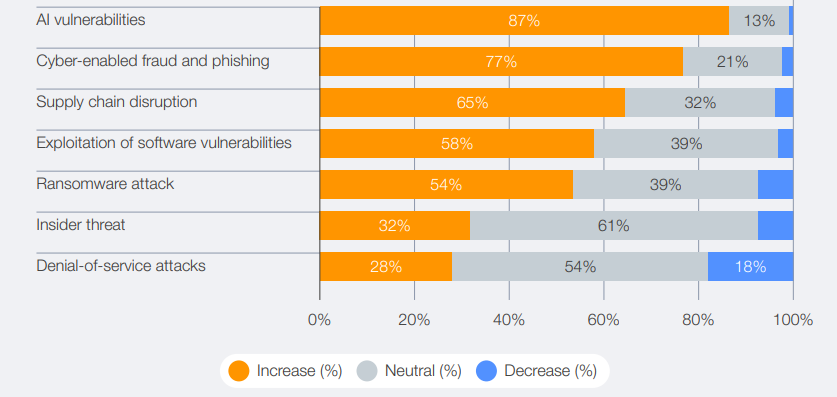
The build-out of AI has amplified risks across the landscape. Indeed, 87% of respondents to the WEF survey identified AI-related vulnerabilities as the fastest-growing cyber risk in 2025.
Responses to the question: ‘In the past year, do you think the following cyber risks have increased, decreased or stayed the same?’
Source: World Economic Forum
The escalation in threat activity is sharpening some investors’ focus on companies with direct exposure to the heightened cybersecurity demand, as well as those strengthening their own defences to safeguard long-term growth.
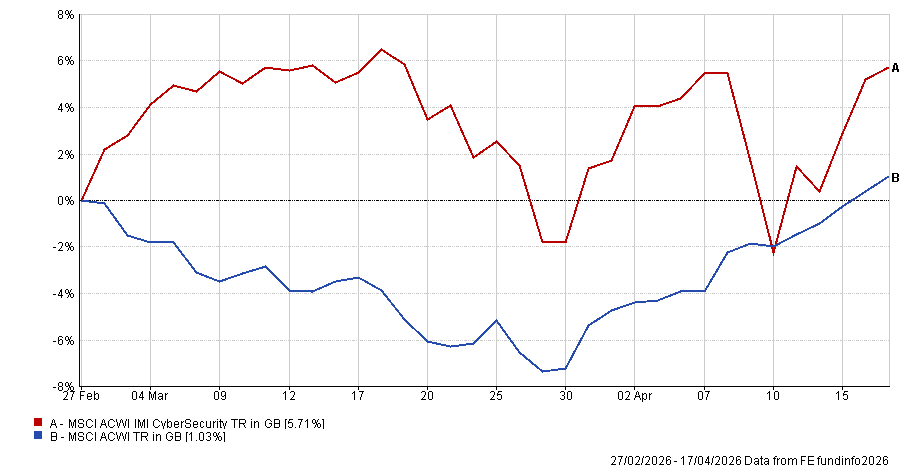
For example, since the start of the Iran war, the MSCI Cybersecurity index has made 5.7% versus 1% from the MSCI AC World – as many expect Iran-affiliated proxies to step up cyber-warfare against the country's enemies.
Performance of MSCI ACWI IMI Cybersecurity vs MSCI ACWI since the 2026 Iran war
Source: FE Analytics
As such, Trustnet asked fund managers which companies they believe are best positioned to benefit.
NCC Group
Ed Wielechowski, co-manager of Odyssean Investment Trust, pointed to information assurance business NCC Group.
It spans the full cybersecurity lifecycle, from consulting on and planning cyber strategies to fully outsourcing security services.
New company management was implemented in 2023 to implement and execute an updated strategy aimed at delivering revenue from a broader service portfolio and addressing the full cybersecurity lifecycle. Since then, Wielechowski said the company has “turned from an acquisition-built group into a coherent whole”.
“The turnaround has started to deliver, with the group returning to growth in recent quarters [following a period of underperformance]; and management setting out ambitions that the new standalone cyber business Escode should deliver mid-teens EBITDA margins,” he added.
Wielechowski said he expects the company to further benefit from the consequences of widespread AI adoption as there will be greater demand for organisations with cyber-threat expertise.
“Simultaneously, the opportunities for NCC to deploy AI across its own operations – improving consultant productivity, detection capabilities and service delivery – are substantial.”
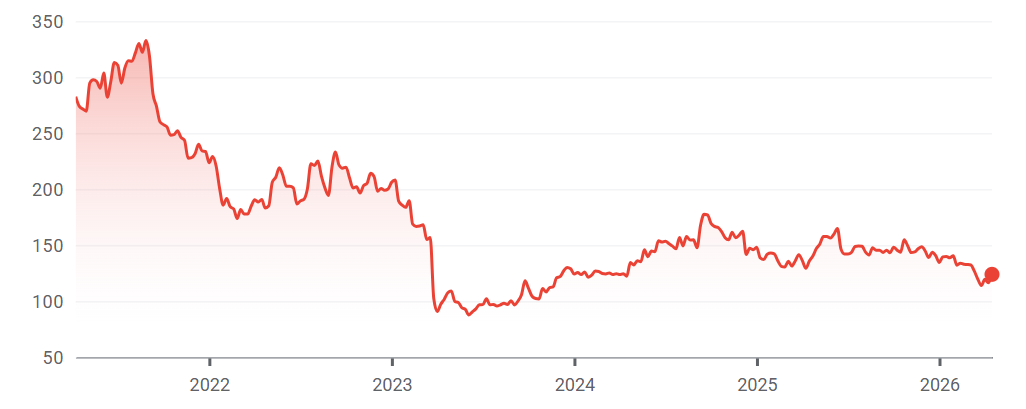
Despite this outlook, Wielechowski said the business is materially undervalued, “largely because the investment case is currently obscured by corporate activity”.
Stock price performance over 5yrs
Source: Google Finance
Invisio
Rene Petersen, portfolio manager at Nordea Asset Management, suggested Invisio, a Swedish communications technology provider.
“As European policymakers prioritise resilience, industrial capacity and reduced dependence on external suppliers, demand is accelerating for capabilities designed, produced and maintained within Europe,” Petersen said.
Invisio is a “trusted supplier” to NATO and EU forces through its offering of proprietary technology for secure communications.
Among its achievements in 2025, Invisio secured a 10-year US Coast contract – its first major maritime agreement and a potential springboard into wider maritime platforms.
“With strong earnings and additional growth potential through new product lines, Invisio stands to benefit further as the European Defence Fund allocates €8bn for next-generation technologies by 2027.”
For the full year of 2025, Invisio generated £1.4bn in sales, equating to 5% reported growth.
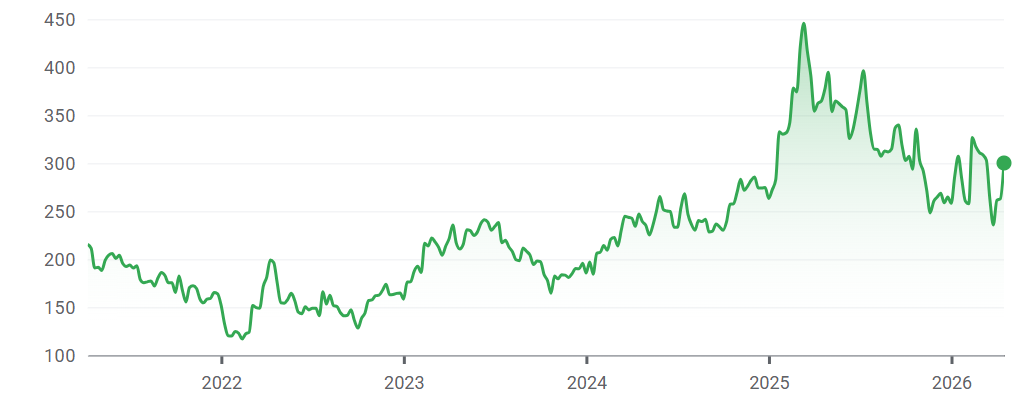
Stock price performance over 5yrs
Source: Google Finance
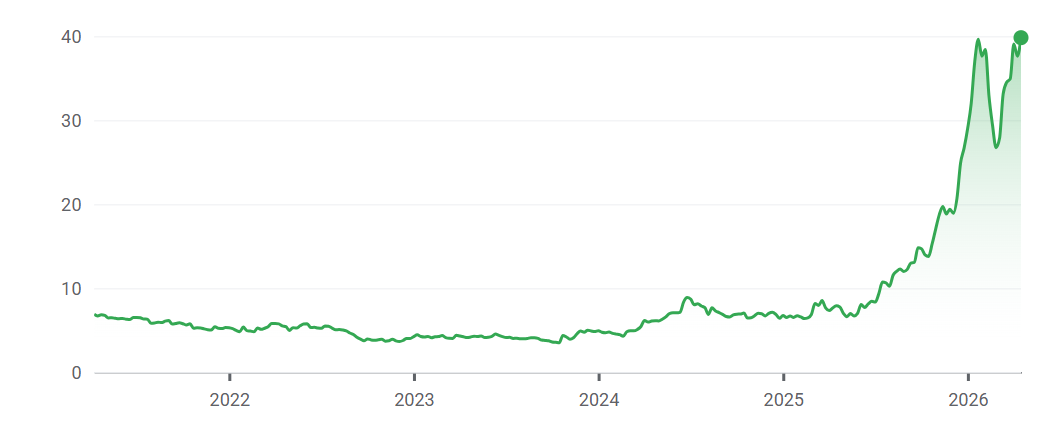
Bittium
Shayan Heidari, manager of Finserve Global Security Fund, highlighted Finnish engineering company Bittium.
He noted that Bittium is a relatively small but profitable company, with a strong niche in secure communications for the defence sector, where barriers to entry are high and customer relationships long-term, providing structural growth tailwinds linked to rising military and cyber budgets.
“Bittium’s products offer European militaries independence from US-owned communications while still meeting NATO-level requirements,” Heidari said.
Net sales grew by 40.1% to €119.3m for the full year of 2025, while the operating profit reached €19.4m – a 16.3% margin.
Heidari said that the company’s balance sheet remains robust, with an equity ratio of 70.9%, net-debt free.
Its European positioning means it will likely further benefit from European governments prioritising sovereign suppliers in 2026, he said.
Stock price performance over 5yrs
Source: Google Finance
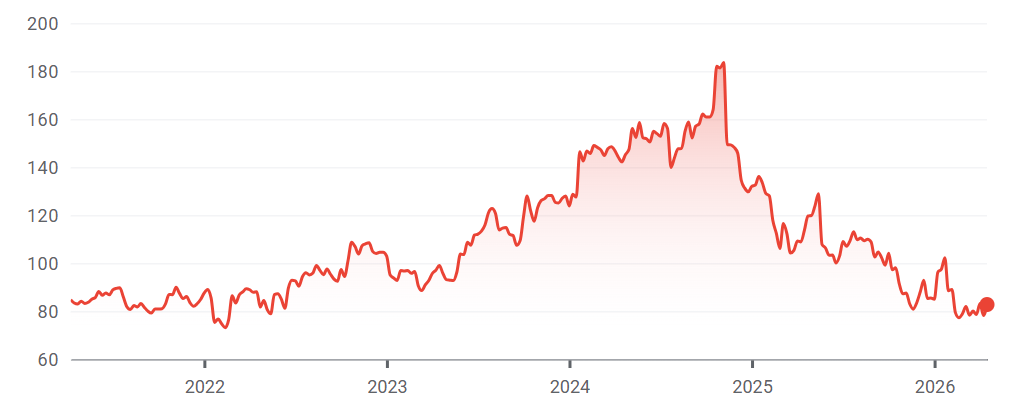
Booz Allen Hamilton
Graeme Bencke, manager of Amati Global Innovation, picked Booz Allen Hamilton – a leading provider of cyber solutions to the US federal government and intelligence agencies.
“Their often-classified projects mean that they are frequently overlooked by investors within the AI/cyber peer group, despite their cutting-edge sophistication,” Bencke said.
For example, Booz Allen’s new Vellox AI-protection product suite “would be a highly rated standalone AI software business, if not hidden within the wider group”.
Bencke said the company’s shares fell almost 60% following the creation of the US Department of Government Efficiency, which targeted perceived contractor overspend and pushed valuation multiples to unusually low levels despite the firm’s central role in cybersecurity and space. As such, he said the stock remains attractively valued.
Stock price performance over 5yrs
Source: Google Finance
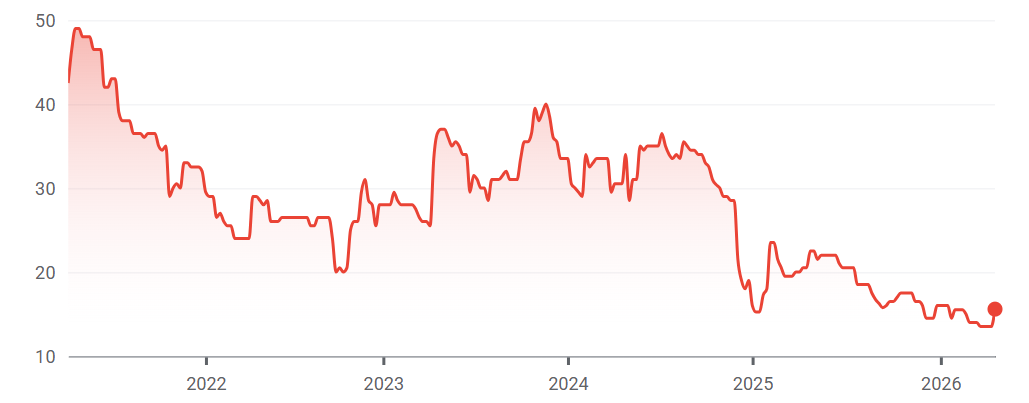
SysGroup
Technology solutions provider SysGroup was highlighted by Ken Wotton, manager of Baronsmead Venture Trust. As a managed-services provider, SysGroup supports small- and medium-sized enterprises (SMEs) with cloud hosting, cybersecurity and digital transformation.
“Its end-to-end solutions assist in building robust cybersecurity systems spanning not only the core business but also its supply chains – a critical yet often overlooked area of vulnerability for many groups,” Wotton said.
With a diverse client base spanning finance, healthcare, education and professional services, we believe SysGroup is well positioned for sustained growth.”
This conviction has been reinforced by the company’s recent full-year results.
Its latest trading update showed a 7.6% growth in revenue to £22.1m for the year to 31 March 2026. The adjusted EBITDA is expected to come in at £1.2m for the full year of 2026, up from £900,000 the previous year and ahead of market expectations.
Stock price performance over 5yrs
Source: Google Finance
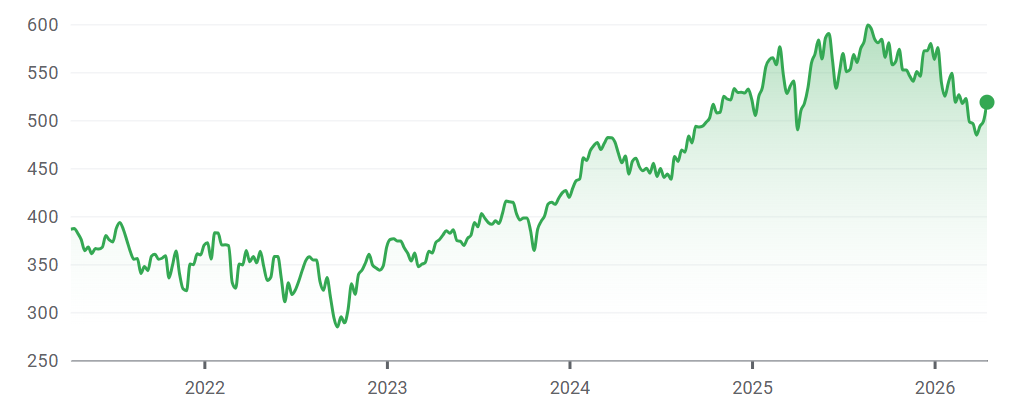
Mastercard
Greg Eckel, portfolio manager at Canadian General Investments, pointed to global payment network provider Mastercard.
“Its long-term success reflects not only the power of patient compounding, but also its unique positioning at the heart of one of the most enduring shifts of the 21st century – the move from cash to digital transactions,” he said.
Beyond its core payments business, Mastercard is also increasingly embedding cybersecurity at the centre of its value proposition.
“As digital transactions scale, so too does the complexity of fraud and financial crime, making trust and security critical differentiators.”
Since 2018, the company has invested over $10.7bn to stay ahead of these threats, building AI-powered fraud defence system Safety Net (which prevented $50bn in fraud between 2022 and 2024), while also acquiring firms like Recorded Future to strengthen its real-time threat intelligence offering.
“Mastercard is monetising security through a growing suite of value-added services spanning fraud detection, identity verification and risk analytics, creating high-margin revenue streams layered on top of its core network,” Eckel added.
In 2025, the company’s net revenue reached $32.8bn – up 16% on the previous year – and net income was $15bn. The adjusted earnings per share hit $17.01.
Stock price performance over 5yrs
Source: Google Finance