






JOHCM UK Dynamic has been through a challenging period since the departure of longstanding manager Alex Savvides in 2024, with assets under management (AUM) falling sharply from £1.3bn in 2023 to around £400m as at the beginning of May 2026.
However, co-managers Vishal Bhatia and Tom Matthews – who have been at the helm alongside FE fundinfo Alpha Manager Mark Costar since 2024 – insist that the strategy has remained true to its philosophy.
“The flows are not really the issue for us as we don’t measure success by AUM. The main issue was taking ownership of the portfolio,” said Matthews.
“There were understandably some large institutional investors who were nervous about whether there would be a change in the process, but we were very clear that the market inefficiencies that this process is designed to capture remain the same.”
Bhatia added: “Yes, it is challenging when a fund goes from over a billion to roughly half that size in that time, but our focus is on maintaining the portfolio structure so that investors entering and exiting are treated the same from a size and risk perspective.”
Liquidity is key in these situations. As Paul Angell, head of investment research at AJ Bell, explained, the position “neither a fund manager or investors want to be in is where the fund’s highest-quality and most liquid assets have been sold to fund outflows, while the fund’s less desirable stocks remain”.
But with around 85% of the fund invested in stocks with over £2bn of market capitalisation – and this rises to 90% when including stocks above £500m – Bhatia argued JOHCM UK Dynamic remains a “highly liquid” fund.
“We are also quite nimble, as we can take the position size that we want,” he added.
Angell confirmed that a smaller fund size, providing outflows stop, can allow managers to be “more nimble in their allocations and trading”.
Instead of putting all their focus in stemming the outflows, the managers identified a more pressing concern upon taking control of the strategy: the level of risk in the portfolio.
“That is why there has been quite a bit of turnover in position sizes over the past two years,” said Matthews. This activity has been about reducing risk by bringing down leverage, reducing beta and improving the overall resilience of the portfolio.
In the past two years, Matthews said they have added 14 new positions to the portfolio and exited 16.
“For context, that compares against a current portfolio of just 38 stocks and the typical holding period for our business transformation ideas is between 3-5 years – but often longer,” he noted.
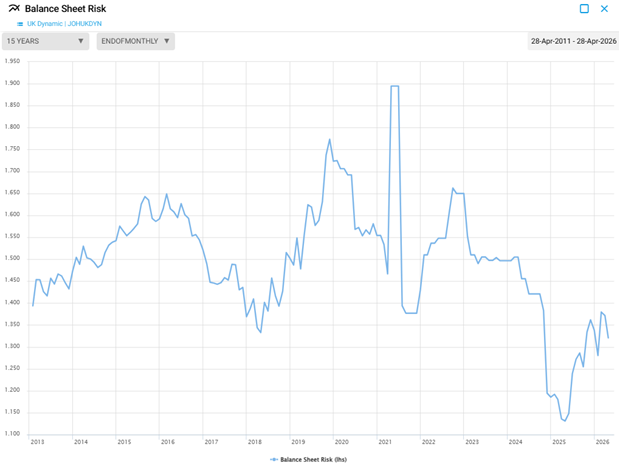
To reduce leverage, the managers monitor each holding following parameters including net debt and earnings before interest, taxes, depreciation and amortisation (EBITDA), as well as, where available, credit default swap (CDS) spreads and credit rating outlooks.
As shown in the chart below, the fund’s balance sheet risk since the beginning of 2024 is at its lowest level in 15 years.
The fund’s balance sheet risk change
Source: JOHCM, Bloomberg
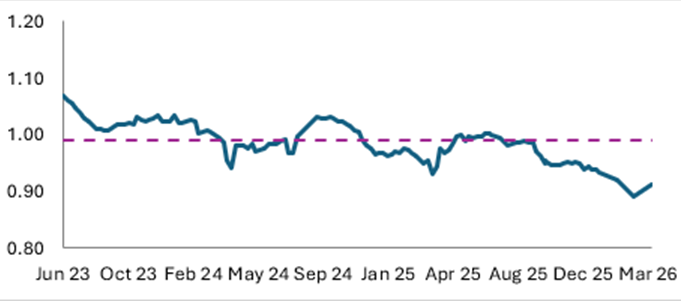
Similarly, the fund’s forward-looking beta over the past three years was also lowered.
The fund’s predicted beta over 3yrs
Source: JOHCM
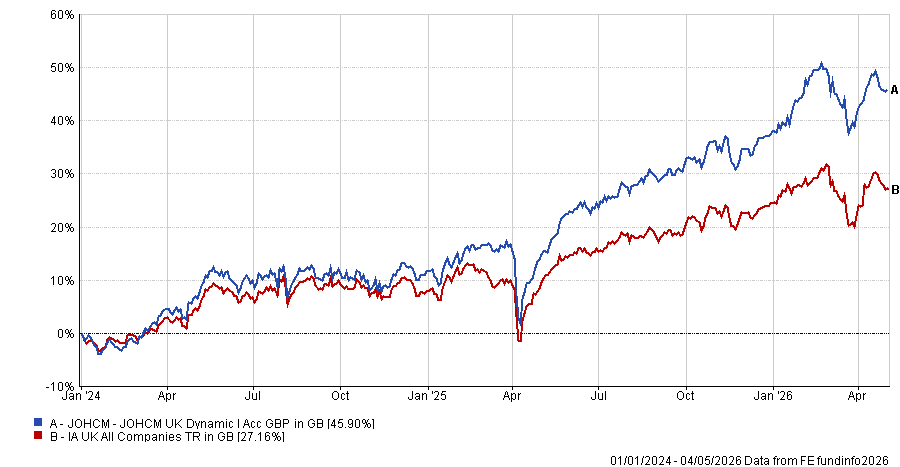
Fund Research Centre has recommended the fund after the change in leadership, citing the trio’s experience and the resilience of the established investment process.
Performance of the fund vs sector since 2024
Source: FE Analytics
Today, the JOHCM UK Dynamic portfolio is shaped by stocks which the managers can access for bargain prices, with Bhatia viewing the UK market as “the Costco of global equities”.
“You walk into Costco and you can buy high-quality items across global brands – and you can get them at very good prices,” he said.
“Similarly, we feel we are operating in a market where you can get access to global brands at valuations that are at a significant discount to their fair value and to their global peers.”
Bhatia pointed to British beverage business Diageo as an example, which has seen its share price more than halve over the past five years.
JOHCM UK Dynamic invested in Diageo after Debra Crew departed as CEO in 2025, replaced by interim chief executive officer Nik Jhangiani until former Tesco boss Dave Lewis took over the role in January 2026.
“There has been a clear commitment to a free cashflow-focused business that will address the balance sheet,” Bhatia said.
“We firmly believe the deleveraging story at Diageo is strong and underappreciated. While we do appreciate that in the long run there is a moderation trend, at the same time the valuation is sitting at a multi-decade low, free cashflow is in the high single digits and the balance sheet is improving.”
As such, Bhatia said that Diageo is at the start of a multi-year transformation.
He also believes online trading platform IG is in a similar position, following the appointment of former Paddy Power Betfair chief Breon Corcoran in 2024.
“[Corcoran] took over a business that was essentially accepting that the active user base would not grow forever – the new chief executive comes in and fundamentally challenges that,” Bhatia said.
A third example in the fund’s portfolio is British multinational advertising and communications company WPP.
“The market capitalisation peaked at around £24bn and is now sub-£3bn,” Bhatia said. The company’s share price has also fallen by over 70% in five years.
Bhatia noted that a “transformation is underway”, with the likes of former BT chief executive officer Philip Jansen sitting in a leadership role.
Nonetheless, the UK market outlook looks uncertain, both Bhatia and Matthews agreed.
Such an uncertain landscape also makes their continued efforts to prioritise risk management important, added Matthews.
“What we do know is that uncertainty is high, change is rapid and narratives are becoming more extreme and more binary – that creates inefficiencies and it also increases risk if you don’t manage the portfolio carefully,” he said.
“We believe this fund is now running with a lower level of risk than at any other point in its history. That combination – inefficiency plus discipline – is exactly where active investors can add value.”