






Listed real estate, in the form of stock exchange-quoted property companies and real estate investment trusts (REITs), has spent much of the past three years in the investment wilderness.
Weaker bond prices, rising interest rates, concerns about office and shopping space demand, and competition from higher-yielding cash, as well as for infrastructure and technology investment opportunities, have created challenging conditions.
Some stalwarts of the sector have become synonymous with structural decline, particularly following the post-pandemic reassessment of commercial property.
Yet beneath the headlines, a different picture is emerging. Across many segments of the real estate market, fundamentals have strengthened materially while valuations remain subdued.
This divergence raises an important question: could listed real estate be one of the most mispriced asset classes in today's market? The answer depends on whether investors are focusing on short-term narratives or long-term economics.
Looking beyond the office debate
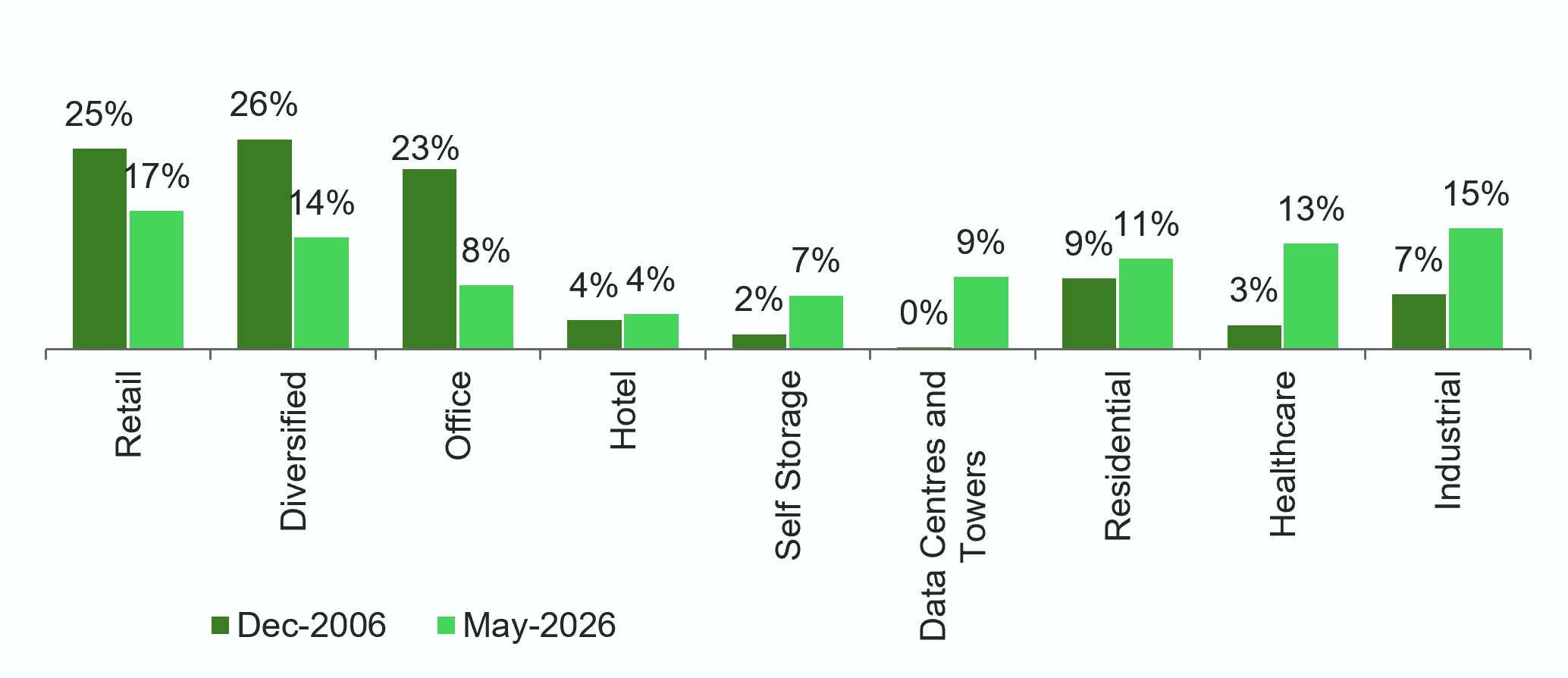
One of the biggest misconceptions about listed real estate is that it remains heavily dependent on traditional office buildings. The composition of global REIT markets has evolved significantly over the past two decades.
Global REIT Index Composition – 2006 vs 2026
Source: Bloomberg
The sector has steadily shifted away from areas facing structural challenges and towards parts of the economy benefiting from long-term growth trends.
Today, data centres, logistics facilities, residential housing and healthcare property account for a growing share of the global listed real estate universe.
This evolution reflects a simple principle. Real estate ultimately houses economic activity in virtually every shape and form. As economies change, commercial property markets adapt alongside them.
The rise of e-commerce created demand for logistics facilities. Demographics matter and the ageing population in many developed countries has increased the need for healthcare and senior housing. The rapid growth of digitalisation and artificial intelligence is driving unprecedented demand for data centres.
The real estate sector is not static. It is constantly reshaping itself around the needs of the modern economy.
The supply story investors may be overlooking
While much attention has been paid to demand trends, supply dynamics may be even more important for future returns. Apart from data centres, where demand is at extreme levels and tenants are seemingly rent insensitive, across many developed markets and sectors, new commercial real estate construction has slowed dramatically.
Higher interest rates, elevated financing costs and rising construction expenses have not been offset by commensurate rental growth. Consequently, many development projects are economically unattractive. In other words, developers simply cannot achieve returns that justify starting new projects.
More importantly, this supply restraint is occurring at a time when occupancy rates remain relatively high and there is evidence of growing tenant demand, particularly for better-located, higher-quality properties.
The result is a mismatch between available space and ongoing tenant demand.
For existing property owners, this creates an increasingly favourable backdrop. When little new space is being delivered, landlords gain pricing power in new lease negotiations. With low vacancy rates likely to persist, rental growth can accelerate and cashflows become more resilient.
These dynamics are visible across a range of sectors, including logistics facilities to residential and seniors housing as well as prime retail assets.
The valuation disconnect
Perhaps the most compelling aspect of the current opportunity lies in valuation. Unlike many other asset classes, real estate offers investors a tangible reference point for assessing intrinsic value: replacement cost.
Replacement cost reflects what it would cost to acquire land and construct an equivalent asset today. While it is not a perfect measure, it provides a useful anchor for long-term valuation.
In many markets, listed real estate companies are currently trading at or below estimated replacement cost. In practical terms, investors can buy existing, income-producing assets through public markets for less than it would cost to build them from scratch.
Historically, this has been an unusual situation. When listed property trades at a premium to replacement cost, developers are incentivised to build new assets, eventually increasing supply and moderating returns. Conversely, when assets trade below replacement cost, development activity tends to stall because building becomes uneconomic.
That appears to be the environment today. The combination of subdued valuations and limited new supply creates a potentially powerful setup for future returns for REITs, particularly underpinning stronger rental cashflows and consequent dividend growth.
Stronger balance sheets than many assume
Another legacy misperception is that listed property companies are excessively leveraged and therefore vulnerable to higher interest rates.
While this concern may have been justified during previous cycles, many listed real estate companies entered the recent period of rising rates with significantly stronger balance sheets than in the past.
Over the past decade, many REITs have reduced leverage, extended debt maturities and diversified funding sources. Access to public debt markets has allowed many companies to maintain investment-grade credit profiles and avoid excessive dependence on bank lending.
As a result, the sector has generally proven more resilient than many investors anticipated.
In fact, some REITs have recently been repurchasing their own shares, reflecting management teams' belief that public market valuations fail to reflect underlying asset values.
Furthermore, we are beginning to see an increase in M&A activity within the sector, which again highlights that management sees better value in joining with or acquiring rival REITs than in buying real estate directly.
A changing opportunity set
None of this suggests that every real estate segment will prosper equally. Property remains a highly local and asset-specific business.
Location quality, tenant demand, infrastructure access and changing consumer behaviour all matter enormously. Some assets will continue to face structural challenges, particularly where oversupply or weak demand persists.
However, broad-brush assumptions about the entire sector may no longer reflect reality.
Today's listed real estate market includes some of the facilities underpinning digitalisation, some of the housing required to support demographic change, and some of the physical assets enabling modern commerce.
At the same time, many companies are trading at valuations that imply significant pessimism despite relatively healthy operating fundamentals.
Markets are often efficient over the long term, but they are not always efficient in the short term. When sentiment becomes detached from fundamentals, opportunities can emerge.
For investors willing to look beyond recent headlines, listed real estate may represent one of the more interesting opportunities of that disconnect today.
Andrew Parsons is co-portfolio manager of the Nedgroup Investments Global Property fund. The views expressed above should not be taken as investment advice.