






IA North America funds focusing on small- and mid-caps or on unloved value stocks have rocketed back to the top of the leaderboard in 2026 having spent much of the past decade in the doldrums.
US large-cap growth stocks have been the place to invest over the past decade, with the S&P 500 up 304.8% over 10 years. But the tide has turned so far in 2026.
Mid- and small-caps, represented by the Russell 2500 index, have made 24.1% over six months, more than double the 11.5% made by the S&P 500 index.
This partly reflects the subdued returns from the mega-cap US tech names, with the Magnificent Seven underwhelming in recent months as the market has moved on from the hyperscalers to a broadening out of the AI theme.
This has boosted specialists in the mid-cap space, which have enjoyed the double whammy of a broadening market and a strong US economy, which remains resilient despite an unstable geopolitical backdrop.
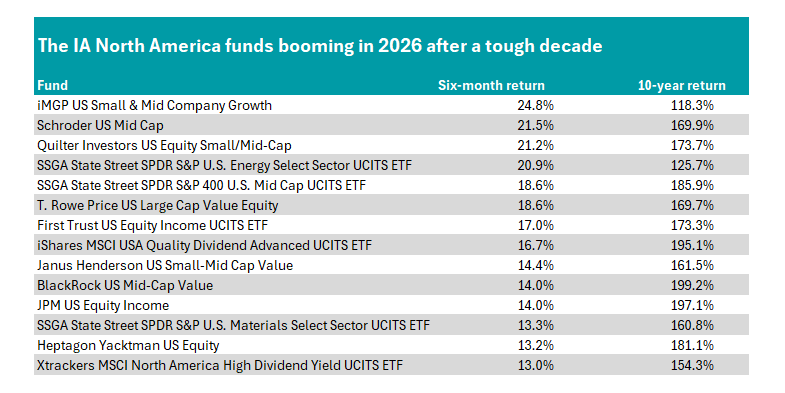
As a result, funds focusing on the lower end of the market capitalisation spectrum dominate the table below, which looks at portfolios that have struggled over the past decade but are rebounding strongly in 2026 so far.
The iMGP US Small & Mid Company Growth fund is the top performer amongst the group, up 24.8%, but it is far from alone. In total, six mid- and small-cap specialists populate the 14-strong table below.
Source: FE Analytics
Schroder US Mid Cap is in second place, up 21.5%. It is one of two funds on the list rated by analysts, with RSMR backing the fund.
Its bottom-up approach focuses on companies with a market cap of between $750m and $10bn, giving managers Robert Kaynor and Joanna Wald a universe of 2,000 stocks, which they then split into three categories: steady eddies, mispriced growth and turnaround stories.
"The strategy prides itself on enabling investors to access a riskier asset class within North American equities at a lower level of risk," RSMR analysts said.
Analysts at the Fund Research Centre also rate the fund, noting it has a "well-established process" that provides investors with a "thoughtful approach to investing in mid- and small-cap companies from a well-resourced and experienced team".
Quilter Investors US Equity Small/Mid-Cap is third on the list with a 21.2% return so far in 2026. It is joined by SSGA State Street SPDR S&P 400 U.S. Mid Cap UCITS ETF, Janus Henderson US Small-Mid Cap Value and BlackRock US Mid-Cap Value as the other funds hunting in the small- and mid-cap arena.
The other clear turnaround story has been the rise of value. For example, T. Rowe Price US Large Cap Value Equity appears on the list having made 18.6% over the past six months.
Run by John Linehan and Gabriel Solomon, the fund invests in large businesses that are currently on discounted valuations relative to their historical average and/or the average of their industries.
Analysts at Vanguard said in their end of year review for 2025 that US value stocks could do well in 2026, as they had "yet to fully price in the potential long-term benefits of AI adoption".
"As AI diffuses across all sectors of the economy, value-orientated sectors such as industrials, financials and select consumer segments may be better positioned to realise efficiency gains and grow earnings, making them potentially more attractive in the medium term," they said.
This has proven the case, with the AI trade moving from hyperscalers to semiconductors and (latterly) to those involved in the build-out of data centres. On the flipside, traditional software companies have been hit hard as the market has priced them as AI losers.
Elsewhere, the outbreak of the Iran war led to an oil price spike after the Strait of Hormuz was closed, boosting energy stocks – a traditionally 'value' hunting ground.
This market rotation can also explain the prevalence of income strategies, which are often closely aligned to value funds as growth stocks do not tend to pay out dividends.
JPM US Equity Income makes the list and is a firm favourite among experts. It is included among Barclays Direct Investing's recommended list, with analysts noting it is a "reliable equity income product managed by an experienced portfolio management team".
Run by Clare Hart, Andrew Brandon and David Silberman, the fund looks for companies with durable business models, strong cashflows, consistent earnings and experienced management teams, all while targeting a dividend yield ahead of the S&P 500 over a full market cycle.
It also appears on the best-buy list of AJ Bell, where analysts said: "This disciplined, quality-based approach to investing in the US is a strong feature for investors seeking a differentiated approach compared to the standard S&P benchmark."
The fund was joined on the list above by passive income options First Trust US Equity Income UCITS ETF, iShares MSCI USA Quality Dividend Advanced UCITS ETF and Xtrackers MSCI North America High Dividend Yield UCITS ETF.
This is part of an ongoing series. Previously we have looked at the UK and Asia.