






Just 42% of active funds beat their passive equivalents in the first half of 2026, unchanged from the same period in 2025, according to AJ Bell's latest Manager versus Machine report.
Asia Pacific ex Japan and global emerging markets funds performed best as 65% of active funds here outperformed passives over the six-month period, the strongest result since AJ Bell launched the report in 2021. Global emerging markets funds followed close behind, with 63% beating passives, a three-year high.
Dan Coatsworth, head of markets at AJ Bell, said: "Emerging markets and Asia Pacific ex Japan regions were among the best-performing parts of the investment universe. Their success was helped by a market rotation from the US mega-cap tech stocks spending big money on AI (i.e. most of the Magnificent Seven) to beneficiaries of this spend.
"Chip companies ruled the roost, including memory chip specialists who benefited from a demand spike in a supply-tight market. Many of the big chip stocks are Asian companies listed in Taiwan and South Korea."
Chipmakers were among the biggest gainers of 2026's opening half, with South Korea's SK Hynix rising 300% in the first half of 2026 and now accounting for around 8% of both the MSCI Emerging Markets and MSCI AC Asia Pacific ex Japan indices.
Global funds fared worst with only 22% of active funds beating passives, the second-worst period since the report began. UK active funds outperformed just 19% of the time.
"The data is a huge embarrassment for the active fund management industry. While a handful of global equity funds significantly beat passives and showed their managers were worth every penny, other players let the team down," Coatsworth said.
"The passive industry will be rubbing its hands with glee, waiting for more investors to give up on using active funds and replace them with tracker funds and ETFs in their portfolio."
Longer-term figures showed a similar pattern. Across the past 10 years, only 21% of active managers outperformed a passive fund, the lowest figure AJ Bell has recorded for this measure.
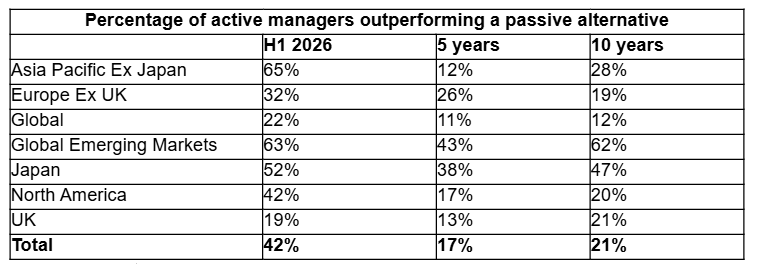
Source: AJ Bell, Morningstar. Total return in sterling to 30 Jun 2026
"Despite a few bright spots, active fund managers remain in the doldrums when looking across the market," Coatsworth added.
He attributed the weak global result partly to market concentration, noting that the 10 largest holdings in the MSCI World index account for 25.7% despite being made up of 1,283 constituents. "Any manager with less exposure to these blockbuster names than the global benchmark might have struggled to outperform," he explained.
Sector rotation weighed on UK, European and North American active funds, as areas that performed strongly in 2025, such as precious metals and mining, defence, and pharmaceuticals, lost momentum. The precious metals and mining sector, part of the FTSE 350, returned 251% in 2025 but fell 11% in the first half of 2026.
However, Coatsworth also said the strong result for emerging markets funds was "not just a flash in the pan", pointing to long-term data that showed a similar pattern of outperformance.