






Investors who bought into global emerging market (GEM) funds last year have mostly chosen true gems, judging by their returns in the first half of 2026.
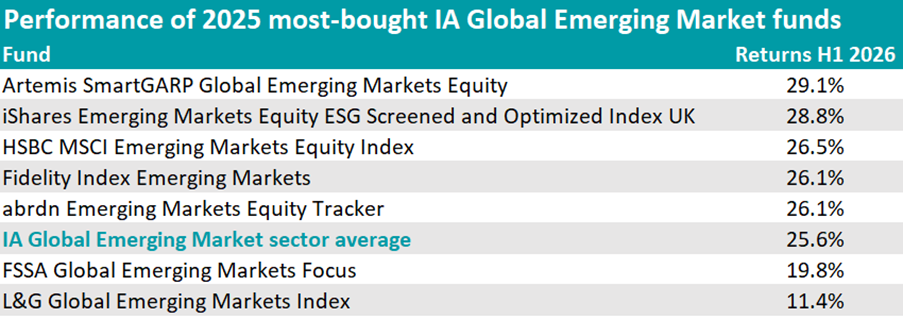
Five of the seven funds that took in £200m or more in 2025 have gone on to beat the IA Global Emerging Market sector between January and June this year, although none shone excessively brightly, remaining relatively close to the average peer.
The spread between the best and worst performers was stark, however, with two strategies some 10 percentage points below the top name in the list.
Below, Trustnet concludes this data series by looking at how each of the most bought emerging market funds of 2025 has fared so far this year.
Source: FinXL
Headlighting the group, Artemis SmartGARP Global Emerging Markets Equity was up 29.1%. Run by FE fundinfo Alpha Manager Raheel Altaf, the fund uses a proprietary model called SmartGARP, which scores stocks across eight factors including growth, value, earnings estimate revisions and environmental, social and governance (ESG) principles, with earnings revisions weighted more heavily given their effect on share price. Altaf then applies his own judgement on top of the model's output.
Analysts at FE Investments rate the tool, which gives the team “an efficient, data driven solution” for screening the asset class, pointing to its focus on companies that combine growth with a low price relative to book value.
They added that the manager's own due diligence on top of the model helps guard against value traps, where a cheap share price simply reflects a company in genuine distress.
At 28.8%, iShares Emerging Markets Equity ESG Screened and Optimized Index UK was close behind.
The £ 1.8bn portfolio passively tracks the performance of the Morningstar Emerging Markets ESG Enhanced UK12PM Net Index ESG, which screens and weights securities for their environmental credentials.
Its recent performance took it from the third quartile against the peer group over the past three years and 12 months to the second quartile over six months.
Concluding the top three was another passive name, HSBC MSCI Emerging Markets Equity Index, up 26.5%. Off the podium, Fidelity Index Emerging Markets and abrdn Emerging Markets Equity Tracker were level at 26.1%.
Fidelity's fund tracks the MSCI Emerging Markets Index, in which China typically makes up between 20% and 30% of the index, alongside large weightings to India, Taiwan and South Korea.
Analysts at Square Mile said their ‘Recommended’ rating reflects Fidelity's “very strong commitment to managing passive strategies”, based on the suitability of the benchmark, the size of the fund, its costs and its record of tracking the index closely.
All trackers sat above the IA Global Emerging Market sector average of 25.6%.
Failing to beat the average peer, FSSA Global Emerging Markets Focus lagged the sector by some distance, returning 19.8%.
It is run by the FSSA team, which invests without constraint across emerging and frontier markets and holds a concentrated book of 40 to 45 names, screened initially for a return on equity and earnings growth potential of 10% or more.
Analysts at RSMR said the fund is managed “with an eye to the downside and a focus on quality”, with the manager showing no willingness to move down the quality scale to chase returns. They noted that performance is driven by stock selection rather than any country or sector call, since the fund is built to be indifferent to its benchmark's composition.
L&G Global Emerging Markets Index was the weakest performer by a wide margin, returning 11.4% – some 14.2 percentage points behind the sector average.
The fund replicates the FTSE Emerging index, which has lagged behind other indices, including MSCI Emerging Markets, because it doesn’t include the star performer of the year, South Korea, as FTSE Russell classified the country as a developed market back in 2009.
RSMR analysts still rated LGIM's fund, praising its “pragmatic approach to index investing, driven by its focus on delivering the best value to investors”.