






Things might be on the up for Japan, with investors increasingly gaining confidence in the market thanks to slowly improving corporate governance reforms as well as the Bank of Japan stepping away from negative rates. For the first time in years, advisers have reported renewed client interest in Japan.
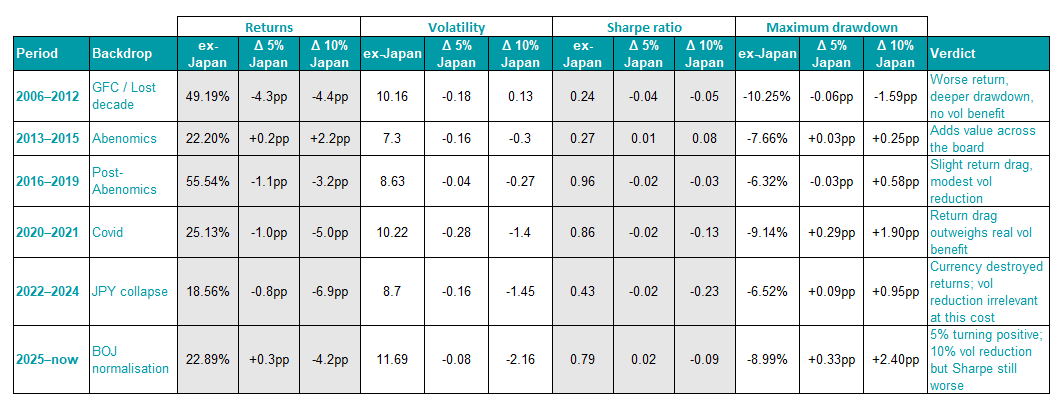
But over the past decade, adding Japan to an investment portfolio hasn’t improved it materially on different metrics, including Sharpe ratio, volatility and maximum drawdown, according to the Trustnet study below.
The exception was during the period known as Abenomics (2013 to 2015), when then-prime minister Shinzo Abe started the reforms that are being further implemented today by incumbent prime minister Sanae Takaichi, who took power in October last year.
In this study, we used a 60/40 global portfolio as a baseline, split between the MSCI ACWI ex Japan index for equities and the Bloomberg Global Aggregate index for bonds. Then we added a 5% and 10% allocation to Japanese equities, which have been carved out of the 60% equity sleeve.
As the Japan proxy, we used the IA Japan sector average, which represents the average fund that the average investor might have chosen to access the market.
For each allocation split, we measured four metrics: cumulative return, which shows the outcome; volatility, which tells how smooth the journey was; Sharpe ratio, which measures return per unit of risk taken and whether Japan's diversification properties actually earned their place in the portfolio or whether they came at too high a cost; and maximum drawdown, which isolates the worst peak-to-trough loss within each period.
Source: Trustnet
What the data shows
Adding Japan to a global portfolio over the past decade did little for returns and only slightly smoothed the ride. A 10% allocation to the IA Japan sector average returned 129% over 10 years, well below the 167.4% delivered by a portfolio that left Japan out altogether. A smaller 5% allocation came closer, at 162.4%, but still lagged.
The shortfall was not spread evenly across the decade. Three periods drove most of it – the aftermath of the financial crisis, the Covid years and the yen's collapse between 2022 and 2024.
While the figures above paint a bleak picture for Japanese equity enthusiasts, Joshua Adler, Japan investment specialist at Orbis, said things look different once dispersion between managers is accounted for.
Japan “has not been a beta market”, he said. Outside of Abenomics, the 2023 Tokyo Stock Exchange reforms and the recent AI rally, middling to poor returns have meant that the market has been rewarding for stock pickers, noting that the Orbis Japan fund has outperformed the MSCI World index on a constant currency basis.
Simon Evan-Cook, multi-manager at Downing, added that the figures above may not be as bad as they first appear, particularly when considering the strong returns of US markets, which now tend to dominate developed equity indices (and even more so with Japan removed).
“I wonder how much of that is down to Japan and how much is down to just how well US equities have performed," he said. “I suspect for almost any country you could find that you'd have been better off not holding any, and all because the global index's biggest component – the US – has produced exceptionally high returns.”
Also, the average fund has suffered relative to the market due to an underweight in mega-caps, Evan-Cook explained, a phenomenon that is “not unique to Japan”.
That said, he still recommended including Japan in portfolio, and in particular, active funds. “The valuation of the market looks fair, while there are plenty of bargains lower down the market-cap scale as investment trends have left them behind,” he said.
Adler added: “Passive exposure to Japan already offers a low correlation building-block within a global portfolio; actively investing within Japan can enhance diversification even further.”
A genuine change is going on across Japanese companies, said Adler. Long associated with lazy balance sheets, piles of idle cash, cosy cross-shareholdings and poor capital allocation, now management teams are being held accountable.
“Active engagement lets us identify and work with companies genuinely committed to improving, potentially accelerating their re-rating rather than waiting for the market to price it in,” he said.
“Passive exposure to Japan already offers a low correlation building-block within a global portfolio; actively investing within Japan can enhance diversification even further.”
The outlook for Japan from here
While the past may not show Japanese equities in the most positive of lights, the more recent data is appealing. Since 2025, including these stocks in a portfolio has provided better returns while also bringing volatility down.
Comparisons may be made to Abenomics, although Adler said there were some key differences, as well as similarities.
For example, the corporate reform that Takaichi inherited is a continuation of Abe’s, but we are now “much further along the line and reformation in Japan has picked up real traction”.
However, Abenomics was part of a plan to escape deflation, including “a program of aggressive easing from the Bank of Japan, with open-ended asset purchases and negative interest rates, deliberately weakening the yen”
More recently, Japan has spent most of the past four years with inflation running above the Bank of Japan’s target. Asa result, today, the Bank is doing the opposite.
This could be a positive, according to Nicola Takada Wood, Japan managing director at Asset Value Investors, who argued today's backdrop was more durable than the early stages of Abenomics.
“While the 2013 rally was driven primarily by aggressive monetary easing, fiscal stimulus and a sharp depreciation of the yen, the current backdrop is underpinned by more durable structural improvements," she said, citing stronger capital allocation, higher dividends and buybacks, and a gradual shift of household savings from cash into equities.
She expected Takaichi to continue or accelerate that momentum and saw the unrealised opportunity sitting in smaller companies, where governance reform remained in its early stages.