






The 2020s so far have been one of the most turbulent periods for UK investors in recent memory. The decade opened with the continued fall-out from Brexit reshaping trade, regulation and market sentiment. What followed brought further uncertainty, with the Covid-19 pandemic, surging inflation and spiking interest rates shaking the equity market.
Political instability only compounded the economic uncertainty, with a revolving door of prime ministers and chancellors. Volatility has therefore been a defining feature in the UK market – and beyond.
However, periods of instability often create opportunities for active managers willing to take the risk. As such, this new series aims to identify funds where elevated volatility paid off between 31 December 2019 and 31 July 2026.
Starting with the UK equity sectors, this article highlights the most volatile funds across all three sectors that delivered top-quartile returns alongside top-quartile Sharpe ratios (meaning they converted risk into return more efficiently than most of their peers).
To calculate each fund’s Sharpe ratio, Trustnet used the average Bank of England base rate over the assessed period – 2.76% – as the risk-free rate. This better reflects the actual opportunity cost investors faced throughout the 2020s so far, a period that includes both near-zero interest rates and an aggressive hiking cycle that began in December 2021.
IA UK All Companies and IA UK Equity Income
For these sectors, Trustnet compared funds against the FTSE All-Share, reflecting the shared universe of mid- and large-cap UK stocks. From the beginning of 2020 to the end of July 2026, the index gained 74.4% with a volatility of 13.3%.
It also logged a Sharpe ratio of 0.45, which forms the baseline level of risk-adjusted return available simply by tracking the index.
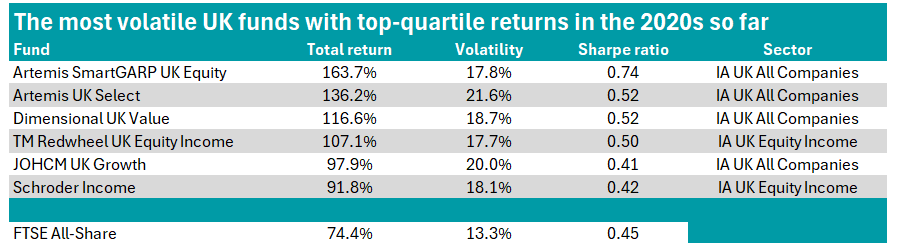
The six funds in the table below delivered a first-quartile return and Sharpe ratio against funds across both sectors, while ranking among the most volatile. Four of them did so more efficiently than the FTSE All-Share.
Source: FE Analytics
The standout performer in the table is Artemis SmartGARP UK Equity, which logged a 163.7% return with a volatility of 17.8% and a Sharpe ratio of 0.74.
The £1.6bn strategy has been managed by FE fundinfo Alpha Manager Philip Wolstencroft since its 2010 inception. It utilises the firm’s proprietary SmartGARP framework to remove behavioural biases when identifying opportunities.
The 64-stock portfolio is currently dominated by financials (which make up around 45% of the fund), including Lloyds Banking Group, HSBC and NatWest.
Since 2020, the fund has logged a first-quartile return in the IA UK All Companies sector in four calendar years, with particularly strong performance during former prime minister Keir Starmer’s tenure – during which it posted the strongest return across all three UK equity sectors.
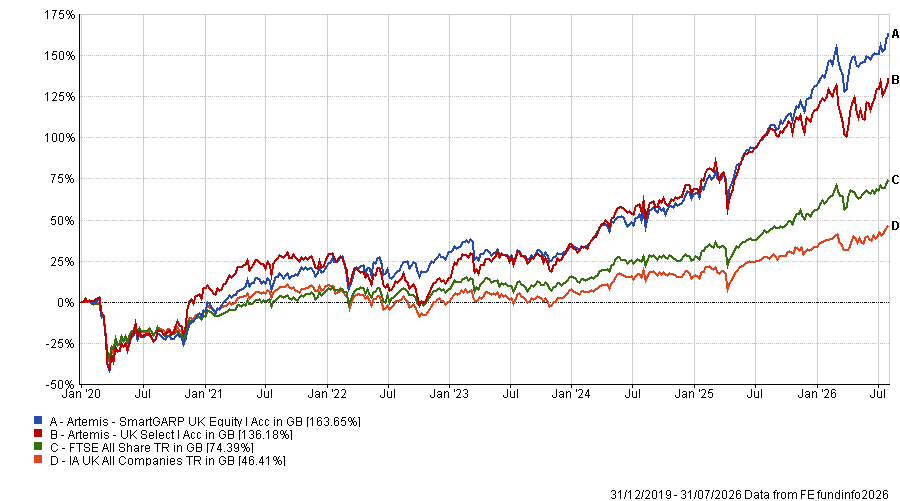
Its stablemate Artemis UK Select also made the table, returning 136.2% with higher volatility (21.6%) and a lower Sharpe ratio (0.52).
Performance of the funds vs sector and benchmark, 2020-31 July 2026
Source: FE Analytics
The £342.3m Dimensional UK Value strategy also made the table, returning 116.6% with a volatility of 18.7% and a Sharpe ratio of 0.52.
The fund is rooted in academic research rather than discretionary stock selection, applying systematic rules to capture long-term drivers of return.
Its value tilt has also translated into a strong income profile as, over the five years to the end of 2025, Dimensional UK Value paid out £2,270 per unit – the highest dividend distribution in the sector. It has also outperformed on both the upside and downside over that same period.
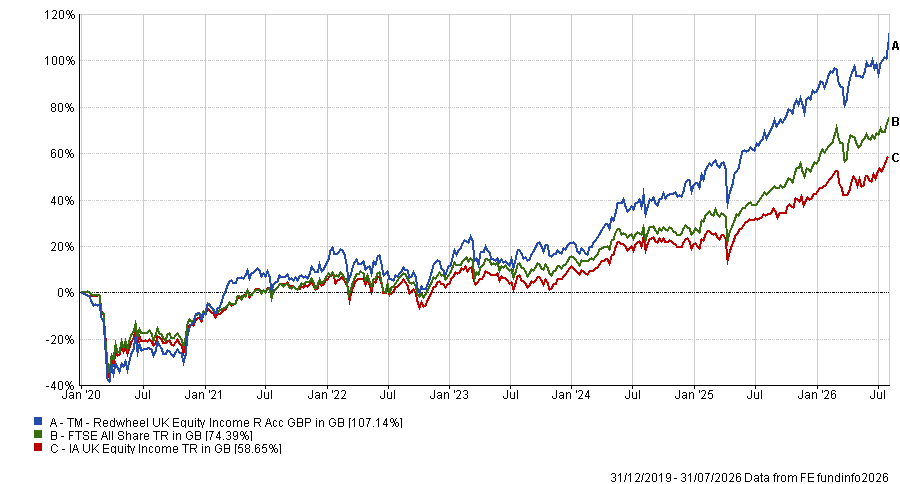
From the IA UK Equity Income sector, TM Redwheel UK Equity Income was the strongest performer, returning 107.1% with 17.7% volatility and a Sharpe ratio of 0.50.
The £1.6bn 36-stock fund has been co-managed by Ian Lance and Nick Purves throughout the assessed timeframe. It has logged first-quartile returns in its sector over one, three and five years to July 2026.
Performance of the fund vs sector and benchmark, 2020-31 July 2026
Source: FE Analytics
Rounding out the table are JOHCM UK Growth and Schroder Income, which delivered top-quartile returns of 97.9% and 91.8% respectively.
However, neither achieved a higher Sharpe ratio than the FTSE All-Share index, meaning the additional risk did not translate into superior risk-adjusted returns.
IA UK Smaller Companies
The UK small-cap fund universe has faced an even tougher backdrop since 2020, as more domestic-facing companies struggled.
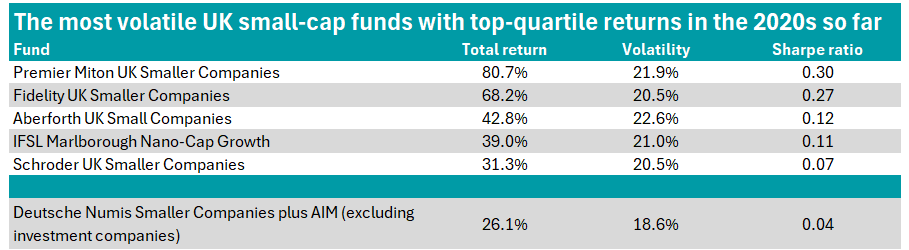
The Deutsche Numis Smaller Companies Plus AIM (Excluding Investment Companies) index has returned just 26.1% in the 2020s so far, with a volatility of 18.6% and Sharpe ratio of 0.04.
All five of the funds in the table below beat this benchmark on a risk-adjusted basis, while also logging first-quartile returns against peers.
Source: FE Analytics
The strongest performer in the sector to meet the criteria was the £60m Premier Miton UK Smaller Companies fund, which has been co-managed by Gervais Williams and Martin Turner since 2012. It returned 80.7% with volatility of 21.9% and a Sharpe ratio of 0.30.
The fund focuses on micro- and small-cap companies where information gaps may create mispricing opportunities, with its current highest sector weightings being materials (18.2%), energy (14.5%) and information technology (13%).
Next in the table is Fidelity UK Smaller Companies which has been managed by Jonathan Winton since 2014 and targets companies that have gone through periods of underperformance but possess unrecognised growth options.
RSMR analysts said the manager’s contrarian focus on especially unloved parts of the market “makes this fund a little different to many of its peers”.
“Since inception, the fund has performed well against its peers and benchmark and this trend has continued under the current management,” the analysts said.
Indeed, the fund has a first-quartile gain of 150.7% over the 10 years ending July 2026.
Performance of the fund vs sector and benchmark, 2020-31 July 2026
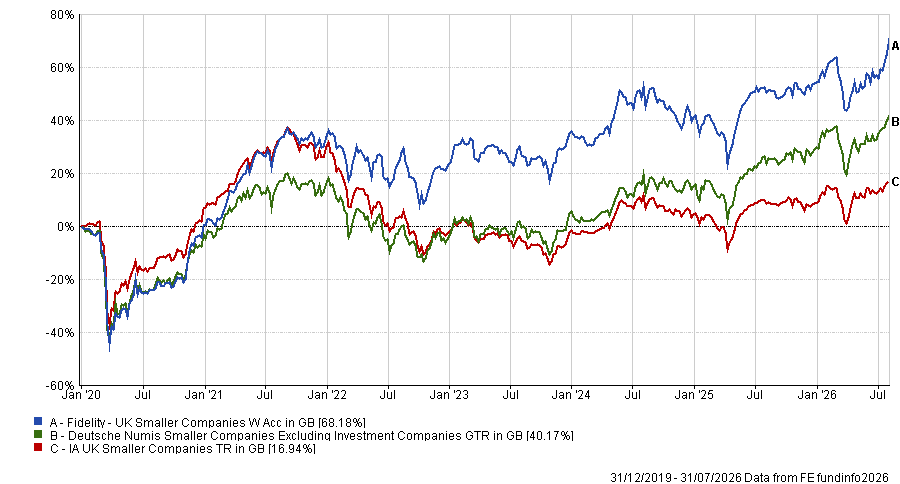
Source: FE Analytics
Aberforth UK Small Companies, IFSL Marlborough Nano-Cap Growth and Schroder UK Smaller Companies round out the table, each delivering top-quartile returns while being among the most volatile in the sector – and each beating the Deutsche Numis index’s risk-adjusted return despite the challenging environment for UK small-caps.