






The Alternative Investment Market (AIM) has had a rough few years but not every fund manager has lost the faith.
Britain’s junior market used to boast around 1,700 companies before the financial crash but a steady combination of takeovers, cost burdens and regulatory read tape, has pulled that number down gradually over time.
Following the 2024 Budget, in which inheritance tax (IHT) relief on AIM shares was cut from 100% to 50%, this shrinkage has only accelerated.
According to the London Stock Exchange, as of July 2025, there are 598 companies listed on AIM in total, with 511 UK-domiciled and 87 international – down from the 679 recorded around the mid-point of last year.
And those that are listed on AIM have been underperforming.
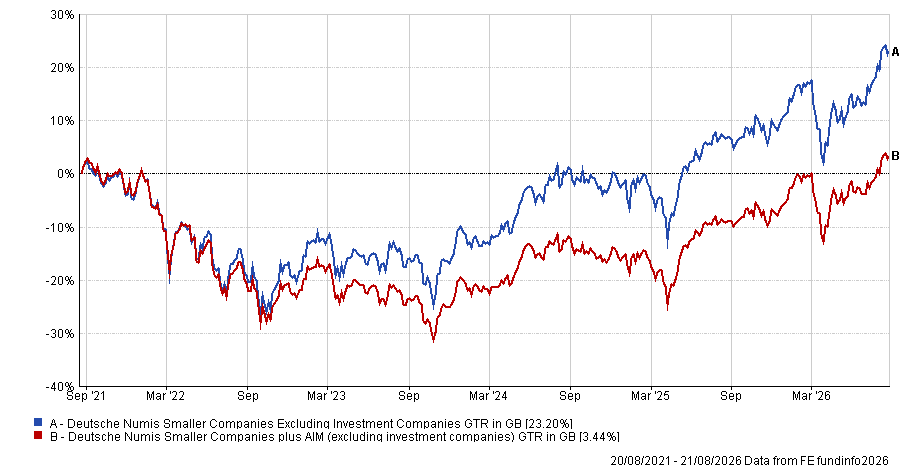
Trustnet assessed the performance of the Deutsche Numis Smaller Companies ex Investment Companies index against Deutsche Numis Smaller Companies Plus AIM (excluding investment companies) over five years (to 21 August 2026).
While the former has logged a 23.2% return over that time, the index including AIM managed just 3.4%.
Performance of the two indices over 5yrs
Source: FE Analytics
That underperformance is now feeding a bigger question. An FT Lex column from earlier this month questioned whether AIM remains the most effective route for growing UK companies, or whether private markets are better placed to supply the growth capital they need.
In response, Ken Wotton, managing director of public equity at Gresham House and manager of WS Gresham House UK Smaller Companies, does not deny that AIM has struggled. However, he disputes the argument that private markets are a better model for growth.
He said: “It’s not that private markets are flying and public markets are not – the key issue is that there has been a lack of capital flowing into listed companies.”
This, in turn, drives lower liquidity and lower ratings for AIM companies, Wotton noted, which makes it less attractive for a new company to list or for an existing company to raise equity due to higher costs.
“There has been less issuance, fewer initial public offerings (IPOs) and therefore naturally a bigger focus and interest in private markets,” Wotton said.
However, when accounting for the over 30 years in which AIM has been established, on balance, Wotton maintained it has objectively been a significant force for good for the UK economy and UK growth.
“To let that wither away in favour of private markets would be a gigantic policy mistake and negligent,” Wotton said. “Why try to direct capital elsewhere when we have got something that already exists, which just needs a bit of focus and revival?”
Private equity is circling AIM
Despite the reduction in the number of companies listing on AIM, Wotton argued there is a “whole host” of exciting growth companies trading at a discount. So much so that AIM is attracting private equity buyers.
“A private equity firm can buy into a company it thinks is attractive and pay 5x profit for it when it is listed on AIM – if it was private, that fund would be paying 10x,” Wotton said.
“All else being equal, you are going to make a lot more money out of the company you pay 5x for rather than 10x.”
Wotton attributes this difference in valuation as one of the reasons why there are so many takeovers happening on AIM, noting that private equity firms, in particular, are enticed by the discount.
“Either they can buy a private company for 10x profit or a public one at a premium to the 5x it is trading on – say they pay a 60% premium to what the market is paying – that is still a 20% discount to what they would have to pay for a similar company in private markets.”
By hunting for good quality companies in the AIM market, private equity firms are scoring a better deal, Wotton argued.
Private markets versus AIM
There are pros and cons for any company – or investor – to consider.
Wotton said: “With private equity or venture capital, the capital structure you are committing to means that control is quite different – if you underperform, there is a high probability of losing your business or your job. It’s not all warm and fluffy and supportive; it’s fine if things are going well, but it’s quite brutal if they are not.”
In contrast, public companies have a more diversified group of shareholders who have a lot less control, allowing company management more autonomy.
“Not all founders want a private equity capital structure with debt on the balance sheet – they might want more flexibility to incentivise their employees through listed equity options and so on,” he said.
So private equity is great for some companies, less good for others – but the problem, according to Wotton, is that if the valuation applied to your company is double in private markets, then all those other considerations diminish.
“Because you’re not going to list somewhere that ultimately means selling part of your company for half price,” Wotton said.
What could fix the AIM problem
Wotton noted that intervention is needed for capital to flow back into AIM. One way to reinvigorate the market would be to incentivise and encourage UK pension funds specifically to direct more capital in domestic assets. The amount of pension money flowing into UK listed equities has been notably falling over time.
The government has been working to do address this, both with the Mansion House Compact in 2023 and the updated Mansion House Accord in 2025. Both agreements have been signed by UK pension providers.
However, while these secure a loose agreement from pension funds to direct money back into the UK (up to 10% of assets), Wotton argued the emphasis has been placed more on private markets rather than public ones.
“We need key government figures to loudly and clearly point out that AIM is a really important component of the overall growth-company ecosystem that Mansion House is designed to support,” Wotton said.
As a further measure, Wotton suggested the government could skew tax incentives to more explicitly encourage pension funds to allocate towards AIM.
“There is some £60bn-plus worth of annual tax subsidy for pension saving alone – why wouldn’t you want more of those tax subsidies to be directed so that it benefits the UK economy?” he posited.
“Why on earth would you instead be allocating more to the most expensive and concentrated equity market in the world – the US – dominated by large tech companies with one big theme, which, if it rolls off the other way, gives you material downside, when you could be investing in your domestic equity market, which is one of the cheapest in the world?”