






A global fund has the ability to diversify across regions, sectors and styles, meaning it theoretically can seek out pockets of safety when markets prove volatile.
But for much of the 2020s, there has been nowhere to hide, with a global pandemic, a historic inflation spike, aggressive rate-hiking cycles and wars across continents.
This has all conspired to make the 2020s thus far some of the most volatile years in recent memory for investors – even for those with the broadest possible mandate. Of course, in crisis, there is always opportunity, with some funds profiting off the chaos.
This article marks the final instalment in Trustnet’s series identifying funds where taking more risk paid off.
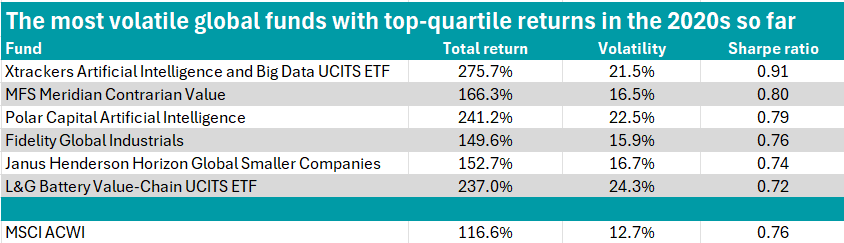
Turning to the IA Global and IA Global Equity Income sectors, Trustnet has identified the most volatile strategies that posted first-quartile returns between 2020 and the end of July 2026, alongside a first-quartile Sharpe ratio.
The Sharpe ratio indicates whether a fund’s returns have justified the level of risk taken, using the same risk-free rate applied consistently across the series – reflecting the average Bank of England base rate to represent the uniform baseline for UK investors in the 2020s so far.
The majority of funds across both sectors benchmark themselves against the MSCI ACWI index, which returned 116.6% over the assessed period, with a volatility of 12.7% and a Sharpe ratio of 0.76.
Starting with the IA Global sector, the funds below all met the set criteria.
Source: FE Analytics
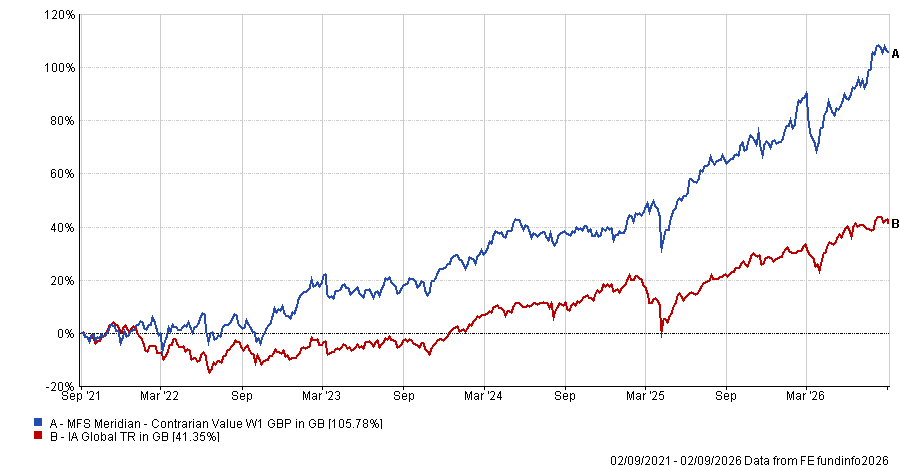
Among actively managed strategies, MFS Meridian Contrarian Value logged the highest Sharpe ratio at 0.80, making returns of 166.3% over the assessed period with a volatility of 16.5%.
The global equity strategy seeks areas of controversy in the market and approaches them from a fundamental, bottom‑up perspective to identify asymmetric investment opportunities that aim to limit downside, with the managers prioritising investing in companies trading at a discount due to adverse sentiment, operational challenges or transitional periods.
Reflecting its value tilt, the fund has its highest sector exposures to industrials (23.3%), healthcare (14.6%) and financials (14.1%), with no exposure to the information technology sector. It is also overweight the more defensive UK equity market and underweight the growth‑oriented US market.
The strategy has logged first‑quartile returns over one, three and five years to the end of August 2026, gaining 108.3% over the half‑decade.
Performance of the fund vs sector over 5yrs
Source: FE Analytics
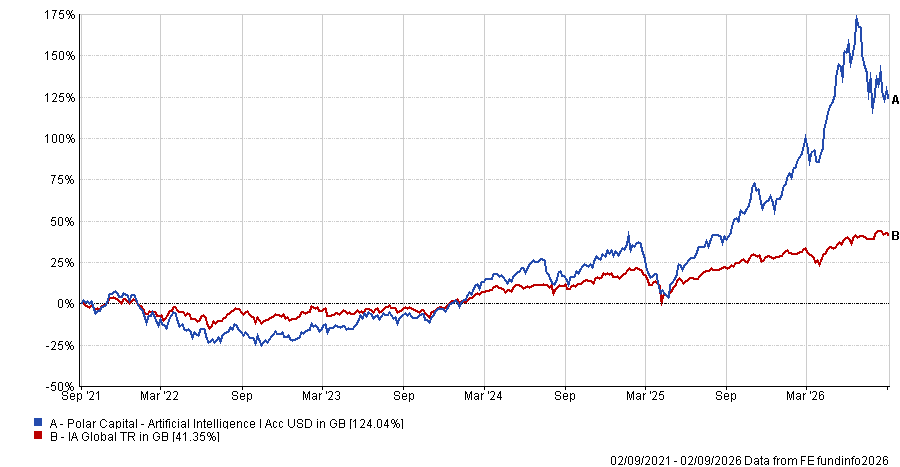
The highest return among the actively managed funds in the table came from Polar Capital Artificial Intelligence, which gained 241.2% with a volatility of 22.5% and a Sharpe ratio of 0.79.
Awarded an Elite Rating by FundCalibre last month, the strategy – which is managed by Ben Rogoff, Nick Evans and Xuesong Zhao – takes a broad approach to investing in the build-out of AI, including companies constructing AI infrastructure as well as businesses set to benefit from the technology. Current top holdings include Nvidia (5%), Alphabet (2.6%) and Caterpillar (2.3%).
Launched in 2017, the fund has proven sensitive to AI-driven momentum rallies and sell-offs, moving from the first to fourth quartile in the sector as sentiment has shifted. Nonetheless, these peaks and troughs smooth out to paint a picture of consistent outperformance over the past three full calendar years and first half of 2026.
The strategy has grown rapidly, reaching $3.9bn in size – more than doubling its assets since August 2025. Polar Capital Artificial Intelligence has gained 127.1% over the five years ending August 2026.
Performance of the fund vs sector over 5yrs
Source: FE Analytics
Other funds in the table include Fidelity Global Industrials, Xtrackers Artificial Intelligence and Big Data UCITS ETF, Janus Henderson Horizon Global Smaller Companies and L&G Battery Value-Chain UCITS ETF. However, the Janus Henderson and Legal & General strategies failed to beat the benchmark for risk-adjusted return.
It should also be noted that the highest Sharpe ratio in the IA Global sector was logged by Heptagon Kopernik Global All Cap Equity, at 1.07. It also gained 207.2% over the assessed period. However, its volatility of 14.9% placed it in the third quartile, meaning it generated a strong return for more moderate risk, with not enough volatility to qualify.
Turning to the IA Global Equity Income sector and only one fund met the criteria: Artemis Global Income.
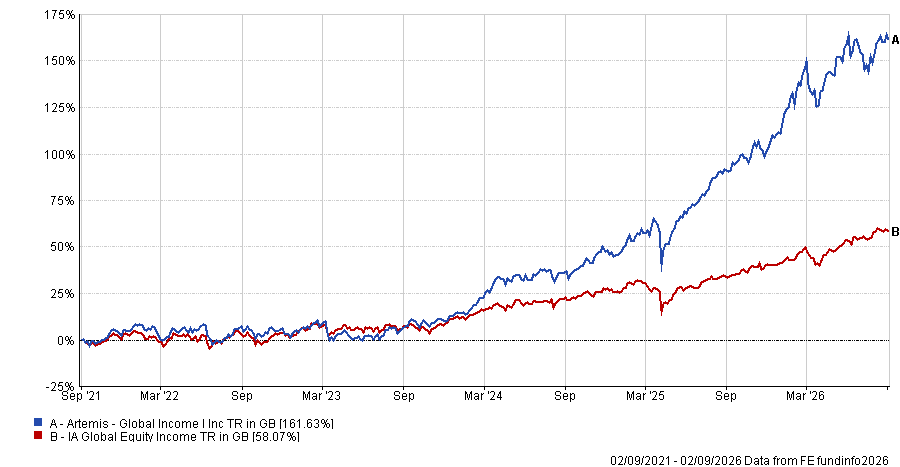
The £6.6bn strategy, which aims to grow both income and capital over a five-year period, returned 200.7%, with a volatility of 15.2% and a Sharpe ratio of 1.01.
Co-managed by FE fundinfo Alpha Manager James Davidson and Jacob de Tusch-Lec, the fund carries an FE fundinfo Crown Rating of five and has a historic yield of 2.28%.
The managers take a contrarian approach, actively adjusting regional, sector and style exposures through the economic cycle and favouring attractively valued businesses often not held by similar funds the managers deem capable of generating high levels of cash and paying reliable dividends.
Top holdings include Samsung Electronics (4.2%), Cisco (3.5%) and Lam Research (2.3%).
Artemis Global Income has consistently outperformed, logging first-quartile returns in the sector over one, three, five and 10 years, gaining 290.5% over the decade.
Performance of the fund vs sector over 5yrs
Source: FE Analytics