






The AI investment theme has dominated markets in recent years and many expect this area to continue to pay off as the technology matures and is deployed across the wider economy.
However, investors should be wary of having their entire portfolio anchored to a single theme. In a recent note, BlackRock strategists suggested that investors might want to broaden their exposure to the AI narrative or look for investments with a low correlation to the theme.
With this in mind, Trustnet has looked across the Investment Association universe to identify the funds that have not been tied to the fortunes of AI stocks. To do this, we ran the correlation with the $1.4bn WisdomTree Artificial Intelligence UCITS ETF – which invests in AI enhancers, enablers and engagers to gain exposure to the whole AI value chain – over the past three years.
On a fund sector level, IA Technology & Technology Innovation is, unsurprisingly, the most linked to the AI ETF. Over the three years under consideration, the average tech fund has had a 0.91 correlation to the ETF.
It is followed by IA North America at 0.74, then IA Mixed Investment 40-85% Shares and IA Global with a 0.73 correlation. IA Global Emerging Markets rounds off the top five with a 0.71 correlation to WisdomTree Artificial Intelligence.
We would expect to see all these sectors here: tech funds are going to take significant exposure to the AI theme, the US is the base of many of the major AI players, global funds and equity-heavy multi-asset funds have large weightings to the US, and emerging markets is home to AI chip heavyweights such as Samsung, SK Hynix and TSMC.
Source: FinXL
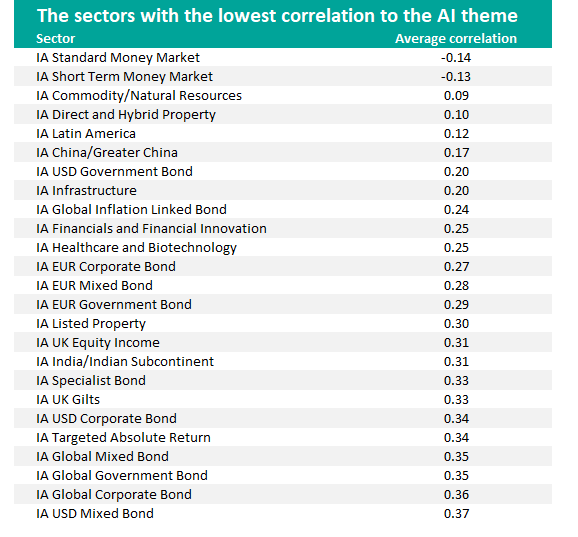
The 25 sectors with the lowest average correlations to WisdomTree Artificial Intelligence UCITS ETF can be found in the table above. The two money market peer groups are the only sectors with a negative correlation.
IA Commodity/Natural Resources comes next with a 0.09 correlation to the AI ETF. Commodities stocks are seen as 'old economy' investments, as opposed to the 'new economy' tech stocks, and assets such as oil and gold have tended to go up in market episodes when the AI theme has struggled.
In this sector, the lowest correlation has come from iShares Oil & Gas Exploration & Production UCITS ETF at -0.23, followed by Xtrackers MSCI World Energy UCITS ETF and Guinness Global Energy (both -0.22).
Energy stocks have made strong returns in 2026 when oil prices spiked after Iran effectively closed the Strait of Hormuz following attacks by the US and Israel. Around 20% of the world's oil and gas supply passed through the strait before the war started in late February.
Energy funds have underperformed AI stocks over the past three years. However, gold funds have beaten WisdomTree Artificial Intelligence, thanks to the meteoric rise in the yellow metal in 2025 and early 2026.
The iShares Gold Producers UCITS ETF (which resides in the IA Global sector) has a -0.09 correlation to the AI ETF but has made 237.2% over the three-year period. UBS Solactive Global Pure Gold Miners UCITS ETF has a 0.08 correlation with a 280% return and Amundi Gold Miners (from the IA Specialist sector) was -0.06 correlated with a 233.2% return.
Most of the sectors with a low correlation are fixed income, reflecting that bonds have historically risen when stocks have fallen and vice versa.
IA Financials and Financial Innovation is one equity sector with a low AI correlation. Polar Capital Global Insurance has a three-year correlation of -0.13 to WisdomTree Artificial Intelligence, with a 43.8% total return.
Amundi Euro Stoxx Banks has a 0.13 correlation but has made 231% over the past three years, reflecting the often-overlooked fact that European banks have been one of the strongest places to invest in recent years.
Not all funds in the financials peer group have a low correlation with AI, however: Jupiter Global Financial Innovation and its offshore sibling are 0.76 correlated to the ETF as their interest in payments technology, digital financial services and similar themes leads to semiconductor and tech exposure.
Aside from single-sector funds, there are some more mainstream peer groups with a lower correlation to AI. The IA UK Equity Income sector is one, owing to the UK's general underweight to tech and funds' preference for more mature dividend payers over high-growth companies.
The Vanguard FTSE UK Equity Income Index fund has the lowest correlation to WisdomTree Artificial Intelligence at 0.12 with iShares UK Dividend UCITS ETF just behind at 0.13. Both have made around 85% over the three years under review.
Fidelity UK Equity Income, M&G Dividend, CT Select UK Equity Income, Barclays UK Equity Income and VT Munro UK Equity Income are some of the peer group's active members with a correlation to the AI theme of less than 0.2.
For investors seeking global equity funds, there are some worth looking at despite the sector's generally high correlation to the ETF.
Many of these are sector-specific ETFs, however, such as State Street SPDR MSCI World Energy UCITS ETF, iShares Gold Producers UCITS ETF, Xtrackers MSCI World Consumer Staples UCITS ETF and Xtrackers MSCI World Utilities UCITS ETF.
Active funds ticking the low-correlation box include Ranmore Global Equity (0.08 correlation; 61.6% three-year return), YFS Charteris Global Macro (0.11; 90.6%), Heptagon Kopernik Global All Cap Equity (0.14; 101.8%), IFSL Evenlode Global Equity (0.25; 8.3%) and Jupiter Global Value Equity (0.29; 42.9%).