






Markets have entered a new regime in which active management decides returns as the expectations of interest rate hikes reduce the appeal of broad exposure, according to Edmond de Rothschild Asset Management global chief investment officer Alain Krief.
The Federal Reserve and the European Central Bank recently abandoned the rate-cutting path that markets had priced in, raising interest rates in September as growth held firm and inflation remained too high.
The ECB moved first, lifting its three key rates by 25 basis points on 10 September. The Fed then raised its benchmark rate by 25 basis points on 16 September, taking it to a range of 3.75% to 4%, its first increase since 2023.
Both decisions reversed the market consensus that slowing inflation would free central banks to support growth through rate cuts.
Krief argued: "In both the United States and Europe, the resilience of the economy and the return of inflationary pressures have led central banks to resume their monetary tightening policies.
"But beyond these decisions, it is above all the shift in the direction of monetary policy that, in our view, is of particular importance."
The Fed's updated projections show US GDP growth of 2.3% in 2026, unemployment at 4.1% and inflation, measured by the PCE index, at 3.7%. The median federal funds rate is projected to reach 4.1% by the end of the year.
Federal Reserve 'dot plot' of policymakers' assessments of appropriate monetary policy
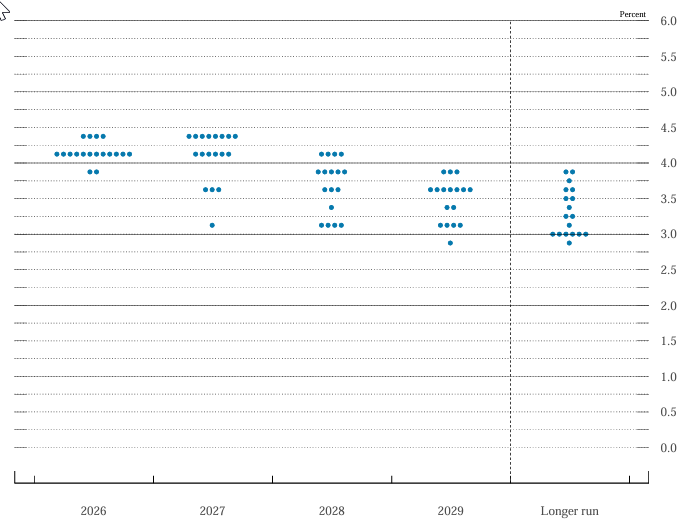
Source: Federal Reserve
The CIO added that the Fed now sees the greater risk in inflation taking too long to return to its 2% target, Krief said.
"This situation is fundamentally changing the way we interpret the markets. Weak economic data no longer necessarily means lower interest rates. Favourable economic data is no longer necessarily good news for risky assets if it further delays monetary easing. It is this asymmetry that we must now consider in our investment decisions."
The same logic applies in Europe, he added. The ECB expects average inflation of 3% in 2026, easing to 2.1% by 2028. It has also raised its growth forecasts to 0.9% in 2026 and 1.4% in 2027, citing eurozone resilience that has exceeded earlier expectations.
Krief described this as "a paradoxical situation": the European economy performing better than forecast, yet with inflation persistent enough to keep the ECB on a restrictive footing.
He warned that geopolitical and energy tensions could still trigger a supply shock, pushing up costs for energy, transport and goods, and squeezing corporate margins and household spending power.
But the deeper risk, he said, is not runaway inflation but inflation that stays just high enough to stop central banks cutting rates even as growth begins to slow. "This is a much more complex environment for the markets, and it is precisely during such periods that broad, overly directional asset allocations reveal their limitations," the CIO warned.
Against that backdrop, Krief pointed to dispersion as the defining theme for the months ahead.
"We are convinced that one of the key investment themes in the coming months will be divergence: divergence across economies, sectors, companies, and various segments of the bond markets. While this phenomenon challenges investment approaches based on broad market exposure, it also opens up significant opportunities for active management," he explained.
"When all companies are reporting strong results simultaneously, stock selection adds relatively little value. Conversely, when disparities in growth, profitability, financial structure and valuation widen, knowledge and analysis of fundamentals once again become a genuine competitive advantage."
In credit, Edmond de Rothschild Asset Management prefers carry and selectivity over duration, citing rising policy rates as a reason for caution on longer-dated exposure.
Krief said specific segments he favours are European high-yield issuers with robust balance sheets, European financial subordinated debt, corporate hybrid bonds from issuers with strong cash generation and selective emerging-market corporate debt.
"In the European high-yield bond market, we favour companies whose balance sheets can withstand a sustained environment of rising interest rates," he said, while European financial subordinated debt is liked because of the improvement in capital ratios and stricter regulatory requirements, which provide significant support.
In equities, the asset management house continues to view artificial intelligence, digitalisation, productivity gains and elements of the energy transition as supportive of earnings across many sectors.
Performance of global equity sectors in 2026
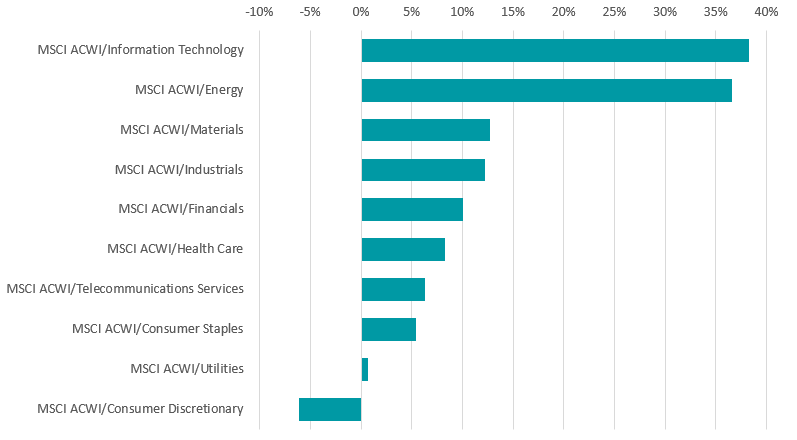
Source: FinXL. Total return in sterling between 1 Jan and 25 Sep 2026
However, he noted that this does not justify every valuation and said the key question is whether companies can convert heavy investment into actual earnings growth and cashflow.
"Artificial intelligence remains a compelling theme, but exposure alone is no longer enough," Krief said.
He pointed to widening gaps even within the AI sector itself: between semiconductors and software, between infrastructure providers and the companies using their technology, and between firms turning AI investment into growth and those for whom it remains "a long-term promise".
Valuations of growth stocks in these areas have climbed for several years and the key question from here is whether companies' massive investments in areas like AI will turn into earnings growth and cashflow.
Krief argued that "a highly selective approach is required", as investors want to own the companies that can capture value over time, rather than just benefit in the short term from being part of a favourable trend.
"It is now essential to understand macroeconomic conditions, select the right issuers and companies, actively manage duration and adjust a portfolio's risk as conditions evolve. Such an environment highlights the limitations of a passive approach and reinforces the value of active management," Krief said.
"In a world where surprises are becoming more frequent, conviction, expertise, flexibility and active management are emerging as essential drivers of value creation."