






John Healey used his first Labour Party Conference speech as chancellor of the exchequer to place fiscal discipline at the heart of Andy Burnham’s economic agenda. But with fiscal headroom shrinking and spending commitments continuing to mount, market experts warned that the numbers are not yet adding up.
As part of his speech, Healey announced a £6bn commitment in contracts for British shipyards and the rebirth of the Union Learning Fund, which used to finance the training of 180,000 workers a year before it was abolished back in 2021.
This time around, he said he wants the learning fund to come with a focus on AI to help British workers harness the technology rather than be outrun by it.
These funding commitments follow the government’s recent decisions to cut VAT from electricity bills, cap bus fares at £2 and reduce business rates on pubs, clubs and music venues – all to provide people with “a bit of breathing space” during the ongoing cost-of-living crisis.
More recently, prime minister Burnham laid out his intentions to reform social care and make it free at the point of use in the next Parliament.
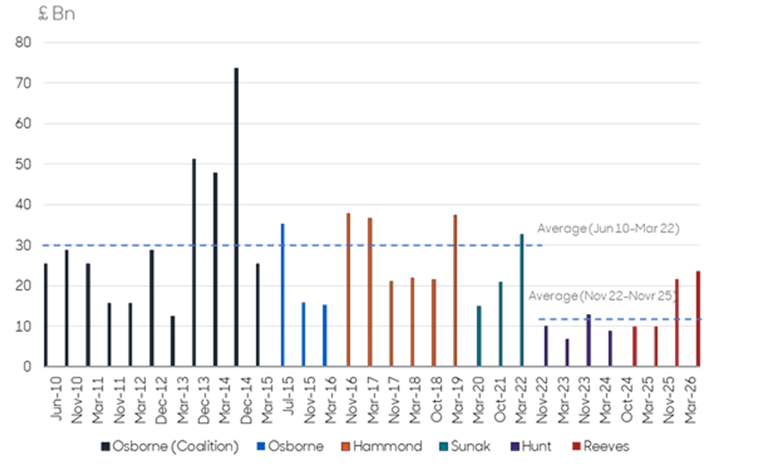
As such, the fiscal headroom regained by former chancellor Rachel Reeves in the 2025 Budget has shrunk, with the Office for Budget Responsibility estimating current fiscal headroom at between £10bn-£15bn – down from £23.6bn earlier this year.
UK fiscal headroom under previous UK chancellors
Source: Aberdeen, Office for Budget Responsibility
Lizzy Galbraith, senior political economist at Aberdeen Investments, said: “Healey seems to be comfortable leaving headroom around this level, rather than rebuilding it back to the £20bn+ levels Reeves increased it to. But, given recent spending announcements, further tax rises are likely.”
However, Healey is currently constrained by his party’s manifesto commitment to avoid raising VAT, income tax, employee National Insurance and Corporation Tax.
Richard Carter, head of fixed interest research at Quilter Cheviot, said markets are “crying out for fiscal responsibility from the UK, particularly given its exposure to inflation-linked shocks, but we await if it is something that can still be delivered by this new government”.
Carter said initial evidence suggests it is going to be difficult to achieve, with borrowing costs “incredibly challenged” and the conflict in the Middle East showing “no sign of calming and thus energy costs will remain raised”.
Despite the new spending commitments, Healey himself acknowledged that the money the Labour government had in the 1990s’ to spend is “simply not there now” and that the amount of money the country is spending servicing its debt is preventing the government spending in other areas.
He added that he and Burnham are “in lockstep that we will meet the fiscal rules [and] that we will maintain control of Britain’s finances”.
“We can’t succeed without it,” he said.
Dr Valentin Boboc, senior economist at the Institute of Economic Affairs, said Healey’s speech today was a “sobering” one that illuminated how little room there is for “expensive state projects”.
“Backing British industry and getting more people into work are worthwhile ambitions – but government contracts, subsidies and union-led training schemes are no substitute for creating the conditions in which businesses can invest, innovate and employ,” he said.
“The chancellor should use next month’s Budget to cut taxes, bring down energy costs and remove the barriers holding back investment and growth.”
Galbraith expects capital gains tax is “one obvious lever” Healey may pull in the Budget to raise more money, although she expects further reform rather than equalisation with income tax.
However, concerns over the growing tax burden will likely mean the overall size of the fiscal package at the Budget in October is likely to be fairly contained, she said.
“We are expecting a fairly small UK Budget due to the constraints on government finances, with tougher decisions on welfare, youth unemployment, social care and long-term defence spending pushed to next year’s spending review and the release of Burnham’s 10-year plan,” Galbraith said.