






Money market funds are an attractive low-volatility component of a diversified portfolio, providing liquidity and stability during periods of market uncertainty.
They are also becoming increasingly popular, with recent Trustnet research finding that IA Short Term Money Market funds make up an increasingly larger share of the overall Investment Association universe, rising from 0.9% in 2016 to 3.7% by July 2026, from £8.9bn to £55.7bn.
This increase follows a period of higher UK interest rates, which has made cash and money market funds more competitive with other asset classes, as markets moved beyond the notion that inflation would prove transitory and investors realised they do not have to take on substantial credit or duration risk to access attractive yields.
Michael Heapy, senior investment analyst at iBoss, said: “This has transformed the asset class from a capital preservation tool into one that can also provide a meaningful level of income, something that was difficult to achieve before 2022.”
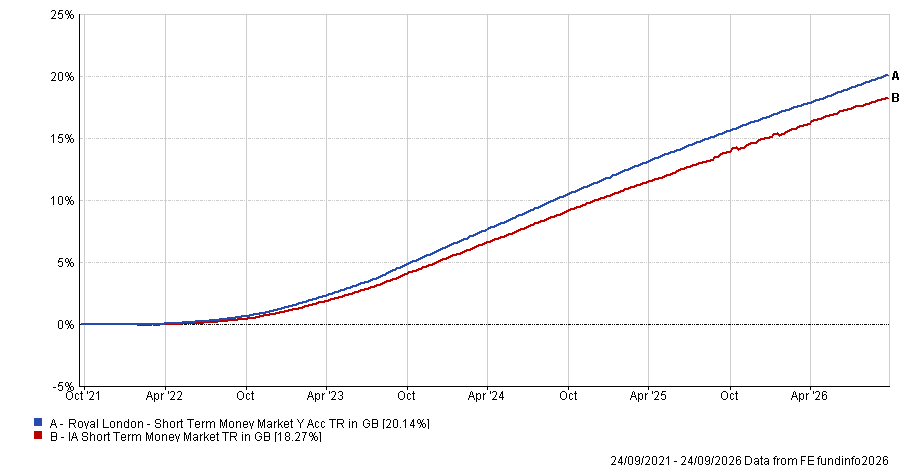
Royal London Short Term Money Market was the most-researched money market fund and one of the most-researched funds overall on Trustnet in the 12 months ending August 2026.
According to Heapy, factors that contributed to the fund’s popularity include the longevity and stability of the management team, the long-standing track record of the fund itself, which may have aided platform accessibility and adviser familiarity, and Royal London’s position as a large mutual life, pension and investment company, which could provide a natural source of internal demand for the strategy.
The fund uses diversified instruments such as certificates of deposit, commercial paper, repo and short-dated bonds and provides investors with income every month.
Heapy said: “This can be particularly appealing for clients in a decumulation portfolio, where regular withdrawals are being taken from the portfolio, as it provides a predictable and consistent stream of cashflow.”
Royal London Short Term Money Market has also maintained a competitive ongoing charges figure (OCF) of 0.10%.
Alex Watts, senior investment analyst at interactive investor, added: “With a strong yield of just under 4%, low-cost and minimal sensitivity to interest rate changes, Royal London Short Term Money Market has understandably surged in popularity.”
Performance of the fund vs sector over 5yrs
Source: FE Analytics
Below, Trustnet asked fund selectors for possible lesser-known alternatives.
For investors who prefer larger but less frequent payments, Heapy suggested the £4.2bn L&G Cash Trust fund, which instead of monthly, pays a higher income quarterly.
Managed by John Wherton, the fund has delivered returns broadly comparable to Royal London over time. It has a distribution yield of 3.7%, and 31.6% of the portfolio is invested in assets with a majority between zero to seven days.
The fund is also slightly more expensive than Royal London Short Term Money Market, with an OCF of 0.15%.
Rob Morgan, chief analyst at Charles Stanley, suggested the significantly larger (with £47.8bn in assets) BlackRock ICS Sterling Liquidity.
Size tends to be an advantage rather than an impediment for money market funds, said Morgan.
“BlackRock is one of the largest cash managers globally, which offers good access to trading partners, efficient trade execution and greater buying power,” he added.
“BlackRock ICS Sterling Liquidity is also an Irish-domiciled institutional cash fund rather than a UK money market fund, though inside an ISA or SIPP there is no practical difference.”
For investors with a slightly greater risk appetite and longer investment horizon, Watts suggested looking to high-quality short-term bond funds, which typically average a duration of one to two years.
“While money-market funds are fairly well insulated if interest rates were to rise, given their very short duration, there is an element of reinvestment risk if rates were to fall. What is more, given the current shape of the UK yield curve, adding a little extra duration and credit risk can mean higher starting yields on offer,” he said.
“A little more duration can yield capital appreciation if interest rates continue to fall (though the converse may be true if rates rise).”
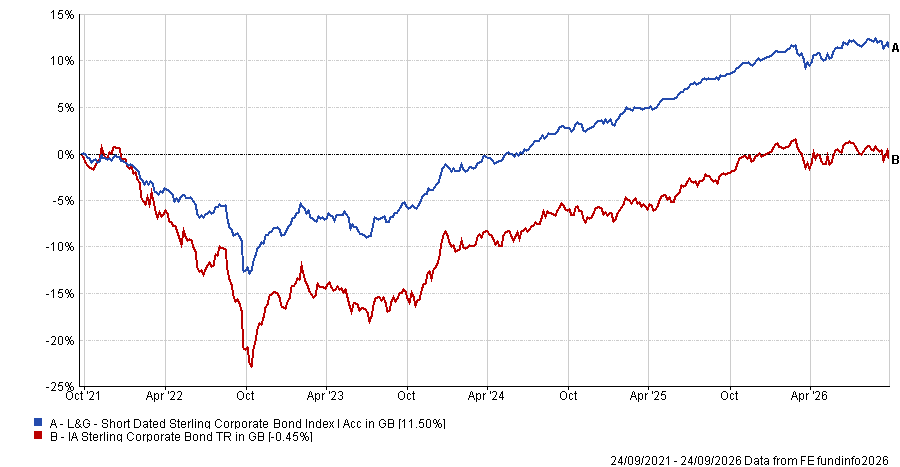
His choice was the £3bn L&G Short Dated Sterling Corporate Bond Index fund, which invests in short-dated company bonds with less than five years to maturity, “which tend to be less sensitive to changes in interest rates than longer-dated bonds”.
“However, the fund will carry a greater duration risk than a money market fund, which you may expect to have a weighted average maturity of holdings of around 50-60 days,” Watts said.
The fund is passive, which is reflected in the price with an OCF of 0.14%. It tracks the performance of the Markit iBoxx GBP Corporates 1-5 Index of investment-grade corporate bonds.
The duration of the fund stands at around two and a half years and the bonds within the portfolio ranging between AAA- and BBB+-rated.
It has a higher yield than Royal London Short Term Money Market as 5.1%.
Performance of the fund vs sector over 5yrs
Source: FE Analytics