






Interest rates across many developed markets are on the rise as central banks battle to bring inflation under control – with the Federal Reserve and European Central Bank both hiking and the Bank of England expected to follow suit in the coming months.
For investors, the question is how to position their portfolios for a world in which interest rates will remain sticky for the foreseeable.
Those seeking to capture the income benefits of higher rates while limiting sensitivity to further rate moves might wish to consider high yield bonds, which Paul Angell, head of investment research at AJ Bell, described as a compelling middle ground. In this sphere, his selection was the £1.7bn Aegon High Yield Bond fund.
“High yield bonds are typically issued with shorter maturities than their investment grade counterparts, making them less sensitive to interest rate movements and better positioned to adapt to a higher-for-longer rate environment,” Angell said.
Aegon High Yield Bond has been co-managed by Mark Benbow and Thomas Hanson since 2018 and 2019 respectively, meaning they have been at the helm through the pandemic and the subsequent interest rate hiking cycle.
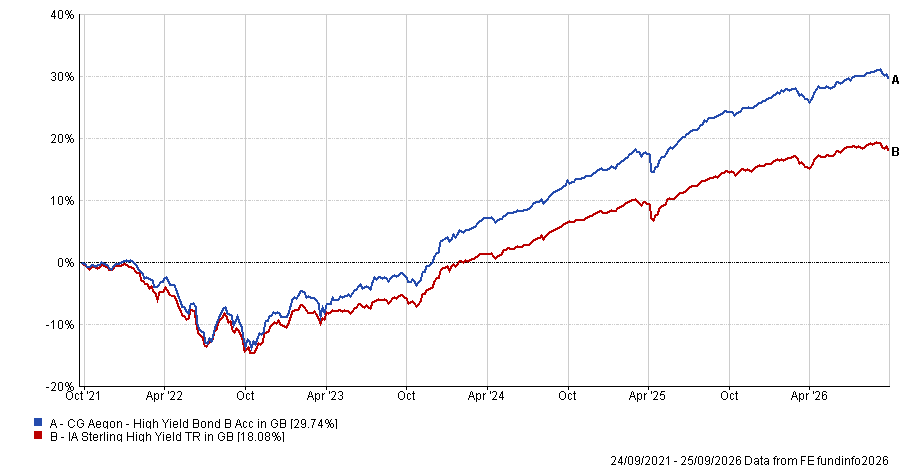
Over one, three and five years to the end of August 2026, the fund has logged top-quartile returns against its peers in the IA Sterling High Yield sector.
Trustnet recently highlighted the popular fund as one of the most consistent in the IA Sterling High Yield sector over the past 10 years, beating the sector average in eight years.
Performance of the fund vs sector over 5yrs
Source: FE Analytics
Along a similar vein, Emma Bird, head of investment trusts research at Winterflood, suggested CVC Income & Growth.
Managed by Pieter Staelens, the investment trust provides investors with access to a diversified portfolio of sub-investment grade debt instruments – primarily of European large-cap issuers, including loans, high yield bonds and structured debt.
The portfolio is typically split between performing credit, consisting of core income investments, and credit opportunities, which includes higher yielding debt with greater potential for capital growth.
“As at 31 July, 77% of the portfolio was invested in floating rate assets, meaning the fund should benefit from a rising or higher-for-longer interest-rate environment, in the form of rising/higher income generation,” Bird said.
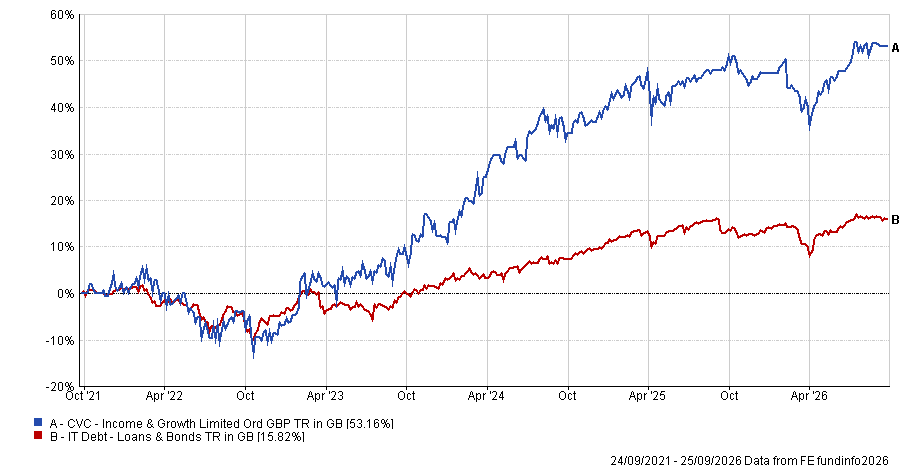
The trust is currently trading at a narrow premium to net asset value (NAV) at 1.22%, while its sterling shares offer a yield of 8.2%.
Performance of the trust vs sector over 5yrs
Source: FE Analytics
However, while higher bond yields can offer more attractive income, Dzmitry Lipski, head of funds research at interactive investor, argued that persistent inflation and uncertainty over the path of rates call for bond funds offering flexibility and diversification.
Lipski said: “Unlike traditional bond funds aligned more closely to a particular market or benchmark, strategic bond managers can adjust duration, credit exposure and sector allocation as macro conditions change.”
This means strategic bond managers can favour shorter-duration bonds when interest-rate risk is elevated, capture attractive yields in corporate credit or increase exposure to longer-duration government bonds if growth weakens and interest rates begin to fall.
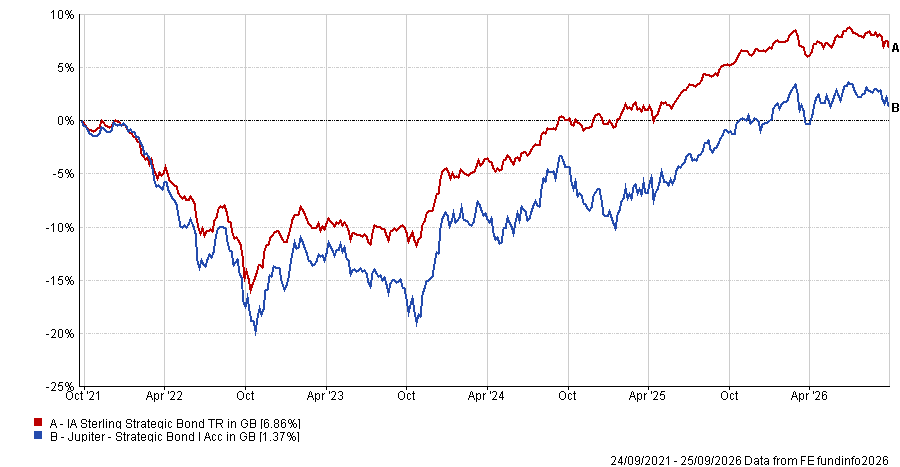
As such, Lipski suggested the £1.2bn Jupiter Strategic Bond fund, which is co-managed by Ariel Bezalel and Harry Richards.
Given the fund’s ability to alter its interest-rate sensitivity, Lipski said “it could be a flexible core bond allocation for investors comfortable with active manager risk”.
“It can capture income from higher bond yields while giving the managers scope to reposition if the economic or interest-rate environment changes,” he added.
Performance of the fund vs sector over 5yrs
Source: FE Analytics
Beyond fixed income, Lipski also pointed to global equity income strategies. The emphasis on dividend sustainability and pricing power can provide investors with a degree of protection against the corrosive effects of persistent inflation.
“Higher interest rates increase the cost of capital and can place a greater emphasis on companies with strong cashflows, resilient balance sheets, pricing power and sustainable dividends,” he said.
He suggested Fidelity Global Dividend, which was launched in 2012 and is managed by FE fundinfo Alpha Manager Daniel Roberts alongside Tristan Purcell.
“Within portfolios, it could be a core global equity holding with a defensive income discipline, offering participation in long-term equity growth alongside the potential for more resilient income and lower volatility than the broader global equity market,” Lipski added.
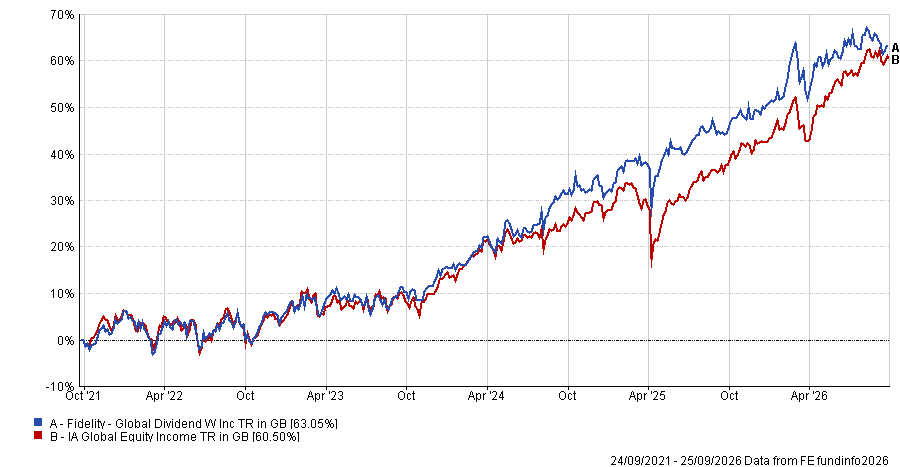
The fund returned 61.6% over the five years to the end of August 2026, beating the IA Global Equity Income sector average return of 59.4%.
Performance of the fund vs sector over 5yrs
Source: FE Analytics
Looking beyond traditional asset classes, infrastructure and other alternative assets can also provide inflation protection and diversification in a higher-for-longer environment.
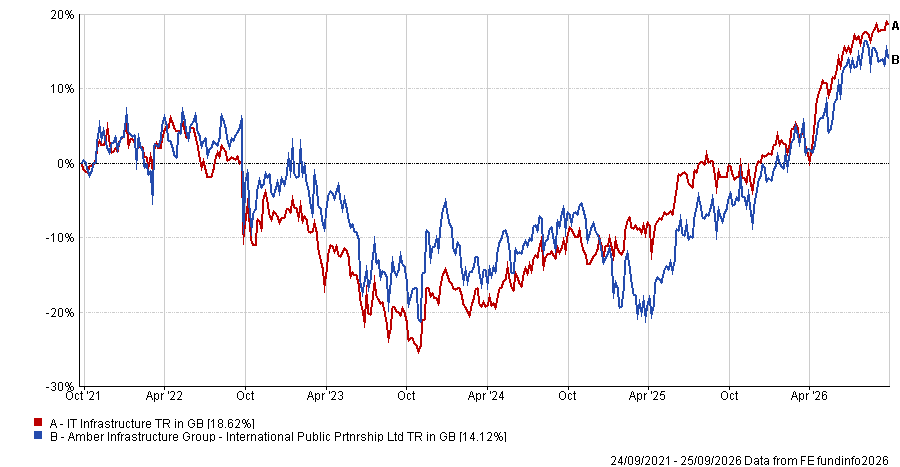
Matt Ennion, head of investment fund research at Quilter Cheviot, highlighted the £2.5bn International Public Partnerships trust. It aims to provide investors with long-term, inflation-linked returns by growing its dividend while also targeting capital appreciation.
Alongside government-backed and regulated assets, where revenues are often contractually linked to inflation, Ennion noted that even within the trust’s corporate investments, “many underlying assets benefit from inflation-linked revenue streams, providing additional resilience”.
Most of the portfolio (72%) is invested in the UK, followed by Belgium, Australia and Germany. It has just 2% invested in the US.
It is in the second quartile for returns in the IT Infrastructure sector over the five years to August 2026 and is in the first quartile over 10 years, up 53.2% over the decade.
The trust is trading at an 8.9% discount to NAV, meaning it “offers investors the opportunity to access a portfolio of high-quality infrastructure assets at an attractive valuation, making it a compelling option in an inflationary backdrop”.
Performance of the trust vs sector over 5yrs
Source: FE Analytics
Should rates stay higher for the foreseeable, then investors may also want to consider funds investing more specifically in companies that benefit operationally from higher rates, such as banks or insurers.
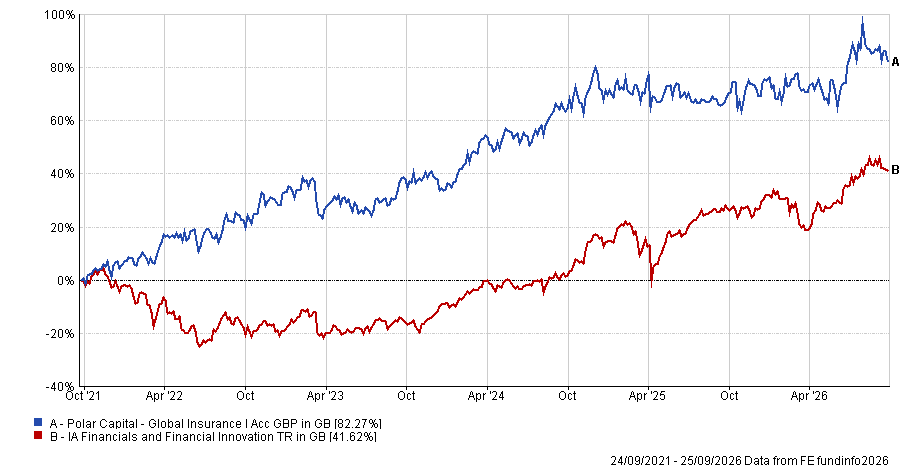
For funds in this category, Angell pointed to Polar Capital Global Insurance, which has £2.3bn in assets under management invested in companies operating within the international insurance sector.
He said: “Higher interest rates are not universally bad news. In fact, they can be highly supportive for insurance companies, which earn investment income on large pools of premiums before claims are paid.”
Rather than relying on traditional economic growth drivers, insurers' earnings are largely linked to underwriting profitability and investment income.
“Polar Capital Global Insurance is managed by a specialist team with deep industry expertise,” Angell noted. “Within a portfolio, the fund acts as a diversifying global equity holding that can benefit from elevated interest rates whilst offering exposure to a defensive and often overlooked part of the market.”
Performance of the fund vs sector over 5yrs
Source: FE Analytics