






Fixed-income markets have been making headlines this year as government bond yields have climbed across most major economies.
The US 10-year treasury yield rose above 5.2% in late September, the highest since 2007, while the UK 30-year gilt yield reached almost 5.9% at the start of the month, the highest since 1998. Behind the moves are inflation and fiscal worries.
This, combined with concentration in equity markets, has driven investors to rediscover bonds as an asset class. For those determined to buy, there are two options: trusting an active manager and their views on the market or going passive.
Exchange-traded funds (ETFs) made up only 3% of the liquid global bond market by value in February 2024, according to Xtrackers, but since then, investors have kept adding to bond ETFs: European-listed fixed income ETFs took in $65.3bn in the first seven months of 2026, against $35.9bn a year earlier, according to ETFGI.
While an index tracker holds whatever its bond index contains for a low annual charge, an active manager picks the bonds based on their risk-return judgement – but the pros and cons aren’t so clear-cut.
Critics of the passive route argue that these instruments allocate more money to the biggest borrowers – a view presented by Richard Woolnough, who runs the flagship M&G Optimal Income fund, and Eva Sun-Wai, manager of M&G Global Government Bond.
On the opposite side, Haneen Sakhi, ETF investment specialist at Xtrackers, makes the case that passives aren’t as concentrated in risky names as people might think.
M&G: The index buys more of whoever borrows most
The premise for Sun-Wai is that the market now works differently from the era of near-zero interest rates. Low inflation kept the cost of government borrowing down and banks, central banks, pension funds and insurers absorbed the supply of new bonds.
With inflation and rates higher, and central banks letting bonds mature or selling them outright, that supply has to be cleared by investors in the market. They want extra yield for holding longer-dated debt, known as the term premium, and prices swing more as a result.
These yields are cheaply and easily accessed with a passive, with Sun-Wai noting that investors often tell her they want an index fund for the specific reason that current yields look attractive. Most bond indices weight each borrower by the amount of debt it has outstanding and many exclude inflation-linked bonds, which pay out more when inflation rises.
“If you're buying the passive, the two main risks that we're up against at the moment are almost structurally embedded in that passive. For one, the more an issuer borrows, the bigger part of the index they become, so your concentration risk increases with the fiscal risk, so you're structurally exposed to risk number one,” she said.
“The other main risk we're up against at the moment is inflation,” she said, noting that inflation-linked bonds – which provide a natural hedge with real yield – tend not to appear in passive products.
By this logic, buying a tracker means structurally exposing yourself to some of the main risks that active fixed-income managers claim to be able to – at least partially – hedge against.
Woolnough noted that yields and spreads (the extra yield companies pay over government bonds) are roughly where they were 20 years ago, but “the opportunity set has expanded tremendously” as the range of instruments and the depth of knowledge of active managers have grown.
At the same time, indices “tend to result in a misallocation of resources”.
“My job is to allocate resources correctly. The index provider just does nothing, just copies what everybody else is doing. It's not vigilant,” he said.
“It's very careless. We're very vigilant. I think what we've created over time shows that influence.”
Xtrackers: Bond indices are more spread out than critics assume
For Sakhi, the concentration worry is a misunderstanding.
Bond indices are built by market value, she explained, so a borrower's weight reflects how much debt it has issued. However, “when you look at market value weights, they do not necessarily result in concentration risks,” she said.
Sakhi noted that if someone were to split the benchmark and look into the small bonds that make up the tail end of the index, overall, the smaller weights cumulatively will make up a larger portion of the benchmark itself, which, she said, “just means it's more broadly diversified.”
“So you're not necessarily concentrated to those larger issuers, and also those larger issuers are not necessarily heavily indebted or poorer quality,” she said.
“These tend to be established issuers with strong financials that can actually manage higher leverage, rather than issuers with lower creditworthiness that can't.”
On top of that, many index providers also apply an issuer cap, which limits how much of an index a single borrower can make up.
“Typically, within fixed income indices you see a cap within a benchmark, around a 3% issuer cap. That's within the rules-based methodology itself.”
Issuer caps and safeguarding measures ensure broad diversification, which in the case of euro and dollar-denominated corporate bond indices “far exceeds that of large and mid-cap equity indices”.
Fixed income indices diversified by default
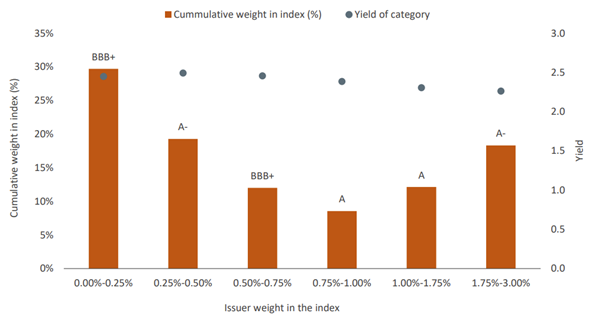
Source: Xtrackers
Additionally, a February 2024 S&P Dow Jones Indices study found that active bond funds beat their benchmarks more often over shorter periods and less often over longer ones. Sakhi suggested that index diversification, which spreads default and downgrade risk across the market, is “a key driver” of that result.
She conceded, however, that fixed income has limited upside but unlimited downside, which has traditionally made it “a place where more active risk management could be applied”.